[The content of this article has been produced by our advertising partner.]
A foul-smelling river in Tuen Mun, mountains of parcel packaging and the waning proficiency of Cantonese among young people have become the inspiration behind a series of student-led social innovation projects recognised at the second cohort of the Seek Our Ways Ideation Programme.
Organised by the Hong Kong Federation of Youth Groups Leadership Institute and supported by Hang Seng Bank, the programme drew more than 400 secondary and tertiary students, who submitted around 90 proposals linked to sustainability, culture and elderly wellbeing.
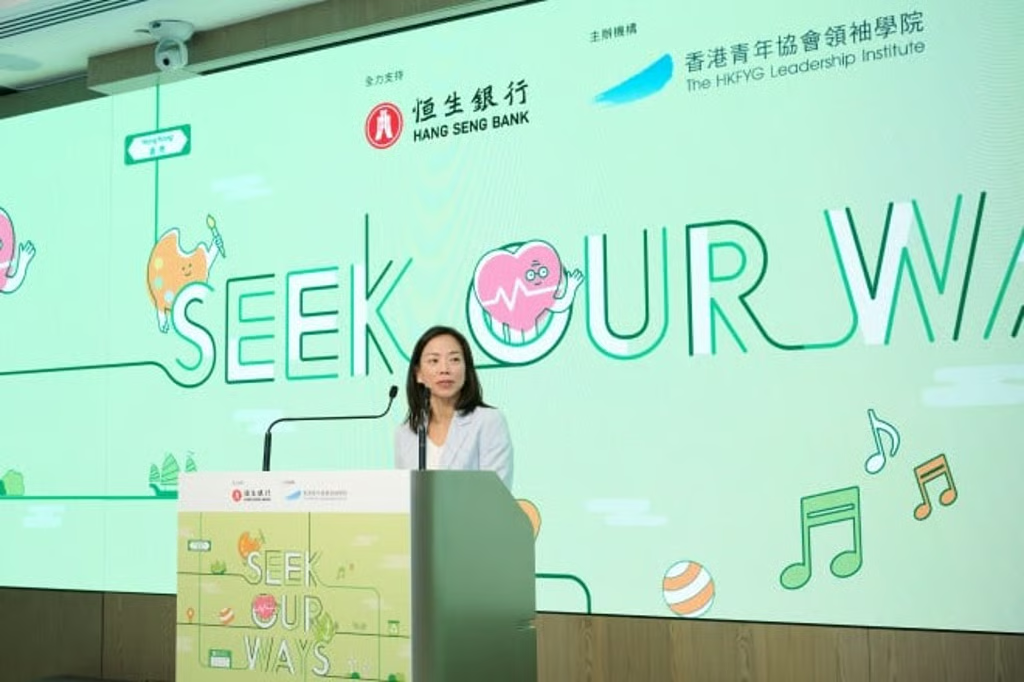
Speaking during the award ceremony, Luanne Lim, Executive Director and Chief Executive of Hang Seng Bank said many teams had managed to turn ideas into practical action through experimentation and prototyping.
“We hope the Programme not only inspires young people’s passion for social innovation but also encourages them to keep exploring and putting ideas into practice, bringing more positive impact to the community,” she said.
Clarence Leung, Acting Secretary for Home and Youth Affairs said the projects reflected how young people were approaching social issues from their own perspectives while proposing workable solutions.
Hsu Siu-man, Executive Director of HKFYG said many of the proposals had emerged from direct interaction with communities rather than classroom learning alone.
“Your inspiration came from curiosity and empathy towards society and the environment,” she told participants.
River Lord: Turning a “smelly river” into a lively community for clean water
Among the winners was “River Lord”, a team from S.K.H. St. Simon’s Lui Ming Choi Secondary School, whose floating ecological purification system for Tuen Mun River also received the “My Favourite Team” Award through audience voting.
Team representative Wang Ming-fang said the idea came from years of living and studying beside the river.
“Tuen Mun River is right next to our school. Since we were young, people have always said it smells bad,” she said. “We wanted to let people see a better side of Tuen Mun.”
Working with other teammates including Cai Yu-yin, the group designed a floating system using zeolite, nitrifying bacteria and native aquatic plants to reduce ammonia and odours naturally.
Cai said the team had revised the design several times after receiving comments from residents and judges during the competition process.
“One of the judges pointed out that an earlier plant species we chose could affect Hong Kong’s ecosystem, so we changed to native plants,” she said. “We wanted a system that could work naturally and continuously without consuming electricity.”
The students said they hoped a small-scale pilot scheme could eventually be tested along sections of the river near their school.
“We want people to pay more attention to Tuen Mun River and remove some of the stereotypes attached to the district,” Wang added.
Onederful: A greener unboxing with packaging made from upcycled rice husks and coffee grounds
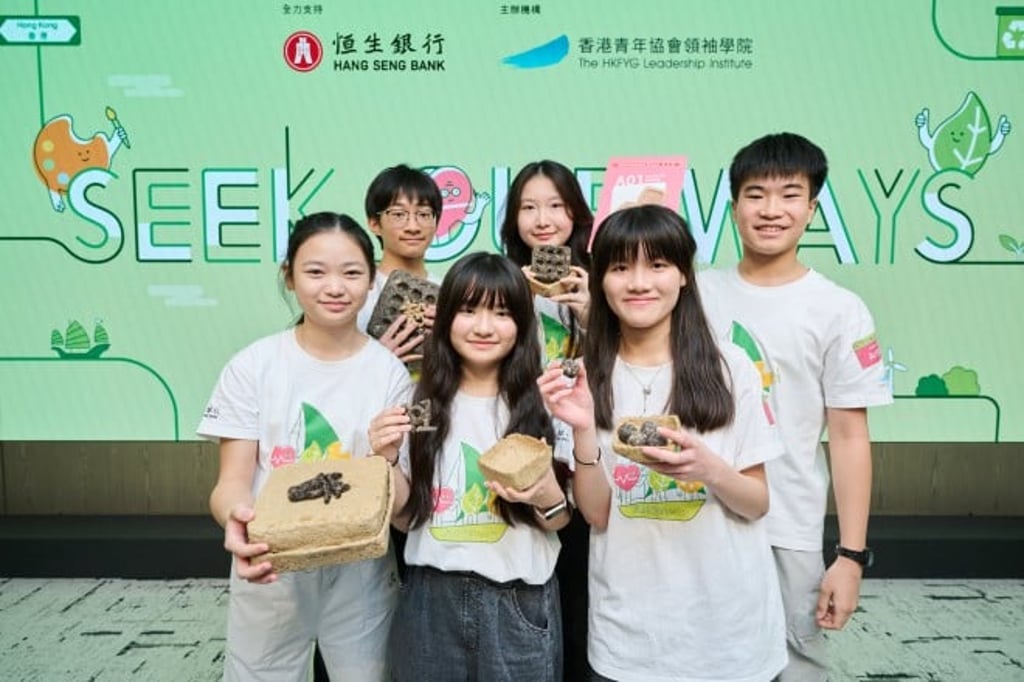
Environmental concerns also drove the Junior Secondary Division Grand Award team, “Onederful”, from Christian & Missionary Alliance Sun Kei Secondary School.
The group developed biodegradable delivery packaging made from rice husks and coffee grounds after noticing large amounts of parcel waste piling up near residential buildings.
“We all shop online quite often and kept seeing discarded packaging downstairs,” said team member Chan Ching-yan. “Even though recycling awareness is there, many materials still cannot be handled properly because of plastic coatings or adhesive tape.”
The team experimented repeatedly at home to produce moulded packaging materials that could withstand delivery use while remaining biodegradable. Team member Law Mon-in said shape and structure testing had become an unexpectedly difficult part of the project.
“We tested many different forms before arriving at a shape that was more shock-resistant,” she said.
The students added that advice from mentors specializing in environmental technology had led them to think more carefully about manufacturing costs, logistics and commercial viability.
“At first we only focused on the environmental side,” Chan said. “Later we realised transport, labour and production costs all matter if the idea is going to be used in reality.”
.jpg?itok=D1pgIPUF "“CantoMore” won the Tertiary Division Grand Award with Cantonese learning games and workshops aimed at helping mainland students integrate into Hong Kong life.")
CantoMore: Helping students have their voice in Cantonese
Cultural identity and social integration became the focus of the Tertiary Division Grand Award winner “CantoMore”, a joint team formed by students from the Chinese University of Hong Kong, the Education University of Hong Kong and City University of Hong Kong.
The group created Cantonese-learning game cards and workshops aimed at helping mainland students adapt to life in Hong Kong.
“We realised more students around us were speaking Putonghua and fewer were using Cantonese regularly,” said team representative Lam Sze-ming. “Some newly arrived students wanted to learn Cantonese but did not really have the environment or resources to practise it.”
The team organised trial sessions involving mainland students and found participants responded positively to learning through games, dubbing workshops and Hong Kong film references.
“We wanted language learning to become more relaxed and interactive,” said teammate Chan Wai-chuen. “At the same time, we hoped participants could understand more about Hong Kong culture through Cantonese.”
Although the projects were developed as part of a competition, several participating teams said they hoped to continue refining their ideas after the event, with ambitions ranging from school expansion plans to possible pilot schemes and future start-up ventures.
.jpg?itok=YFe0ibKB "Participants, guests and organisers gather at the final pitching and awards ceremony of the Seek Our Ways Ideation Programme.")