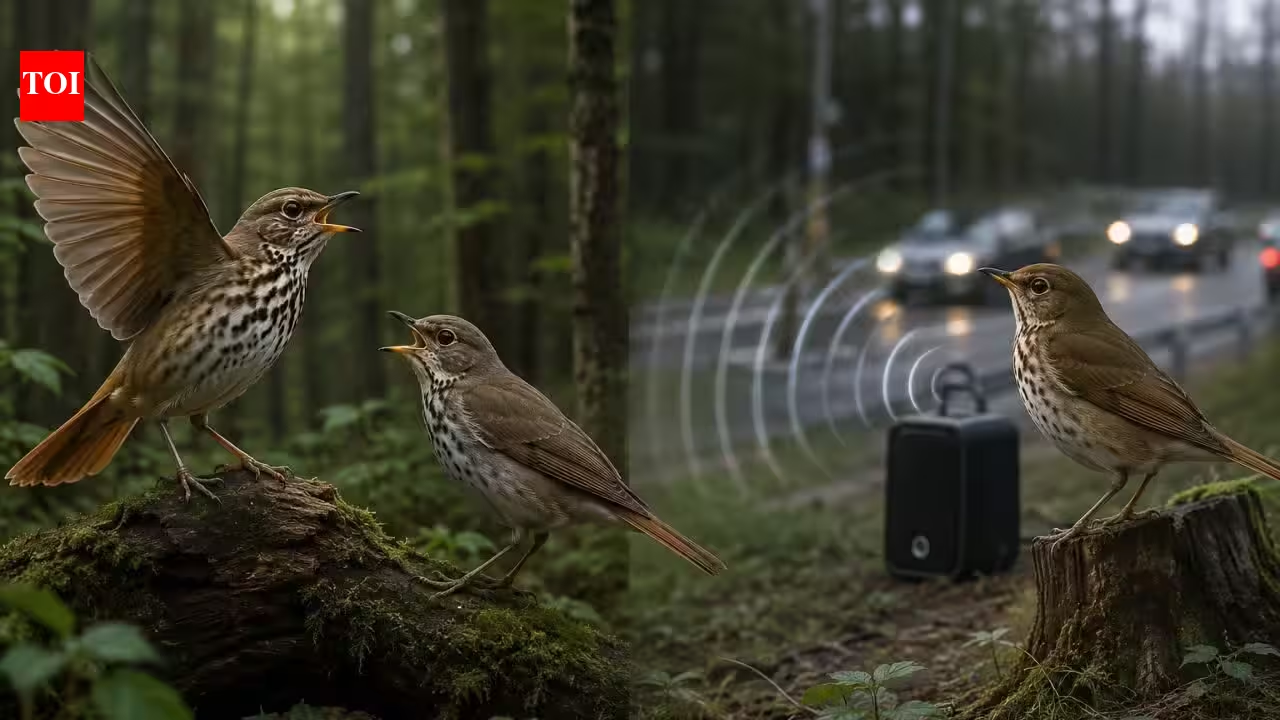
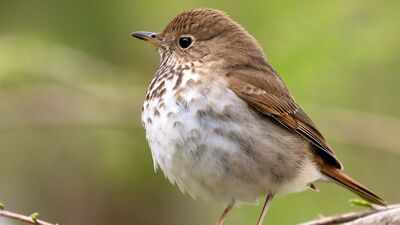
Scientists played artificial traffic noise in songbird territories to see what would happen when the birds thought a rival had arrived. The answer was unexpected. The study, titled ‘Anthropogenic noise impacts territorial defense in a non-urban songbird,’ focused on ‘male hermit thrushes,’ songbirds that use calls and songs to communicate and defend their territories. Researchers played recordings that mimicked an intruding bird, both in quieter conditions and alongside artificial human-made noise. When the noise was present, the birds were slower to approach the apparent rival and showed fewer aggressive displays. At the same time, they sang more loudly. The findings suggest that even short periods of human-generated noise can affect how birds respond during important territorial encounters. They also point to an important difference between living with regular background noise and dealing with a sudden disturbance at a crucial moment.
How did artificial traffic noise make songbirds less aggressive towards rivals
The study looked at how male hermit thrushes reacted when a rival appeared to enter their territory. The research used recorded birdsong to create the impression that another male was nearby. For a territorial bird, a rival’s song is not something to ignore. It can mean another bird is moving into an area that the resident male is trying to defend. The usual response may involve approaching the intruder, singing or displaying aggressively. The researchers wanted to know whether artificial human-made sound could change that reaction.The difference was noticeable. When the added noise was playing, the birds took longer to approach and showed fewer aggressive displays. That does not necessarily mean the birds were simply calmer. The extra sound may have made it harder for them to clearly pick up or interpret the rival’s song. If the signal announcing a potential intruder becomes less clear, the response to that threat may change too. The behavioural analysis included 37 birds. The work took place between April and July 2020 in inland mixed forests around Saint John, New Brunswick, Canada.
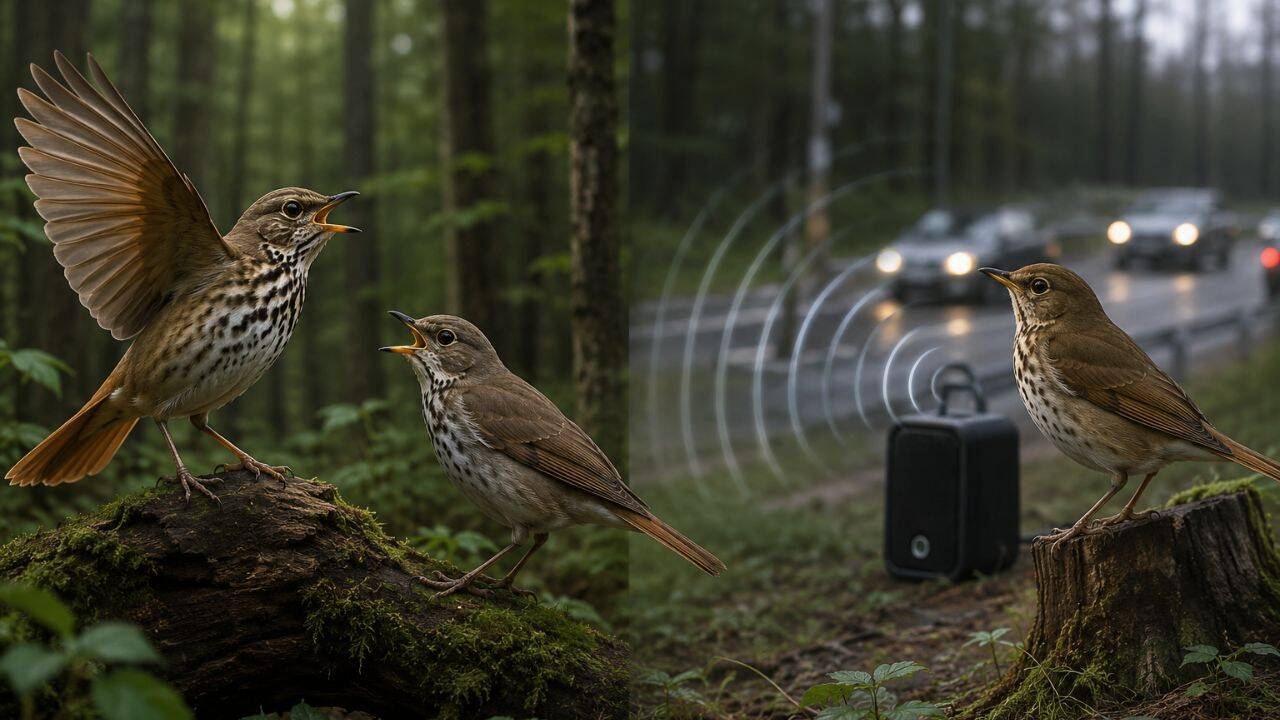
Image Credit: AI Generated
Why did the birds sing louder despite becoming less aggressive
Although the hermit thrushes became less aggressive in some ways, they did not simply fall silent. In fact, they sang more loudly during the noisy trials. This may have been an attempt to make themselves heard over the surrounding sound. Yet the louder singing did not bring their behaviour back to what it was in quieter conditions. The birds still took longer to approach the simulated rival and showed less aggression. This contrast is one of the most interesting parts of the study. The birds appeared able to change their behaviour in response to the disturbance, but that adjustment did not fully solve the problem. It also shows that looking at only one behaviour can sometimes give an incomplete picture. A bird may sing louder while still changing the way it deals with a territorial challenge.
Long-term background noise told a different story
The researchers also looked at the background noise already present around the birds’ territories. Here, the pattern was different from the one seen during the temporary noise experiments. According to the study, ambient noise did not stop the birds from detecting the intruder or produce the same changes in song volume. One possible reason is that the usual sound levels in these habitats were not high enough to seriously interfere with communication. There was another interesting finding. Males occupying more urban territories showed stronger aggressive responses to the simulated intruder. This was consistent with the urban anger hypothesis, which suggests that birds living in human-altered environments may sometimes become more aggressive when defending their territories. But the temporary experimental disturbance had the opposite effect. Rather than making the birds more confrontational, it reduced their aggressive response.
Timing may matter as much as the amount of noise
The study highlights why human-made sound cannot always be treated as one simple environmental problem. Birds may respond differently to the steady sounds around them as compared to how they respond to a sudden disturbance during an important interaction. For a male bird defending a territory during the breeding season, responding to rivals matters. A delayed or weaker response could potentially affect how the bird protects its space. The researchers noted that hermit thrushes are mainly associated with non-urban environments. That makes the findings useful for understanding how increasing human activity may affect species that have not evolved to deal with frequent disturbances.This study by Jennifer L. Moore and Sean Roach suggest that even brief bursts of artificial sound can matter when they occur at the wrong moment. As roads, machinery and other sources of human activity continue to reach natural areas, studies like this one offer a closer look at what happens in those quieter, easily overlooked moments. For a hermit thrush trying to hear a rival nearby, a burst of traffic noise may be enough to change the way the confrontation unfolds.