I love books. I went straight from earning an English degree in American literature to working for one of the best independent bookstores on the planet. For over a decade, my life was focused on reading, discussing and haltingly trying to write books. Then I had a kid, and that all stopped. For years, I didn’t read anything longer than an Instagram post. My son was 3 and I remember thinking, “Huh, I guess I don’t read anymore.” I was sad for half a second, but then it was bathtime.
Once my son was old enough to feed himself and brush his own teeth, I felt like maybe I could go back to books. By that time, I’d become a tech writer, and reviewing e-readers was part of my beat. And I’ll admit, I was resistant. In college and at the bookstore, it was print or death — e-readers were an embarrassment. But how does a reader not fall in love with the idea of carrying all their books all the time, not to mention the gratification of hearing a recommendation one minute and reading it the next?
Today, I’m omnivorous when it comes to format, flitting between e-readers, paperbacks, hardcovers and sometimes even books on my phone. But is that bad? Is everyone like this? Should I stick to print? What would a librarian say? I wanted to know — so I asked.

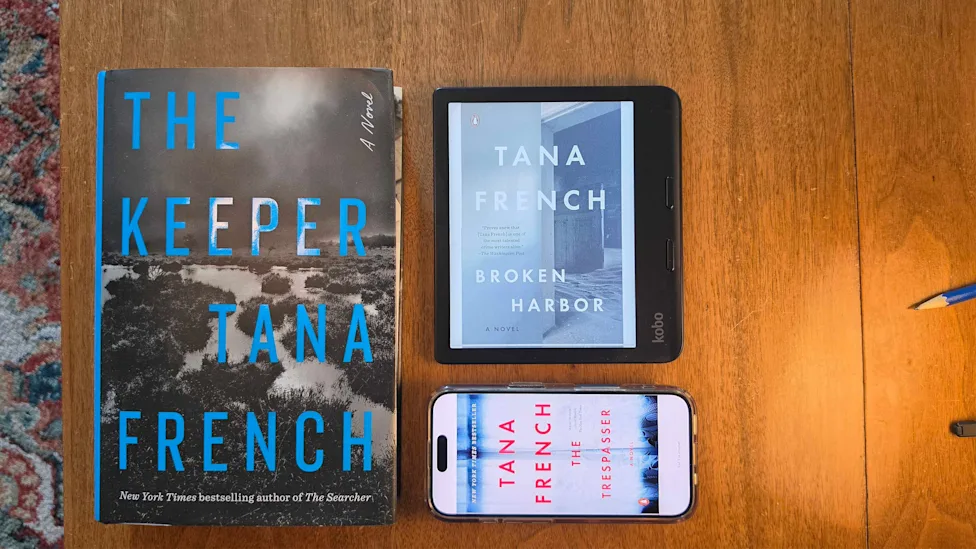
One author, three novels, three formats.
(Amy Skorheim / Yahoo)Print beside the fireplace, e-books on the train
I began my investigation by grilling my co-workers. There are serious readers on the Yahoo Shopping team (we even have a book club) and their answers made me feel better about my own format agnosticism.
Advertisement
Advertisement
True, a couple were decidedly in one camp or the other: “E-reader for the win!” says Senior Operations Analyst Lucy Wan. But Home Editor Elizableth Berry says, “Definitely print books. I genuinely struggle to read a book if it isn’t in its physical form. Call it the English major in me.” One of my colleagues even acknowledged she reads almost exclusively on her phone these days.
But most people have found specific places in their lives for different formats. Travel and commuting? E-readers, hands-down. “But if there’s a thunderstorm, the fireplace is roaring and I have a hot cup of tea … physical books all day,” says Commerce Editor Kris Scott. Senior Editor of Growth and Monetization Izabella Zaydenberg prefers physical books, “but if it’s something that has a weird cover (or a weird title) I’ll probably read it on my phone or Kindle.” Fair enough.
Physical books evoked more emotional responses: “I love the feel and smell of the pages,” says Senior Health and Wellness Writer Kelli McGrane. “I have a tender fondness for physical books,” says Content Operations Manager Amanda Rickert. E-readers, on the other hand, were all about practicality: “As my minimalist tendencies get stronger the older I get, the e-reader is getting more and more use,” says Commerce Editor Saundra Latham.
Editor-approved e-readers

Amazon
This is the most cost-effective e-reader out there. It lacks a few frills, like water-resistance and warm lighting, but it’s got a super-clear e-ink screen that’s far easier on the eyes than reading on a phone.

Amazon
This is my personal favorite e-reader. It has a 7-inch color e-ink screen that’s easy on the eyes, and the physical page-turn buttons are ideal for one-handed reading. Plus it’s waterproof with a lovely, crisp screen.
Your brain on print
But what do the experts think of this anything-goes approach to reading formats? “Reading paper books aids comprehension and retention precisely because we engage in a slower and more intentional way,” says Rebecca Gotlieb, assistant researcher at the University of California and California State University Collaborative for Neuroscience, Diversity and Learning. That lines up with much of the research on the subject, which suggests that people comprehend what they read better when it’s on paper.
Advertisement
Advertisement
Gotlieb pointed out another benefit to paper: “There are more physical cues to aid memory when we read a paper book … We can remember the relative number of pages that were on the left or right side of the book when we read a specific passage or whether a certain quote was at the top or bottom of the page.”
Rebecca Starr, literature and language librarian at Portland Public Library in Maine, also finds reading physical books better for comprehension but says that there’s a time and place for other formats: “You may enjoy a fast-paced thriller on your device, but require the physical book when reading dense nonfiction.”
Go with what works
Unsurprisingly, no one I spoke with told me that reading on an e-reader or a phone was bad. “I would never discourage anyone from reading, regardless of the medium,” says Gotlieb. Her main concern is with the distractions that screens can introduce while we’re trying to read. “When we read on screens that allow for pop-ups, ads, notifications and other distractions, we read quicker and more superficially, and our attention is often divided.”
This is where a dedicated e-reader like a Kindle or Kobo has a real advantage over reading on a phone. Since they’re only made for reading e-books, your texts, emails and TikTok notifications can’t intrude. Still, sometimes a phone is what you’ve got, and it has its advantages. “It’s lightweight, convenient, and if you’re in public, nobody else can see what you’re reading,” Starr points out.
Advertisement
Advertisement
If you want to get in a reading session and all you have is your phone, you could always turn on Focus mode (both iPhone and Android offer the feature). Enable it and nothing will get between you and the words.
Want to buy an e-reader now?

Amazon
We named this the best e-reader overall in our guide to these pocket libraries. It’s got a beautiful, crisp screen with a lovely warm light, plus an impressive battery life, and it’s waterproof.

Amazon
This is our pick for the best non-Kindle budget e-reader. This compact Kobo not only has a color screen and warm LEDs, it’s waterproof and is far cheaper than Amazon’s color models.

Datafy
Here’s a recommendation from our book lover’s shopping guide. Turn pages remotely without having to touch your e-reader so you can find the best possible reading position.

Rakuten Kobo
This page-turner is designed specifically for Kobo e-readers. It has a forward and back button, and a single AA battery powers it for months.


Expert tips for reading more
“Reading is a phenomenal cultural achievement,” says Gotlieb. “It’s an optimal playground for practicing our most human skills: for example, perspective taking, deep reflection, and critical thinking.” Who wouldn’t want more of that in their life?
When I asked what would help people read more, the expert advice boiled down to three tips:
-
Read about what you like. We might feel like we should all read the award-winning books or those recommended by influencers. But really, just read about whatever topic interests you. Ask a librarian (Starr says that’s her favorite part of her job) for recommendations based on what you’ve read before and liked.
-
Keep your books close. If you’re reading a book, put it where you’ll see it. Take it with you when you leave the house (this is where e-books on your phone have the advantage). Personally, I keep my book on a shelf in the bathroom — every time I pee, I read.
-
Go easy on yourself. Don’t compare your reading progress with others, and don’t worry if all you can squeeze in are a few minutes here and there. A few minutes of reading before bed still counts!
Readers agree: Libraries are magic
Nearly all the readers I spoke with agreed on one point: If you want to read, get a library card. Obviously, you can check out physical books, but the Libby app lets you borrow e-books from your library so you can read them on your Kindle, Kobo or phone for free. All you need is a library card.