It was a terrible month for the US labor market in July — but for investors, that’s not necessarily bad news.
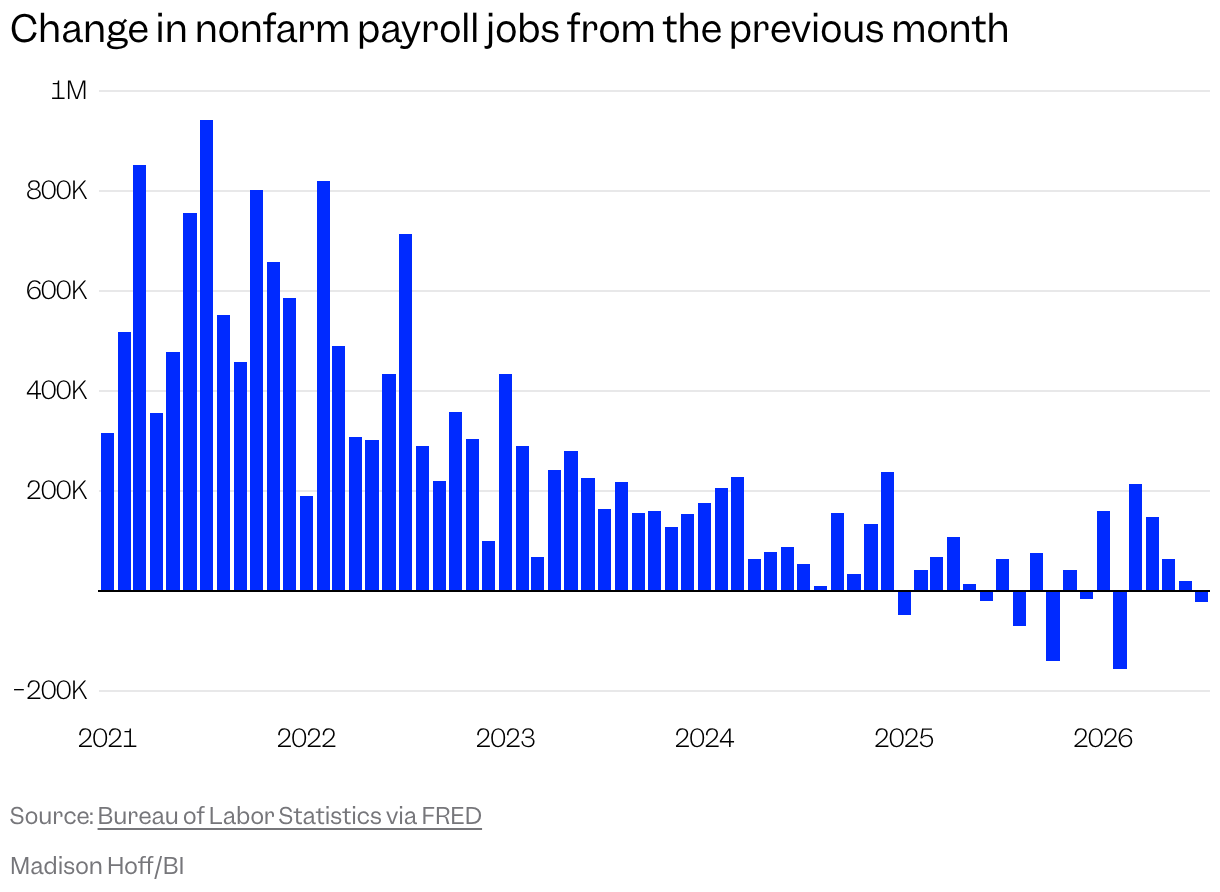
US stocks jumped on Friday even as data showed the US lost 23,000 payrolls in July, a huge miss from expectations of 85,000 jobs added.
The bad news wasn’t confined to July, either. Job gains in the prior two months were also revised downward, with the US adding 20,000 (instead of the initial 57,000) jobs in June and 63,000 (instead of 129,000) jobs in May.
The unemployment rate ticked slightly lower as labor force participation declined.
It was one of the worst months for the labor market in recent memory — but in markets, the news has set off a chain reaction that has led investors to spin the weak results as a potential positive.
Here’s where US indexes stood at the 4 p.m. ET closing bell:
Here’s the tension investors are navigating after the latest jobs data:
The good news: a weaker job market means the Fed won’t be in a rush to raise interet rates, something investors have feared this year as a potential fresh headwind for stocks.
Investors immediately trimmed their rate expectations after digesting the latest jobs report. Markets were pricing in a 75% probability that the Fed would raise rates through the end of the year, according to the CME FedWatch tool, down from 85% on Thursday. The 10-year Treasury yield sank 5 basis points on Friday morning as bond investors recalibrated rate views.
The bad news: a weaker job market could also the US is closer to a recession.
The latest data is also coming at a precarious time for the US economy, with markets still assessing the full impact of the Iran war and President Donald Trump’s tariffs on inflation.
“Friday’s jobs report was not just much weaker-than-expected, it showed that the economy shed jobs during July, which puts the Federal Reserve in a conundrum, since inflation is still elevated and sticky,” Brent Wilsey, the chief investment officer at Wilsey Asset Management, wrote in a note on Friday.
For now, investors appear to be leaning toward the idea that the weak jobs data is a positive — but there’s no telling if future economic prints will scramble the outlook. Markets are awaiting next week’s July inflation report and updated estimates for GDP at the end of the month.
“Today’s report buys markets some breathing room, but only temporarily. With policymakers offering little in the way of forward guidance, next week’s inflation figures now loom even larger and could quickly put rate hike fears back on the table,” Seema Shah, the chief global strategist at Principal Asset Management, said in a Friday note.
The Nasdaq 100 briefly rose as much as than 1%. Here were some of the notable moves:
Here were the biggest moves in the tech sector: