What’s happening: September opened with what looks like four separate market moves, Brent through $92, sovereign yields surging across Japan, UK, Germany and the US, technology stocks under pressure, AUD and NZD weakening sharply against a broadly stronger Dollar. Renewed US-Iran escalation pushed energy prices higher just as global bond markets were already repricing inflation, monetary policy and heavy sovereign financing needs.
Why it matters: These aren’t four unrelated stories, they’re one: duration is becoming more expensive. Rising yields, as pulled up by oil prices, are feeding directly into equity valuations and beginning to pressure Yen-funded carry trades. None of these channels is yet at crisis level, but together they show markets becoming less tolerant of long duration and cheap funding at the same time.
Oil Adds Fresh Inflation Pressure to an Already Fragile Bond Market
September has opened with what looks like four separate market moves, oil higher, sovereign yields surging, technology stocks under pressure, AUD and NZD weakening sharply. But they fit one broader story: duration is becoming more expensive. Renewed US-Iran escalation has pushed energy prices higher just as global bond markets were already repricing inflation, monetary policy and heavy sovereign financing needs. Rising yields are then feeding directly into equity valuations and beginning to pressure some of the carry trades built around low Japanese rates.
Brent pushed through $92 on Tuesday, while WTI traded above $87.50, extending the rebound that began after weekend military exchanges between US and Iran. US forces struck two IRGC rocket launchers on Larak Island on Aug. 30, followed by Iranian missile attacks on two US-linked bases in Jordan. Tuesday added another layer after US President Donald Trump warned, “We’re going to hit them hard,” raising the risk of further retaliation.
Yet escalation is not one-directional. Iranian President Masoud Pezeshkian said Tehran would “immediately reciprocate” if the US abides by commitments under the Islamabad memorandum, offering a potential route back toward the existing ceasefire framework and normalization around the Strait of Hormuz. That leaves oil pricing genuine two-way uncertainty: fresh military risk on one side, an available de-escalation channel on the other.
Sanctions and Military Pressure Are Now Running Together
One important change is that financial and military pressure are no longer operating as alternatives. Treasury Secretary Scott Bessent linked Iran’s renewed military actions to economic pressure from US sanctions, while Iranian authorities themselves have acknowledged severe strain as the rial fell toward 2.1 million per US dollar.
That complicates the narrative that sanctions could replace kinetic escalation. Instead, markets now have to price both simultaneously. Oil therefore reflects more than immediate physical-disruption risk. It also captures uncertainty over whether economic pressure is pushing conflict toward negotiation or increasing incentives for retaliation.
For inflation-sensitive assets, persistence matters more than a one-day spike. Brent sustaining a move toward $100 would carry much greater macro significance than a temporary break above $92, particularly if shipping risks around Hormuz and Bab el-Mandeb remain elevated.
Global Bond Selloff Is Bigger Than Oil Alone
Oil is an accelerator, but it is not the sole explanation for Tuesday’s bond move. Sovereign yields are rising across regions for different but reinforcing reasons: inflation persistence, less-accommodative central banks, duration supply and growing competition for capital.
Japan’s bond market is providing the clearest sign of structural change. Investors are demanding greater compensation to own duration as sovereign issuance and corporate funding needs compete for the same pool of capital. Bond investors are also increasingly focused on “inflation and supply.”
Tuesday’s Global Sovereign Yield Surge
| Market | Yield* | Level |
|---|---|---|
| Japan, 10-year JGB | 3% | First time since 1996 |
| Japan, 5-year JGB | 2.26% | Record high |
| Japan, 2-year JGB | 1.795% | 31-year high |
| UK, 10-year Gilt | 5.25% | Highest since 2008 |
| UK, 30-year Gilt | 5.89% | Highest since 1998 |
| Germany, 10-year | 3.36% | Highest since 2011 |
| US, 10-year Treasury | 4.79% | Highest since January 2025 |
*Rates at the time of writing.
Japan may be especially important because it changes a long-standing global assumption. JGB is repricing as a genuine regime change, as Japan had served as an anchor for global fixed income but has now “flipped.” Higher Japanese yields make domestic bonds more competitive for Japanese capital and reduce the attractiveness of using Yen as an ultra-cheap funding currency.
European equities showed the same broader pressure at the time of writing, with FTSE lower by around 0.7%, DAX down about 1%, and CAC modestly weaker. This is not a disorderly equity selloff, but relative underperformance of technology suggests bond-market transmission is already working through valuations.
FX Shows Dollar Leadership and Selective Carry Compression
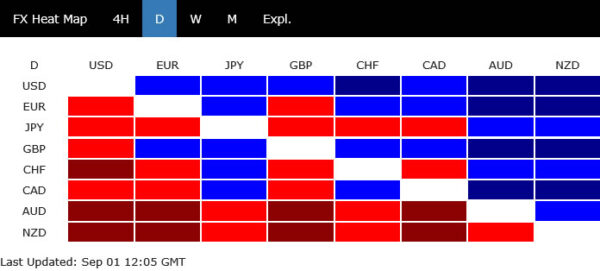
The FX heat map adds another layer. ActionForex Daily Heat Map at 12:05 GMT shows USD stronger against every other major currency, while AUD and NZD sit at the weaker end of the board. Yen is not universally strong, but it is outperforming both AUD and NZD.
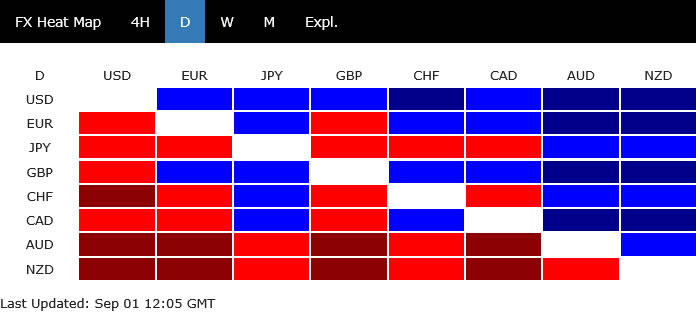
That distinction is important. This is not a textbook haven move in which Yen appreciates broadly across FX. Instead, the market is showing broad Dollar strength alongside selective pressure on Yen-funded carry positions, particularly AUD/JPY and NZD/JPY.
The mechanism is straightforward. As JGB yields rise, the cost-benefit equation behind borrowing cheaply in Yen to own higher-yielding currencies becomes less attractive. Unwinding those positions requires buying Yen back against currencies that had been funded with it. That naturally puts more pressure on AUD/JPY and NZD/JPY than on USD/JPY.
USD/JPY itself remains a special case. The pair has tested above 160 for a third straight session, reflecting the still-wide US-Japan yield gap even after the JGB selloff. US 10-year yield near 4.79% remains roughly 180bp above Japan’s 10-year around 3%, leaving Dollar with significant rate support.
USD/JPY at 160 Adds Intervention Risk, but Carry Story Is Broader
Intervention risk is also complicating Yen positioning. Treasury Secretary Bessent said Monday, “I have information that the market doesn’t have, and it’s my belief that the Japanese government and the BOJ will do the things that will lead to a stronger yen.”
At the same time, traders have strengthened expectations for another BoJ hike at the Sept. 18 meeting. That combination, higher domestic yields, tighter BoJ expectations and renewed intervention concern, makes aggressive short-Yen positioning progressively harder to maintain.
Still, Yen’s heat-map performance argues against calling Tuesday a generalized flight to safety. Yen remains weaker than several majors even while beating AUD and NZD. The best description is therefore carry compression rather than wholesale carry capitulation.
What Would Confirm the Four-Market Story?
The framework is testable.
For oil, confirmation would come from Brent extending toward or through $100, particularly if renewed US-Iran action threatens physical shipping or export infrastructure. A retreat back toward the high-$80s would suggest the current geopolitical premium is being absorbed.
For bonds, key confirmation is whether yields continue rising together across Japan, UK, Germany and US. If oil stays high but yields stabilize, markets would be signaling that the energy shock is viewed as temporary rather than a persistent inflation problem.
Equities provide another confirmation channel. Continued Nasdaq underperformance while long yields climb would reinforce the discount-rate mechanism. If technology stabilizes despite higher yields, valuation sensitivity may already be partly absorbed.
And in FX, AUD/JPY and NZD/JPY are the clearest gauges of carry unwind. Continued declines would suggest higher Japanese yields are forcing further position adjustment. Stabilization would indicate the initial unwind has largely run its course.
One Pressure, Four Expressions
The most important point is that Tuesday’s markets should not be read as four unrelated stories.
Oil is adding inflation risk. Global sovereign yields are repricing duration amid inflation, policy normalization and supply. Higher yields are pressing most heavily on technology equities. In FX, broad Dollar strength is combining with selective unwinding of Yen-funded carry trades against AUD and NZD.
None of these channels is yet at crisis level. But together they show a market becoming less tolerant of long duration and cheap funding at the same time. September is opening not with a simple risk-off move, but with a broader repricing of the cost of capital.
Related Coverage
Bonds & Central Bank Deep Dives
Global Manufacturing PMI Round-Up
Frequently Asked Questions
Q: Why are oil, bonds, tech stocks and FX carry trades being treated as one story instead of four?
A: Because they share the same underlying mechanism, rising compensation demanded for duration. Renewed US-Iran escalation pushed oil higher just as global bond markets were already repricing inflation, policy and heavy sovereign financing needs. Those higher yields are feeding directly into equity valuations, pressuring technology stocks the most, and making Yen-funded carry trades progressively less attractive as Japanese yields rise. Four different assets, one shared driver.
Q: Why is Japan’s bond market considered the clearest sign of a structural regime change?
A: Because Japan had long served as an anchor for global fixed income, low, stable JGB yields underpinned the Yen’s role as an ultra-cheap funding currency for carry trades worldwide. With the 10-year JGB yield hitting 3% for the first time since 1996, the 5-year at a record 2.26%, and the 2-year at a 31-year high, that anchor is repricing. Higher domestic yields make Japanese bonds more competitive for Japanese capital and directly reduce the appeal of borrowing in Yen to fund positions elsewhere.
Q: Why is Yen only outperforming AUD and NZD rather than strengthening broadly?
A: Because this isn’t a textbook safe-haven move, it’s carry compression. Yen remains weaker than several majors even while beating AUD and NZD specifically, which points to selective unwinding of Yen-funded carry positions rather than broad-based haven demand. As JGB yields rise, the cost-benefit case for borrowing cheaply in Yen to hold higher-yielding currencies weakens, and unwinding those trades means buying Yen back specifically against the currencies that had been funded with it, which is why AUD/JPY and NZD/JPY feel more pressure than USD/JPY.
Key Takeaways
- Brent pushed through $92, WTI above $87.50: After Trump warned “We’re going to hit them hard,” though Pezeshkian offered a potential de-escalation channel via the Islamabad memorandum.
- Sanctions and military pressure are now running together: The rial fell toward 2.1 million per dollar, complicating the idea that sanctions could substitute for kinetic escalation.
- Global sovereign yields surged together: Japan’s 10-year JGB hit 3% for the first time since 1996, UK’s 10-year Gilt reached 5.25% (highest since 2008), and US 10-year traded near 4.79% (highest since January 2025).
- Japan’s bond market may represent a genuine regime change: Higher domestic JGB yields reduce Yen’s attractiveness as an ultra-cheap global funding currency.
- The FX heat map shows broad Dollar strength, not a textbook haven move: Yen is outperforming AUD and NZD specifically, consistent with carry unwind rather than universal Yen strength.
- USD/JPY tested above 160 for a third straight session: Reflecting a still-wide roughly 180bp US-Japan yield gap even after the JGB selloff.
- Intervention risk and rising BoJ hike expectations are squeezing short-Yen positioning: Though the pattern is described as carry compression, not wholesale capitulation.
- The framework is testable: Brent toward $100, yields rising together across regions, continued Nasdaq underperformance, and further AUD/JPY and NZD/JPY declines would all confirm the same underlying story.
What to Watch Next
Watch whether Brent extends toward $100 or retreats toward the high-$80s, and whether sovereign yields keep rising together across Japan, UK, Germany and the US rather than stabilizing. Nasdaq’s relative performance as yields climb, and AUD/JPY and NZD/JPY specifically, remain the clearest gauges of whether this is a genuine regime shift or a temporary repricing.