Key Points
-
Tesla’s recent stock pullback looks more like a buying opportunity than a reason to keep waiting for a “perfect” price.
-
The company’s real upside will depend on its ability to turn its Cybercab, Optimus, and energy-storage ambitions into profitable businesses.
-
Because Tesla stock is extremely volatile and expensive, I’d recommend building your stake gradually and keeping your final position relatively small.
- These 10 stocks could mint the next wave of millionaires ›
I keep hearing people say they want to own Tesla (NASDAQ: TSLA) stock but are waiting for a better price, and I understand the instinct, because the stock has swung between $297.38 to $498.83 over the past year. The problem is that Tesla is already 30% off its high while deliveries grew 25% and energy storage jumped 40%, so the discount everyone is waiting for may already be here.
Tesla is down roughly 17% over the past four weeks, and I think that pullback is the entry point rather than a reason to wait for a deeper one.
Where the stock sits
Tesla trades today roughly 25% below its 52-week high, and about 23% above its 52-week low. Over the past 12 months, the stock has risen by 9.5%, meaning a year of operational progress has produced half the average price appreciation of the S&P 500, which is up by about 19%. Tesla’s forward price-to-earnings ratio sits near 207, with a trailing multiple of about 340, so nobody is buying the stock based on its current earnings math. If you’re buying it at all, you’re doing so based on your view of what the company is building.
Missed Nvidia in 2009? This Rare Signal Is Flashing Again. In 2009, a “Double Down” signal flashed for a little-known chipmaker called Nvidia. For the first time in years, that same “Total Conviction” signal is flashing for a company 1/100th the size of Nvidia. Continue »
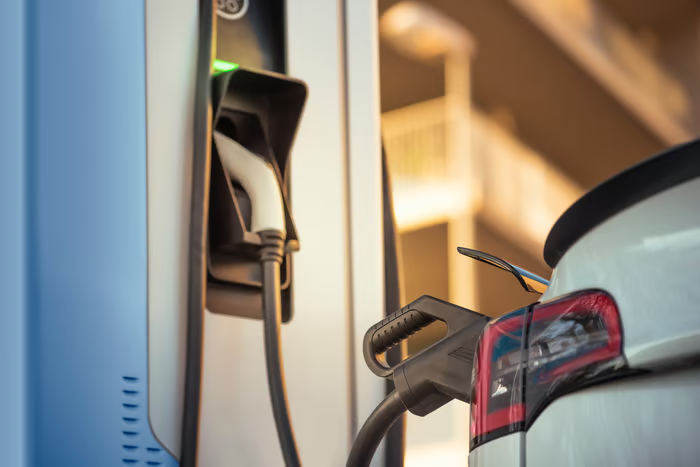
Image source: Getty Images.
Second-quarter deliveries hit 480,126 electric vehicles (EVs), up 25% year over year, compared with 451,758 vehicles produced. The energy storage business deployed 13.5 GWh of capacity in the quarter, up 40% from 9.6 GWh in the prior-year quarter and up 53% from the 8.8 GWh it deployed in 2026’s first quarter. It was Tesla’s second-largest quarterly increase in storage ever, behind only the 14.2 GWh it added in the fourth quarter of 2025. Cumulative deployments now exceed 132 GWh since 2016, with 22.3 GWh in the first half of 2026 alone.
Tesla’s network of Powerwalls — rechargeable home batteries that store electricity for later use, including during power outages — supported more than 89,000 virtual power plant events across over 1 million installed units, saving homeowners more than $1 billion on electricity bills. Megapack 3 and Megablock production are starting at Megafactory Houston this year.
Why the next few weeks matter
Tesla will unveil the production version of the Cybercab at a launch event on Sept. 3 in Austin. Pilot production started in February at Gigafactory Texas, and by July, hundreds of units had been spotted near the plant. The production specs are public: a 48-kWh battery, a single-motor setup producing 219 horsepower, roughly 293 miles of EPA range, no steering wheel or pedals, and a target price of $30,000. Tesla’s stated annual goal is to produce 2 million Cybercabs per year at full design capacity across multiple factories.
Mass production of the Optimus Gen 3 robot began at the company’s Fremont factory on Jan. 21, with roughly 300 units in Tesla factories running in a learning phase, and a planned $20,000 to $30,000 target price at scale. Tesla ended production of the Model S and Model X at Fremont this spring, specifically to free up capacity to manufacture the robots.
How I would actually buy it
First, a risk to consider: Tesla pulled its production volume guidance for the Cybertruck, Semi, and Megapack 3 from 2026 in its second-quarter letter, and removed the language on Optimus volume production entirely. Its capital expenditures will run to $25 billion this year, about three times historical levels. The more than doubled its on-site compute capacity in Texas in the first half of 2026 and is targeting nearly 400 MW by year’s end. That spending is compressing Tesla’s near-term margins.
Position sizing will do more work for you than entry timing here. For a stock with this type of volatility profile, I cap the size of my equity allocation to 2% to 5% of my portfolio, then build my position with gradual purchases on a set schedule rather than by making a single lump-sum buy. Tesla pays no dividend, so every dollar of return on this investment will depend on how it executes on its Cybercab, Optimus, and energy storage plans. If those land, waiting to buy until the stock dips by another 20% dip from its current $365 could look like a costly error.
Don’t miss this second chance at a potentially lucrative opportunity
Ever feel like you missed the boat in buying the most successful stocks? Then you’ll want to hear this.
On rare occasions, our expert team of analysts issues a “Double Down” stock recommendation for companies that they think are about to pop. If you’re worried you’ve already missed your chance to invest, now is the best time to buy before it’s too late. And the numbers speak for themselves:
- Nvidia: if you invested $1,000 when we doubled down in 2009, you’d have $573,341!*
- Apple: if you invested $1,000 when we doubled down in 2008, you’d have $60,441!*
- Netflix: if you invested $1,000 when we doubled down in 2004, you’d have $437,097!*
Right now, we’re issuing “Double Down” alerts for three incredible companies, available when you join Stock Advisor, and there may not be another chance like this anytime soon.
*Stock Advisor returns as of September 1, 2026.
Micah Zimmerman has no position in any of the stocks mentioned. The Motley Fool has positions in and recommends Tesla. The Motley Fool has a disclosure policy.