Key Points
-
The Nevada Transportation Authority voted unanimously on Aug. 20 to let Tesla run up to 5,000 driverless vehicles in Clark County over the next 12 months.
-
The prior interim permit had capped Tesla at 10 vehicles along a corridor of the Las Vegas Strip.
-
Tesla’s own second-quarter update still lists Las Vegas as “Preparations Underway.”
- These 10 stocks could mint the next wave of millionaires ›
Until last Thursday, Tesla (NASDAQ:TSLA) was allowed to operate exactly 10 robotaxis in Las Vegas, confined to a corridor of the Strip. Then, on Aug. 20, the Nevada Transportation Authority voted unanimously to raise that ceiling to 5,000 driverless vehicles in Clark County over the next 12 months.
Tesla wasn’t the only winner. Waymo received a permit for up to 1,000 vehicles in the same session, and Uber another 1,000. All told, the approvals clear the way for as many as 7,000 paid robotaxis in the county that includes Las Vegas.
Missed Nvidia in 2009? This Rare Signal Is Flashing Again. In 2009, a “Double Down” signal flashed for a little-known chipmaker called Nvidia. For the first time in years, that same “Total Conviction” signal is flashing for a company 1/100th the size of Nvidia. Continue »
For a stock priced largely on its autonomy future, that is a milestone. But a permit is a ceiling, not a fleet. And I think the distance between what’s permitted and what’s actually deployed is the thing for investors to watch.
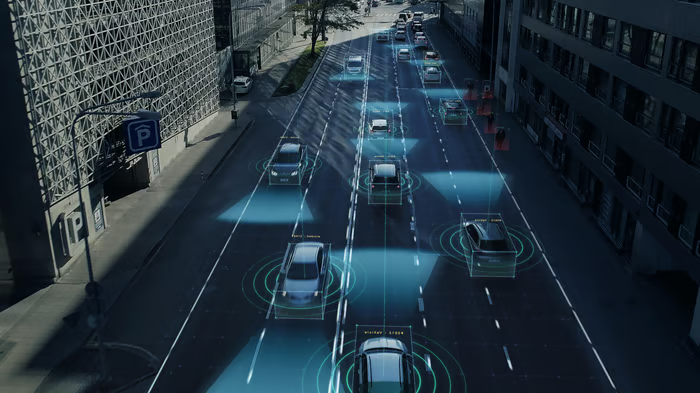
Image source: Getty Images.
From 10 cars to 5,000
The interim permit Nevada issued in late July shows how limited the first version was. Operations were capped at 10 fully autonomous vehicles within an approved zone along the Strip, and passenger rides were prohibited on roads posted above 45 miles per hour.
The conditions ran deeper, too. Every vehicle had to be clearly marked “Robotaxi,” and every passenger notified that a driverless car was picking them up. Pickups were barred at or within a quarter mile of Harry Reid International Airport without authorization.
The new commercial permit replaces that with something far bigger: up to 5,000 vehicles, in an approved area of Clark County, for paid rides. And widening that area later isn’t Tesla’s call alone — changes to the approved zone or its operating terms need the authority’s approval first.
Notably, the company asked for exactly this. Tesla applied in June for a 5,000-vehicle permit, and the authority answered first with the interim 10-car version before granting the full request last week.
What’s still in the way?
Nevada’s own rules are the first gate. Before paid rides begin, companies must document vehicle inspections, maintain insurance, and submit their rates to the authority. And while the approved area includes Harry Reid International Airport, serving it requires separate authorization from the Clark County Department of Aviation, a step that could take time on its own. In a market built around visitors, the airport is arguably the most valuable pickup zone there is.
Then there’s Tesla’s own readiness. The company is retrofitting a 37,000-square-foot building in the southwest Las Vegas Valley (a $3.1 million investment) and hiring for Vegas-based robotaxi roles. However, its second-quarter update, published about a month ago, still lists Las Vegas as “Preparations Underway,” while seven other metro areas are further along.
Even Tesla isn’t talking about 5,000 vehicles as a plan. “The 5,000 has always been a ceiling for us. I don’t think we’ll be in a position by this time next year to deploy 5,000 vehicles,” Cybercab chief engineer Eric Early said last week. He added that reaching 2,500 would make Tesla “extremely happy.”
A ceiling isn’t a forecast
That candor is worth taking seriously. Tesla’s entire paid robotaxi operation today spans seven metro areas, most of them added just this year, and the company itself describes the service as ramping. The program is in its early innings everywhere, not just Nevada.
After all, even Waymo, which has been giving paid driverless rides in other U.S. cities for years, took a Nevada permit one-fifth the size of Tesla’s.
And in more than a decade covering Tesla, I’ve seen the company’s timelines slip far more often than they’ve held. The spending on a new program also tends to show up well before the revenue does.
It’s showing up now. Tesla’s capital expenditures hit $8.3 billion in the first half of 2026, more than double the year-ago figure. Its operating margin, meanwhile, came in at 1.4% last quarter, down from 4.1% a year earlier. And Cybercab, the two-seat vehicle designed for exactly this kind of fleet, only began production during the second quarter.
The Nevada decision is still good news, to be clear. It is arguably the biggest fleet authorization Tesla has received anywhere, and a sign that regulators may open the path faster than many expected. Sure, the rollout could surprise me and scale quickly. But at about $349 per share as of this writing, shares cost about 155 times next year’s expected earnings — a price that already assumes fleets like this one fill up on schedule.
The constraint is no longer permission. It’s the inspections, the filings, the airport authorization, and the vehicles themselves. For now, the permitted number in Las Vegas is 5,000, and the number carrying passengers is still zero.
Don’t miss this second chance at a potentially lucrative opportunity
Ever feel like you missed the boat in buying the most successful stocks? Then you’ll want to hear this.
On rare occasions, our expert team of analysts issues a “Double Down” stock recommendation for companies that they think are about to pop. If you’re worried you’ve already missed your chance to invest, now is the best time to buy before it’s too late. And the numbers speak for themselves:
- Nvidia: if you invested $1,000 when we doubled down in 2009, you’d have $541,399!*
- Apple: if you invested $1,000 when we doubled down in 2008, you’d have $59,200!*
- Netflix: if you invested $1,000 when we doubled down in 2004, you’d have $431,488!*
Right now, we’re issuing “Double Down” alerts for three incredible companies, available when you join Stock Advisor, and there may not be another chance like this anytime soon.
*Stock Advisor returns as of August 25, 2026.
Daniel Sparks has clients with positions in Tesla. The Motley Fool has positions in and recommends Tesla. The Motley Fool recommends Uber Technologies. The Motley Fool has a disclosure policy.