China Cracks Down On Overseas Investing After Record $1 Trillion Capital Flight To US, Hong Kong Markets
Uncategorized
China Cracks Down On Overseas Investing After Record $1 Trillion Capital Flight To US, Hong Kong Markets
011 mins
Benzinga and Yahoo Finance LLC may earn commission or revenue on some items through the links below.
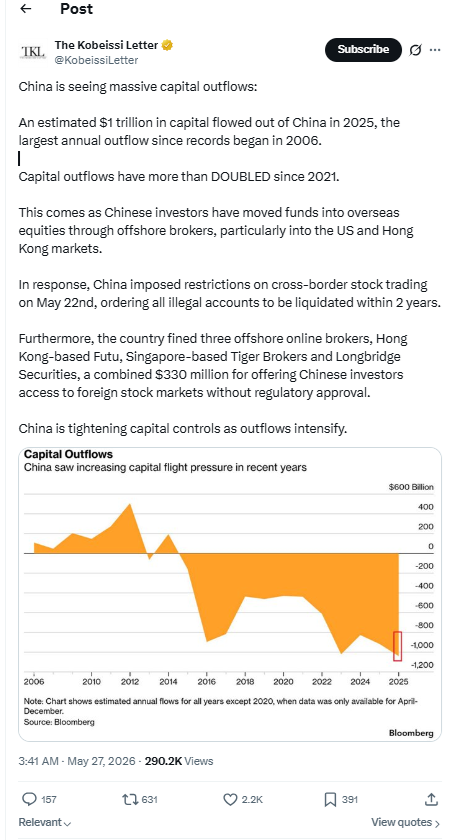
China has imposed restrictions on cross-border trading after the data showed Chinese money is flowing out of the mainland at a record pace into the U.S. and Hong Kong markets.
Massive Capital Outflows
According to an X post by The Kobeissi Letter on Tuesday, China recorded an estimated $1 trillion in capital outflows in 2025, more than double the levels since 2021. This represents “the largest annual outflow since records began in 2006.”
The letter stated, “Chinese investors have moved funds into overseas equities through offshore brokers, particularly into the US and Hong Kong markets.”
Don’t Miss:
A recent analysis by Caixin suggests that a significant portion of China’s $1.2 trillion trade surplus is unexpectedly flowing into the Hong Kong stock market.
China Tightens Capital Controls
In an effort to control capital flight, China has tightened capital controls by imposing restrictions on cross-border stock trading on May 22, ordering all illegal accounts to be liquidated within 2 years.
Under the initiative, the China Securities Regulatory Commission said it will take strict action against Singapore-based Tiger Brokers, Hong Kong-based Futu and Longbridge Securities, imposing a combined penalty of $330 million for conducting illegal cross-border business operations without regulatory approval.
The move would reshape how mainland Chinese access foreign markets. Citic Securities warned that the crackdown could affect as much as HK$250 billion (S$41 billion) of assets in Hong Kong, according to the report by The Business Times.
Chip Market Growing
The capital flight and trade restrictions came at a time when China’s AI chip market is growing rapidly, with chip exports reportedly doubling last month to a record $31 billion.
China’s leading firms like Semiconductor Manufacturing International Co. (SMIC), Hua Hong Semiconductor, and many Huawei-linked chipmakers are scaling production of advanced semiconductors amid the U.S. export curbs, along with growing AI demand and supply shortages.
Photo courtesy: Tomas Ragina via Shutterstock
Read Next:
Building Wealth Across More Than Just the Market
Building a resilient portfolio means thinking beyond a single asset or market trend. Economic cycles shift, sectors rise and fall, and no one investment performs well in every environment. That’s why many investors look to diversify with platforms that provide access to real estate, fixed-income opportunities, professional financial guidance, precious metals, and even self-directed retirement accounts. By spreading exposure across multiple asset classes, it becomes easier to manage risk, capture steady returns, and create long-term wealth that isn’t tied to the fortunes of just one company or industry.
Accredited Debt Relief is a debt consolidation company focused on helping consumers reduce and manage unsecured debt through structured programs and personalized solutions. Having supported more than 1 million clients and helped resolve over $3 billion in debt, the company operates within the growing consumer debt relief industry, where demand continues to rise alongside record household debt levels. Its process includes a quick qualification survey, personalized program matching, and ongoing support, with eligible clients potentially reducing monthly payments by 40% or more. With industry recognition, an A+ BBB rating, and multiple customer service awards, Accredited Debt Relief positions itself as a data-driven, client-focused option for individuals seeking a more manageable path toward becoming debt-free.