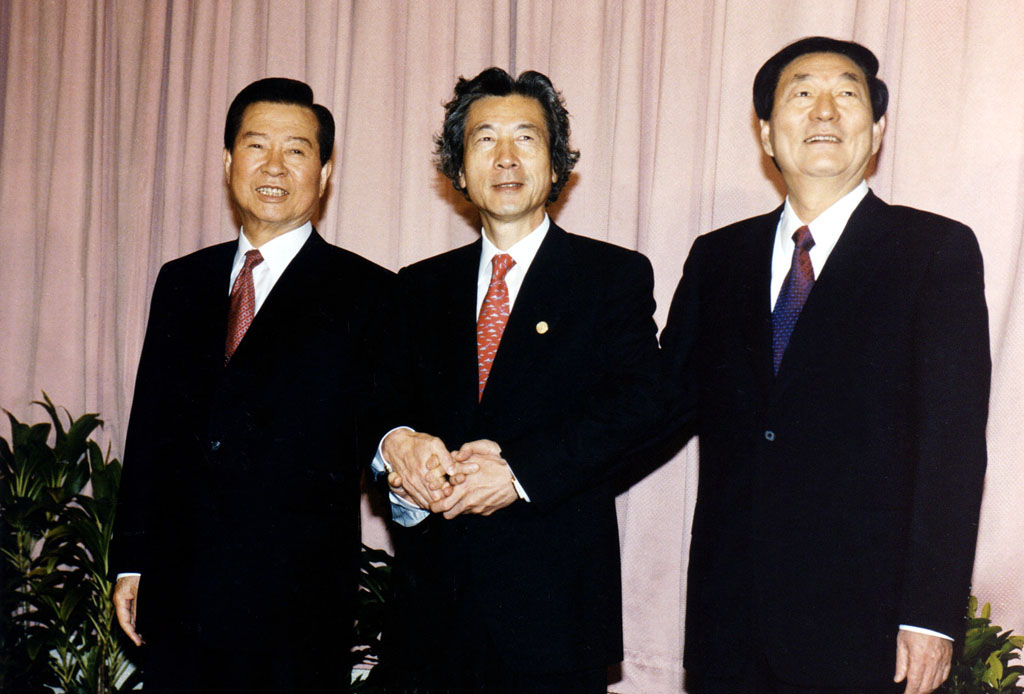
Former Premier of the People’s Republic of China, Zhu Rongji, passed away on last week at the age of 97, with the country raising its flags to half-mast in commemoration of one of its wisest custodians.
His term as the head of state was not a long one—merely 5 years from 1998 to 2003—but his work was paramount to transform the country from the example that American mothers used to convince their children to eat all their dinner, to the economic powerhouse it is today.
This work began in earnest during his role as Vice Premier, a position of much greater power than an American Vice President. Under Premier Deng Xiaoping, Zhu executed critical market reforms in areas of banking, taxation, and government employment.
This included allowing thousands of government-owned businesses to fail, trusting a new private sector to support employment as the state sought to get tens of millions of workers off of the so-called “iron rice bowl” of cradle-to-grave welfare. As VP, Zhu also saw a reduction in the inflation rate from 24.3% in 1994, to -0.8% in 1998, in part through centralizing the wildly decentralized tax system by using an American tax model.
These large successes set Zhu up for election to the Premiership in 1998, which he kicked off with a program of privatization that lasted throughout his period in office, during which the PRC’s private sector experienced rapid growth. This was matched with a halving, roughly, in the bureaucracy between 1998 and 2003, part of an emergency response to the Asian Financial Crisis of 1997.
A 2002 article about Zhu stepping down from the Premiership bears at-the-time witness to the achievements of these market reforms. In 2000, worldwide foreign direct investment had fallen by half, yet it had increased 10% in the PRC. Two years later, global trade had fallen by 1%, but Chinese gross trade had increased by 22%.
“He’s someone who is well respected by Chinese citizens,” Angie Eagan, manager of the US marketing firm Burson-Marsteller’s Shanghai office, told the BBC at the time. “Having somebody who can hold the respect of multiple generations is quite something.”
In 2001, Zhu took the lead in negotiating China’s assent to the World Trade Organization, to domestic and international acclaim, an achievement that required close coordination with the United States and something he managed without kowtowing.
A lasting legacy, rooted in dissent
There was every chance that Zhu Rongji would have become a Mao-era casualty, never to enter the history books.
He was a member of good standing of the Communist Party during his youth, but repeated defiance of Mao Zedong’s cult of personality and catastrophic policies saw him exiled twice.
The first, in 1957, saw him expelled from the party and labeled a radical. Surviving this incident both physically and politically, a pardon led to his return to political life in 1962. He was purged again during the Cultural Revolution, and again survived, though sent to a special farm for disgraced government workers where he performed years of hard agricultural labor.
His arrival within the inner circle of Deng Xiaoping, Mao’s successor, was meritocratic, as the years in political exile left him with few connections among Beijing’s elite. He excelled in the country’s post-Mao academy, and in 1984 was named the founding dean of the Tsinghua University School of Economics and Management, a position that allowed him to meet western academics, and even leaders, for the first time.
“He was a very impressive individual from the very beginning…a man of enormous curiosity,” Dr. Nick Lardy, a China specialist at the Brookings Institution in Washington, who first met Mr. Zhu in the mid-1980s when he was the mayor of Shanghai, said in the BBC piece.
It was as mayor of Shanghai that he instituted that city’s first special economic zone, leading it to becoming a global financial center today.
As Premier Zhu earned a reputation as a strong, strict administrator, intolerant of corruption, nepotism, or incompetence. His shift toward meritocratic values in the bureaucracy was vigorous, opening government offices to private-sector advisors and experts, trying to cut connection-based promotion, and in what was quietly the most impressive accomplishment of all this disciplinariansm, got the military to relinquish its involvement in the business sector.
His nickname as Mayor and Party Secretary of Shanghai was “One Chop Zhu,” a refrain regarding his nature as something like a Western-style corporate axeman. It was this chopping that uncovered and dismantled the largest corruption ring in modern Chinese history—a massive smuggling operation inside the government of Fujian in the south.
After retiring, Zhu invested much of his time and energy into public philanthropy. In 2013 and 2014 alone, he donated 40 million RMB (around $6.5 million US) to charity.
There are many methods for measuring the success or failure of a country’s leadership. However, given the reality of political re-election pressure, even from within the ranks of a one-party system, an especially useful metric is to see whether or not policies left unfinished by one leader are carried out without alternation by the next.
In this sense, Zhu’s influence was profound on the following set of PRC leadership. His successor Wen Jiabao attempted to continue many of the reforms that Zhu had conceived and designed, creating and increasing the powers of independent regulatory commissions and restructuring the bureaucracy on the basis of merit.
Some of these were achieved, others were reversed under Wen’s successor, but with China’s place as the 2nd largest economy, his overall vision was no doubt achieved.
Wang Dan, China director at Eurasia Group, told the South China Morning Post that Zhu was “the true founder of China’s socialist market economy.”
“Subsequent reforms of similar depth have been absent from China; subsequent policies have essentially been reinforcements of the reforms he spearheaded in the 1990s,” he added, joining a chorus of economy-sector voices praising the man and his tenure to the paper.
Zhu Rongji is survived by his wife of over 50 years, Lao An, and their son, a business executive.
SHARE This Story Of China’s Reformist Premier On Social Media…