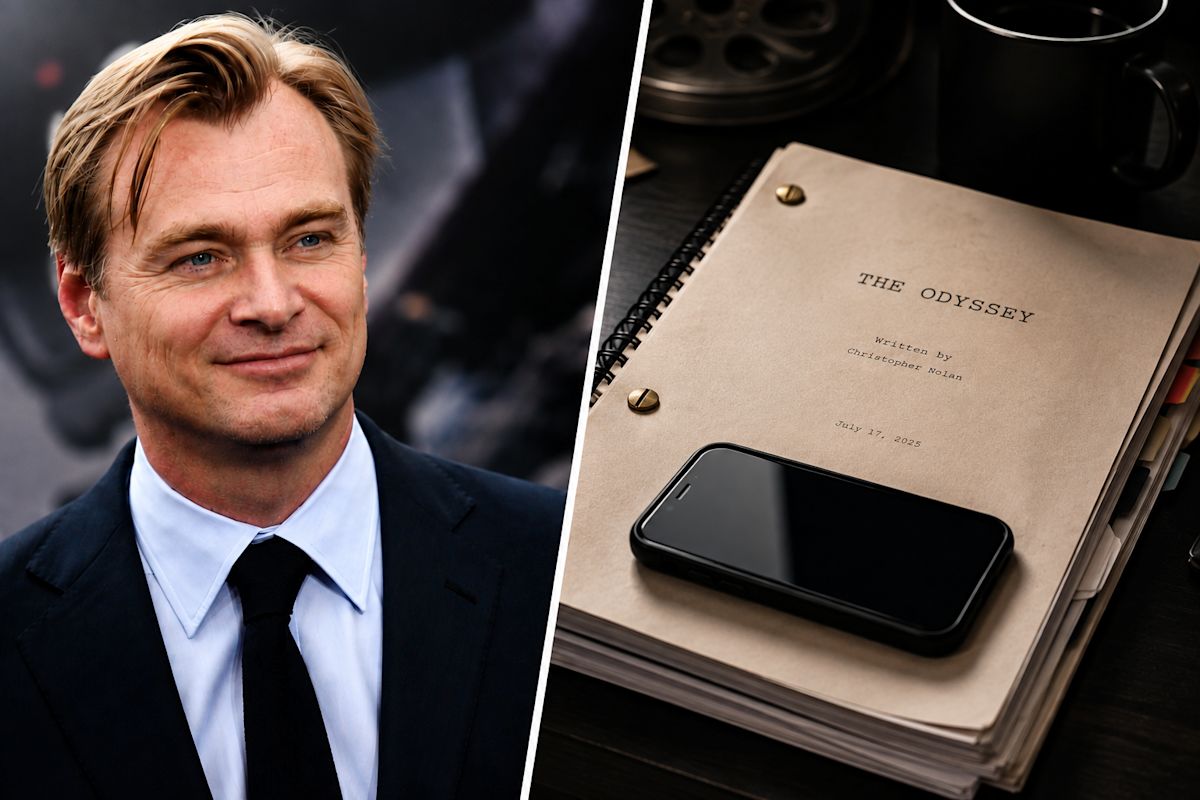
Christopher Nolan makes movies filled with some of the most advanced technology imaginable. He has sent astronauts through wormholes, recreated the development of the atomic bomb, and, most recently, created a masterpiece based on the Ancient Greek poem The Odyssey.
In his personal life, however, the Oscar-winning director is surprisingly low-tech.
Nolan does not use email, does not communicate by text, and still does not carry a cellphone. When he wants to speak to an actor, he finds a landline. Matt Damon recently told People that Nolan’s wife, producer Emma Thomas, usually sends a warning before her husband calls from a random number at a studio.
It sounds wildly inconvenient, but it clearly works. And he’s not the only celeb on our list.
Perhaps they’re onto something.
What science says about technology

Technology has taken over our lives
(Olga Grivcova via Getty Images)Smartphones are useful, of course. They help us navigate unfamiliar cities, check into flights, pay bills, take photos, and stay in touch with the people we love. For many of us, they are also essential for work.
The problem is that they rarely stay in their lane. A phone you picked up to check the weather can somehow lead to 30 minutes of scrolling through cat videos, reading upsetting news, and wondering why everyone else seems to be living a more glamorous life.
Researchers are still studying the effects of electronics on our lives, and not every form of screen use is harmful. Talking to a friend is not the same as doomscrolling, and using a phone for directions is not the same as compulsively checking for likes. Still, a growing body of research suggests that excessive smartphone and social media use can contribute to anxiety, loneliness, poor sleep, stress, and depression.

Science proves that many people benefit from spending less time online
(hapabapa via Getty Images)More importantly, several studies have found that people feel better when they cut back.
A 2025 randomized controlled trial published in BMC Medicine asked participants to reduce their smartphone screen time to no more than 2 hours per day for 3 weeks. Researchers found improvements in depressive symptoms, stress, sleep quality, and overall well-being.
Another randomized controlled trial published in 2026 followed young people experiencing anxiety and depression. Those who reduced their social media use reported lower levels of loneliness.
A broad review of research on social media and mental health also found that heavier social media use has repeatedly been associated with anxiety, depressive symptoms, and loneliness. That does not mean every person who uses Instagram will become anxious or lonely. It does suggest that how often we use these platforms, why we use them, and what they replace in our lives matter.
Some celebrities decided they did not need a scientific study to tell them their phones were taking up too much space in their lives. They stopped using them on their own.
Christopher Nolan
Nolan is one of the most prominent holdouts in Hollywood.
He has said that he does not use email or a smartphone and writes his scripts on a computer that is not connected to the internet. His reasoning is not that technology is inherently bad. He simply does not want to be distracted every time he has a moment to himself.
It is not the easiest way to communicate, but Nolan has clearly decided that protecting his attention is worth the inconvenience.
Christopher Walken
Christopher Walken has never sent an email and does not own a cellphone.
The actor told The Wall Street Journal, as reported by People, that he also avoids social media and does not stream television. When he needed to watch episodes of Severance, Apple sent him DVDs.
Walken hasn’t painted his choices as a dramatic rejection of modern life. Technology simply passed him by, and he never felt compelled to catch up.
Ed Sheeran
Ed Sheeran gave up his cellphone in 2015 after deciding it was interfering with his relationships.
The singer explained during an interview on the Therapuss with Jake Shane podcast that the volume of texts had become overwhelming. He felt as though he was expected to respond to everyone, all the time, and that the constant communication was costing him real-life interaction.
Sheeran told People that he now uses an iPad and checks email about once a week. His team may occasionally give him a device when he needs to film something for social media, but he does not carry a regular cellphone with a personal number.
That means people cannot reach him whenever they feel like it. They reach him when he is ready to be reached.
Simon Cowell
Simon Cowell also gave up carrying a cellphone. The television personality has discussed feeling overwhelmed by the constant stream of messages and calls. His fiancée, Lauren Cowell, recently told Entertainment Weekly that life without the device has had a positive effect on him.
Cowell has joked that walking around with a phone is a little like carrying a toaster. You do not actually need to have it attached to you everywhere you go.
Dolly Parton
Dolly Parton does not text and has said she does not send emails.
Instead, she prefers phone calls and, famously, fax machines.
Parton explained on The Drew Barrymore Show that she is not incapable of learning new technology. She simply does not want to spend her time answering messages or sitting with her face in a phone. As Vanity Fair reported, she described herself as a low-tech person living in a high-tech world.
Her system may sound outdated, but it gives her something many people have lost: control over when she is available.
Selena Gomez
Selena Gomez has more than 400 million Instagram followers, but for years she did not personally manage the account or keep the app on her phone.
Gomez has spoken openly about the effect social media had on her mental health. She deleted the apps and handed control of her accounts to members of her team. In a 2021 interview, she said that distancing herself from social media was a major reason she felt healthier.
She told WWD’s Beauty Inc., as reported by Elle, that being unaware of much of what was happening in pop culture made her happy and that stepping away had, in her words, “saved my life.”
Her situation also highlights an important distinction. Gomez did not disappear from the internet. Her professional accounts remained active. She simply stopped exposing herself to a nonstop stream of comments, criticism, comparisons, and updates.
Jennifer Lawrence
Jennifer Lawrence has also avoided maintaining a public social media presence.
She has acknowledged that she looks at what other people post, but she does not want to expose herself to the backlash and relentless opinions that come with posting publicly. She told InStyle, as reported by Time, that she does not believe she could handle the constant scrutiny.
Lawrence’s concern is understandable. Social media allows celebrities to communicate directly with fans, but it also gives millions of people direct access to criticize their faces, clothes, relationships, opinions, and personalities.
Shailene Woodley
Shailene Woodley was talking about life without a cellphone long before digital detoxes became a popular wellness trend.
In 2014, she told The Daily Beast, as reported by E! News, that she did not own a smartphone or even a basic cellphone.
Woodley said the absence of a phone forced her to plan ahead. If she wanted to meet someone, she had to decide on a time and place and trust that both people would show up.
That sounds almost archaic now. It also sounds like a world in which people paid more attention to their plans because they could not casually change them at the last minute with a text.
Justin Bieber
Justin Bieber also decided the constant connection wasn’t worth it. In a 2021 interview with Billboard, he revealed that he no longer carries a cellphone, choosing instead to communicate with his team through an iPad. The change wasn’t about rejecting technology altogether. It was about setting boundaries. “I definitely learned how to have boundaries, and I just don’t feel like I owe anybody anything,” Bieber said. “That has helped me to be able to just say no… I can’t do everything.” By making himself less accessible, he said he was able to protect his time and his mental health while still staying connected when it mattered.
You probably don’t need to throw away your phone
It is easy for celebrities to disconnect in ways that are not practical for everyone else. Christopher Nolan has assistants and a producer who can arrange his calls. Selena Gomez can hire a team to manage her social media. Dolly Parton can rely on staff members who know how to operate a fax machine.
Most people cannot tell their employers they will check email next Tuesday.
Still, there is a lesson here that does not require fame, money, or an assistant.
These celebrities made deliberate choices about who gets access to them and when. They stopped treating constant availability as a requirement. Some gave up smartphones entirely. Others removed social media from their personal devices or refused to create public accounts in the first place.

There’s a healthy way to use electronics
(blackCAT via Getty Images)Science does not prove that every smartphone causes anxiety or that everyone would be happier without social media. The relationship is far more complicated than that. Online communities can reduce isolation, help people maintain friendships, and offer support that may not be available locally.
The research does suggest, however, that reducing excessive or compulsive use can improve well-being for some people. It also suggests that a device designed to connect us can leave us feeling lonelier when it begins replacing sleep, face-to-face conversations, exercise, and time spent doing things that require our full attention.
Most of us are not going to start faxing our friends or waiting beside a studio landline for Christopher Nolan to call.
The bottom line
We can turn off unnecessary notifications. We can leave the phone in another room during dinner. We can stop checking social media immediately after waking up. We can decide that not every message requires an immediate response.
In a world where nearly everyone is reachable all the time, protecting a small part of your day from interruption may be one of the healthiest luxuries of all.