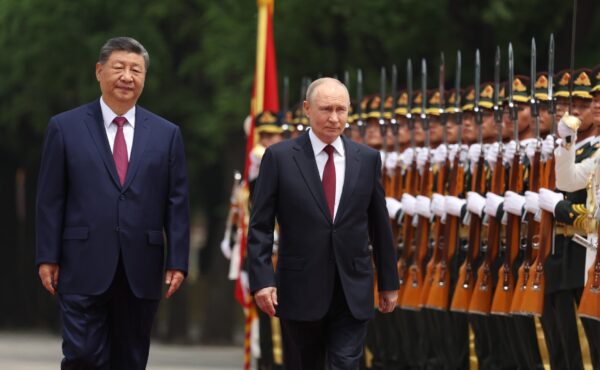
The meeting between Chinese President Xi Jinping and Russian President Vladimir Putin in Beijing on May 20 offered an important insight into the contemporary character of Sino-Russian relations. While Putin hailed the relationship as a “paradigm of comprehensive strategic coordination,” the summit highlighted the persistent tensions between the ideological rhetoric surrounding the partnership, on the one hand, and the practical limits of cooperation as the relationship becomes increasingly dominated by Beijing on the other.
One of the reasons that some commentators tend to ignore the limits of Sino-Russian partnership is by failing to situate the relationship within China’s broader foreign policy framework of “partnership diplomacy.”
Beijing employs a hierarchy of partnerships to signal varying degrees of political importance. At the apex of this hierarchy are “comprehensive strategic partnerships,” a characterization that designates a structured but flexible and non-binding framework for cooperation across multiple issue areas while avoiding the mutual defense commitments associated with traditional alliances. As Evan Feigenbaum noted, “[T]hese Chinese partnerships, unlike Washington’s alliances, carry no presumption of obligation or binding security commitment.”
Viewed through this lens, the Putin-Xi summit demonstrated both the depth and the constraints of the China-Russia relationship.
This can be seen in the statements and documents released by both Moscow and Beijing after the meeting. These reveal a shared dissatisfaction with the existing Western-led international order, a common desire to promote a more multipolar global system and commitments to deepen their practical cooperation. Yet, across each of these aspects of the partnership there is enough daylight between each party’s positions and interests to suggest that they are far from joined at the hip.
The Kremlin’s release of the “Joint Declaration of the Russian Federation and the People’s Republic of China on the Establishment of a Multipolar World and a New Type of International Relations,” for example, clearly spoke to the shared normative outlook of Moscow and Beijing by framing the partnership in primarily ideological terms.
The Kremlin statement portrayed the post-Cold War international order as undergoing an inevitable transition from Western-led unipolarity to a multipolar or “polycentric” system, which Moscow presents as both just and reflective of the interests of the non-Western world. The document condemned “hegemonism” as something that is both “unacceptable” and “must be prohibited,” before decrying “unilateral coercion,” “military blocs,” and attempts by Western powers to impose their political systems or values on others. In place of these pathologies, the Kremlin statement advocated for an order based on respect for state sovereignty, non-interference, and the equal legitimacy of different civilizational and political models.
As such, the Russian document stands as a restatement of the ideological and strategic rationale for the “no limits” partnership that was first offered in February 2022 during Putin’s state visit to China.
By comparison, China’s state new agency, Xinhua, released a detailed report on the summit that adopted a more measured tone. Xinhua’s summary prioritized pragmatic cooperation, economic coordination, and reform of the international order from within existing institutions.
The report noted that both Xi and Putin called for a “more just and reasonable international order” but it did not repeat the more pointed criticisms of “hegemonism” and “unilateralism” that peppered the Kremlin’s declaration. Rather, Xinhua recorded Xi telling Putin that Russia and China as “permanent members of the U.N. Security Council and major global powers” should focus on “their respective countries’ development and revitalization” and “promote the construction of a more just and reasonable global governance system.”
In contrast to the Russian declaration, the Xinhua report noted Xi’s emphasis that Sino-Russian relations are “a strategic choice made by both sides focusing on the fundamental interests of both countries. As such, the two parties must promote both “pragmatic cooperation in economic and trade investment, energy resources, transportation, and technological innovation” and “multilateral cooperation” in such forums as the United Nations, Shanghai Cooperation Organization (SCO) and BRICS to “safeguard the postwar international order and the authority of international law, unite the Global South, and lead the correct direction of global governance system reform.”
This illustrates a key distinction between Russian and Chinese revisionism. Beijing presents itself not as a revolutionary actor or agent of “upheaval” but rather as a defender of the existing, U.N.-centered international order advocating for “reform” from within.
On the question of practical cooperation, in turn, the Kremlin has trumpeted the fact that some 22 agreements were signed in the presence of Putin and Xi in the Great Hall of the People. Besides the “Joint Declaration of the Russian Federation and the People’s Republic of China on the Establishment of a Multipolar World and a New Type of International Relations,” the rest of these documents concern memoranda of understanding (MoUs) between Russian and Chinese ministries, institutions of higher education, and state media organizations.
This continues a trend evident for some time of deepening functional cooperation that goes beyond the pageantry of leader summits (and Putin and Xi’s individual relationship). Such functional cooperation extends from the military-defense realm to energy, technology, finance, and education.
Yet this cooperation is increasingly asymmetric in nature.
While the China-Russia economic relationship continues to develop, for instance, it is structurally imbalanced with Russian exports to China consisting almost exclusively of fossil fuels and/or natural resources, while China’s exports are manufactured goods such as cars, tractors, electronics, and other consumer products.
This trend was evident before Putin’s war of aggression on Ukraine in February 2022, but it has been accelerated due to the imposition of European and American sanction regimes on Russia. As Alexander Gabuev noted, the net result is that “Western sanctions have cleared the Russian market for the Chinese and forced Russian exporters of raw materials to rush to China,” while “Russian import substitution based on Chinese technologies has only accelerated this process.”
Meanwhile, Chinese economic investment in Russia remains limited to around $400 million annually since 2022. China now invests more “in countries such as the Dominican Republic and Zambia” than its supposed “no limits” partner.
The asymmetry of the relationship is apparent too in the realm of Sino-Russian military-defense ties. This was once seen by Russia as a domain of comparative advantage in the relationship. The war in Ukraine, however, has made Russia dependent on China for access to a range of military and dual-use industrial products like ball bearings, vehicle spare parts, optical sights and electric detonators. This dependence is critical in certain sectors of the Russian defense industry, with China, according to Ukrainian intelligence, accounting for the majority of electronics used in Russian military drones.
The summit did little to check this asymmetry.
In fact, the summit treatment of the big-ticket item that Moscow wanted progress on in the economic domain – agreement on the Power of Siberia 2 natural gas pipeline – neatly demonstrates the relative balance of power within the partnership. Progress on Power of Siberia 2 was not only unforthcoming, but it was not even mentioned in Chinese official accounts of the summit.
Moscow no doubt hoped that the energy security fallout from Israel and the United States’ war on Iran would provide renewed incentives for Beijing to sign on. This, however, ignored two crucial realities. First, as Feigenbaum put it, China buys oil and gas “on a global market, and doesn’t hinge its policy in any region – from the Middle East to Latin America – on just one state” – including Russia.
Second, due to Russia’s isolation from European markets it has nowhere else to go, handing China all the leverage when it comes to any prospective negotiation over pricing and the length of gas supply contracts. Indeed, even prior to Putin’s visit it was reported that negotiations between Gazprom and CNPC were stalling due to Chinese insistence that gas prices should be “aligned with Russia’s domestic rates.”
Gabuev reached a conclusion that increasingly encapsulates the entire relationship: ““It is the Chinese comrades who are increasingly able to dictate which projects they are interested in and which are not, and under what conditions the PRC will participate in something.”
The Putin-Xi summit demonstrated that China-Russia relations remain strategically important but are increasingly defined by asymmetry rather than equality.
While both states share dissatisfaction with the Western-led international order and seek a more multipolar system, the summit revealed important differences. Russia continued to frame the partnership in ideological and revisionist terms, emphasizing opposition to “hegemonism” and Western dominance, whereas China adopted a more cautious and pragmatic tone centered on economic cooperation, multilateral coordination, and reform of the international order from within existing institutions.
Beijing’s language reflected its preference for strategic flexibility and stability rather than overt revolutionary confrontation with the West. The summit therefore reinforced that Sino-Russian alignment is driven less by deep ideological unity than by overlapping but not identical strategic interests.
At the same time, the summit underscored the increasingly unequal balance within the relationship. Russia’s dependence on China has deepened substantially since the invasion of Ukraine and the imposition of Western sanctions, leaving Moscow reliant on Chinese markets, industrial goods, technology, and dual-use products. Yet Beijing has shown little willingness to subordinate its own interests to Russian priorities.
While Sino-Russian relations are therefore likely to remain durable because they continue to serve important strategic purposes for both sides, the so-called “no limits” partnership is increasingly one in which China holds the dominant position and possesses growing leverage to shape both the scope and limits of bilateral cooperation.