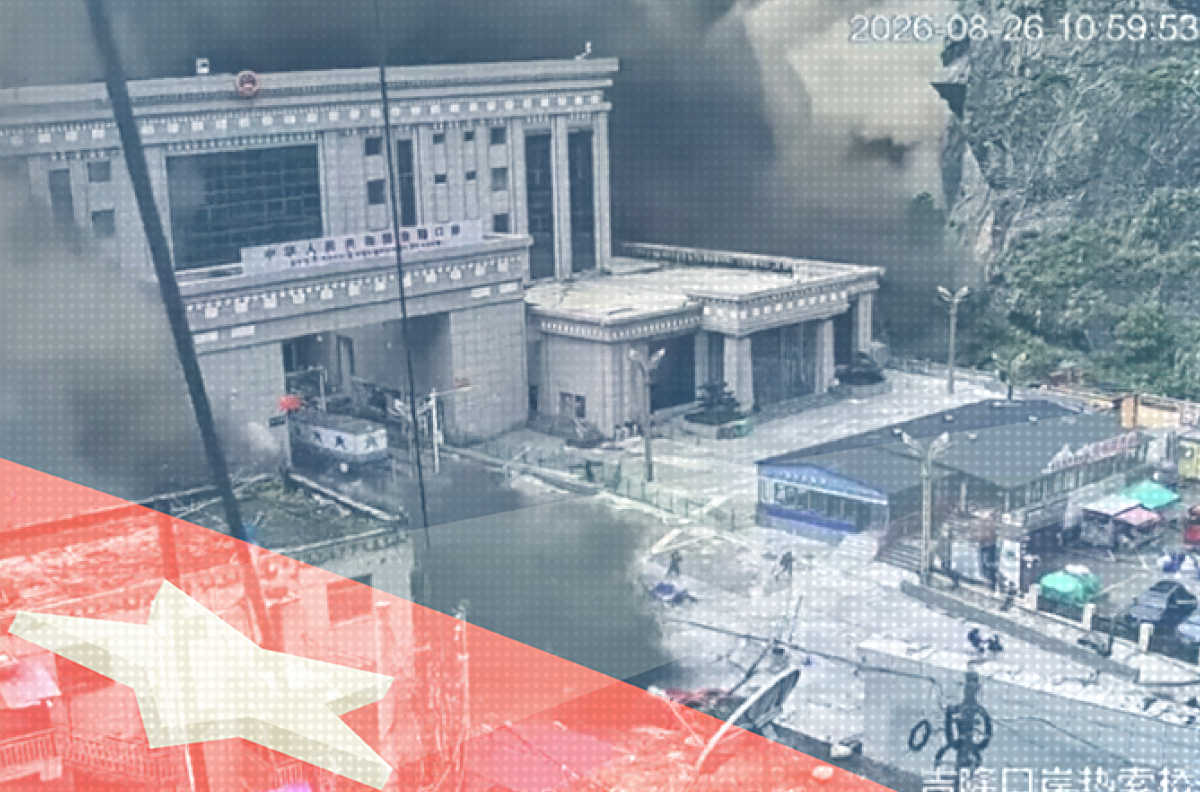
The devastating floods that struck Nepal and Tibet last month after a glacial collapse in the Himalayan border region have to date resulted in at least 1,300 dead, with many more still missing. Through the final week of August, the tragedy dominated headlines around the world. In China, where the border checkpoint of Gyirong port was struck by a destructive wall of water coursing down from the mountains, there was equally intense interest in the story. But that demand was fed through a tightly centralized news system in which the Chinese Communist Party (CCP) held the facts close — and kept the focus on the official response over human reactions.
It is true that China quickly dispatched reporters to the scene. It is also true that limited information about the disaster circulated widely across online media, news apps and social media channels. However, it is crucial to recognize how the centralized containment of reporting and release of information about this tragedy fits within the broader historical development of information controls in the country. Drawing on the news and social media monitoring platform Wisers as well as searches of archived Chinese-language newspapers and online coverage, the China Media Project explored a single critical question: Who produced the core information that circulated inside China, including through millions of social media accounts and thousands of posts on platforms like WeChat and RedNote.
Our findings show that Chinese authorities were essentially effective in ensuring that the source of information on the breaking story was contained to a small number of central-level Party-state media, including the government-run Xinhua News Agency and the various outlets — such as China Central Television (CCTV) and China Radio International (CRI) — under the powerful China Media Group (CMG), the conglomerate directly under the Central Propaganda Department.
Despite Foreign Ministry Spokesman Guo Jiakun’s insistence on August 31 that “China has been open, transparent and timely in information release,” this story should be read as yet another unmistakable sign that Xi Jinping has completely rewritten the script for China’s domestic media.
Shock and Interest
During the first five hours after the disaster, no news reports appeared in China’s media, either from central or provincial CCP-run news outlets or their commercial counterparts. Given the real potential commercial media have still — even after years of constraint under Xi — to reach sources on the ground, this five-hour silence almost certainly reflects the presence of an immediate ban (禁令) against original reporting. It is likely media outlets were held back and told to await an “authoritative” account from Xinhua.
To put coverage of this tragedy in context, it is important to understand that China’s commercial metropolitan press, epitomized by now fully digitalized outlets like The Beijing News and Guangzhou’s Southern Metropolis Daily, tended in the past to pursue breaking stories like this one, often in direct violation of directives from the leadership. In the 2000s and into the early 2010s, more enterprising editorial teams at outlets like these sought ways to capitalize on the moments of opportunity — often before the system had time to react. The clearest example, a crucial backdrop to the Tibet-Nepal disaster, was the May 2008 Wenchuan earthquake, during which scores of media, and literally hundreds of reporters, openly violated an initial ban from the Central Propaganda Department to head to the scene and report first-hand.
As the leadership huddled on August 26 to frame its response, there appear to have been no such breaches of media protocol.
As media outlets sat on their hands awaiting the first Xinhua missive, meanwhile, interest in the story from the public was immediate. Posts quickly circulated on social media. As China Digital Times (CDT) has documented, users on WeChat attempted, unsuccessfully, to share two video clips of the border gate at Gyirong as it was struck by a flash flood wave. Both videos were shared overseas later in the day by the dissident X account “Teacher Li Is Not Your Teacher.”
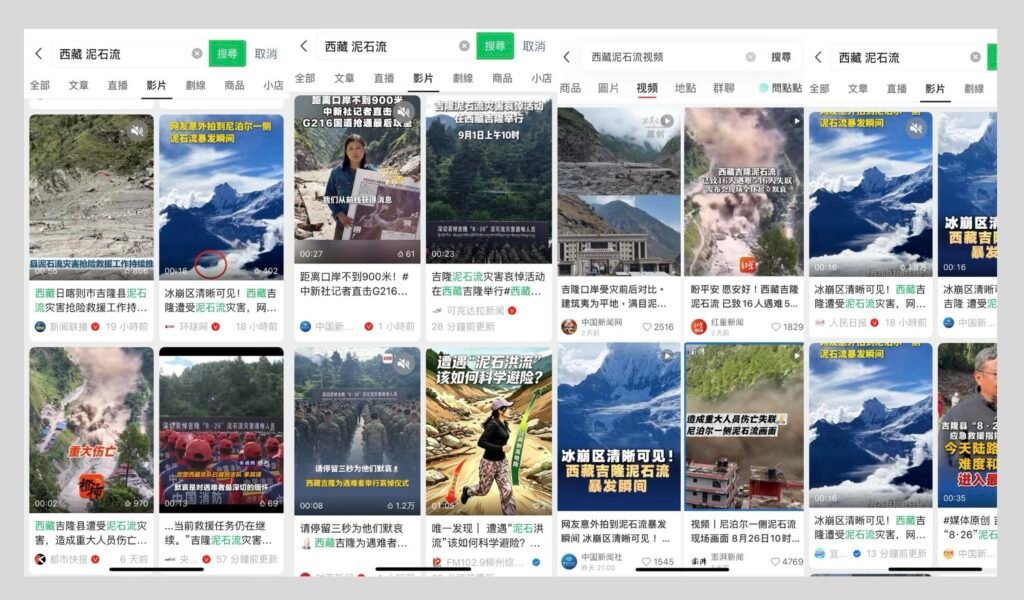
Searching for related video content on the messaging app WeChat and social media platforms on September 1, nearly a week after the disaster, CMP found that the keywords “Tibet” (西藏) and “mudslide” (泥石流) did not return the original Gyirong port video. Most videos, in fact, dealt either with the rescue operations — keeping close to the official framing of active government response — or with the collapse of melting ice and snow on the Nepalese side of the pass. When the Gyirong port video was referenced, as it was by several media through social media channels, the frame again was the sacrificial care shown by authorities and police. One short segment posted by the account “Qianjiang Video”(钱江视频), a WeChat-based video channel run by the official Zhejiang Media Group (浙江广播电视集团), showed a policeman trying to evacuate people seconds before the water struck the port. The text over the top read:
“The last 30 seconds before the mudslide struck Gyirong port.”
“Crowds ran to evacuate, one after another.”
“Only one police officer went against the flow of the crowd, waving and shouting.”
On August 27 and 28, more than 700 topics related to Gyirong trended on the popular social media platform Weibo before disappearing. This included at least one trending topic around 15:00 on August 27, again documented by CDT, in which users questioned why the Gyirong port had been reopened just six months earlier after repairs following a hugely damaging flash flood.

Such discussion, quickly snuffed out, helps to explain why China’s leadership views apparent acts of nature with such trepidation.
In fact, the CCP has always regarded breaking news, including disaster stories, as highly sensitive. Contrary to more simplistic understandings of what is generally termed “censorship,” which imagines “sensitive” political information being targeted for deletion, China’s leadership carries out what it calls “public opinion guidance” (舆论导向) — a more expansive manipulation of ideas through the media to ensure the stability of the regime. Irrespective of the nature of any form of content, one of the leadership’s key objectives is to ensure that mass interest does not cohere around a given topic. Mass attention always has the potential to become criticism at scale in ways that are difficult to predict. The question of why the Gyirong port was reopened just months ago may seem rudimentary; the Party views all such questions as dangerous.
For the leadership, achieving “guidance” is not just about containment, but about driving and controlling the narrative about a news event. The first effort by the Party-state to achieve this came five hours after the disaster, at around 3:30 on August 26, in the form of an official news release, or tonggao (通稿), from the government-run Xinhua News Agency.
Seizing the Story
The Xinhua tonggao is more than just a news story. It is Xinhua’s first political framing of the story, as a disaster receiving the swift action of the top CCP leadership. Certainly, the key factual content is that Xi has demanded officials “do everything possible to search for and rescue missing persons.” But the point is not to deliver news. In fact, the release contains the shortest of informational scene setters before diving headlong into the most important message — that the leadership is responding:
Xinhua News Agency, Beijing, August 26 — At approximately 10:30 AM on August 26, a mudslide on the Nepalese side caused significant casualties and left many people missing at the Gyirong Port in Gyirong County, Shigatse City, Tibet. Following the disaster, Xi Jinping, General Secretary of the Central Committee of the Chinese Communist Party, President of the People’s Republic of China, and Chairman of the Central Military Commission, attached great importance to the situation and issued important instructions . . . .
Neither is Xinhua’s statement that Xi Jinping issued “important instructions” (重要指示) a factual claim about an action with significance. “Important instructions” is a specialized political phrase that since 2013 has been reserved exclusively for Xi, signaling his unassailable leadership of the CCP even as it conveys a decided action. The same report notes that the premier, Li Qiang (李強), the number-two ranking member of the Politburo Standing Committee, offered his “written comments” (批示) to the CCP decision. This is a mark of lesser authority, asserting the proper hierarchy of the Xi era.
It is critical to note the structure of such official releases, for the obvious reason that doing so allows us to clearly distinguish them from news reporting.
The release immediately spread across the online and social media landscape, hitting the website of the official People’s Daily minutes after its release, and the website of the powerful internet control body, the Cyberspace Administration of China (CAC), within 25 minutes. It also appeared that afternoon on the official website of the Tibetan regional government.
The next release from Xinhua did not come until nearly 11 PM that night, and provided only a brief first account of the dead and missing:
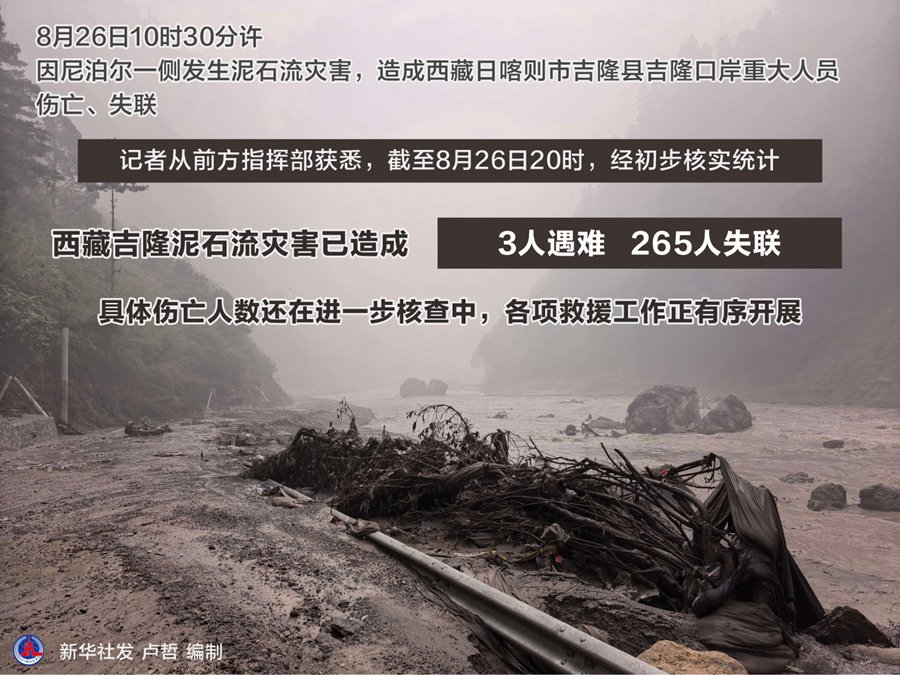
Xinhua News Agency, Lhasa, August 26 — On August 26, a mudslide struck Gyirong County in Shigatse City, Tibet. According to information obtained by a reporter from the on-site command center, as of 8:00 PM on August 26, preliminary verified statistics indicate that the mudslide has claimed the lives of three people, with 265 others still unaccounted for. The exact number of casualties is still being verified, and rescue efforts are proceeding in an orderly manner.
This was the extent of the news update, which was accompanied by a black-and-white image from the disaster scene — the same image that would appear on news reports the next day, including inset on the front page of the Southern Metropolis Daily.
Mirrors and Echoes
The Xinhua tonggao on Xi Jinping’s “important instructions” from the previous day ran directly under the masthead of the CCP’s official People’s Daily newspaper on August 27, the day after the disaster. This treatment of the story, which offered nothing beyond the official statement of action, set the pattern for coverage — to use this term generally — for days to come across not just central-level official outlets, but also across provincial and city-level CCP dailies. And in a pattern entirely unique to the Xi era, the front pages of commercial metro newspapers also closely mirrored this approach.
In fact, treatment of the story in Guangzhou’s Southern Metropolis Daily, historically one of the country’s most professional news outlets, provides a startling picture of just how compliant Chinese media were on this breaking story. On the morning of August 27, the newspaper’s front page contrasted noticeably with that of the People’s Daily, running a full-page image of the scene of the disaster, with the above-mentioned black-and-white photograph from Xinhua inset.
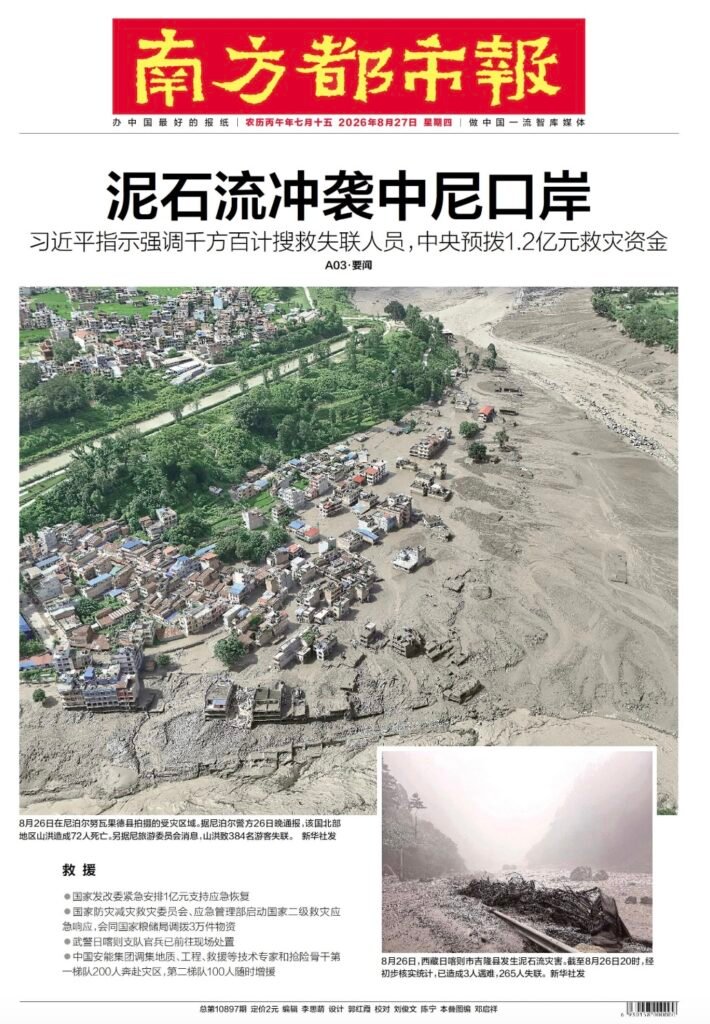
At first glance, this front page resembles the more audience-oriented approach typical of such commercial media outlets compared to their Party paper (党报) counterparts. The larger headline announces the story boldly: “Mudslide Slams China-Nepal Border Crossing” (泥石流沖袭中尼口岸). The image, meanwhile, instantly conveys a sense of the scale of the disaster.
But the content is entirely from Xinhua, and the small headline again centers the story on the top leader: “Xi Jinping’s Instructions Emphasize All Efforts Must Be Made to Find and Rescue the Missing.” A jump directs readers to page three, where the stories are again from Xinhua and China Central Television.
Even more illustrative is the fact that the Tibet-Nepal disaster never again makes the front page of the paper. The next day, August 28, a local book fair takes the entire front page, and a two-page spread based entirely on Xinhua news reports is pushed to the back of the paper. On August 29, the front page is dominated by real estate policy, and the disaster story is mentioned only at the top of page three, a verbatim reprint of the notice from the CCP Politburo meeting the previous day — a perfect mirror of the content under the masthead of the People’s Daily.
In the days that follow there is no coverage whatsoever of the disaster in the newspaper, not even echoes of Xinhua or CCTV. We might imagine that this is neglect on the part of the editors. But it is just as likely a conscientious choice responding to a desperate situation. Because independent reporting of any kind was not possible, the only option available to the outlet was to echo Party-state media from on high, which editors may have found unthinkable. Just consider: If Southern Metropolis Daily had decided to lead with the flood story for its August 29 edition, the only way to do so would have been to place the Politburo story on the front page — a complete act of capitulation.
Editors at other professionally-minded outlets across the country faced the same choice: mimic, or fall silent.
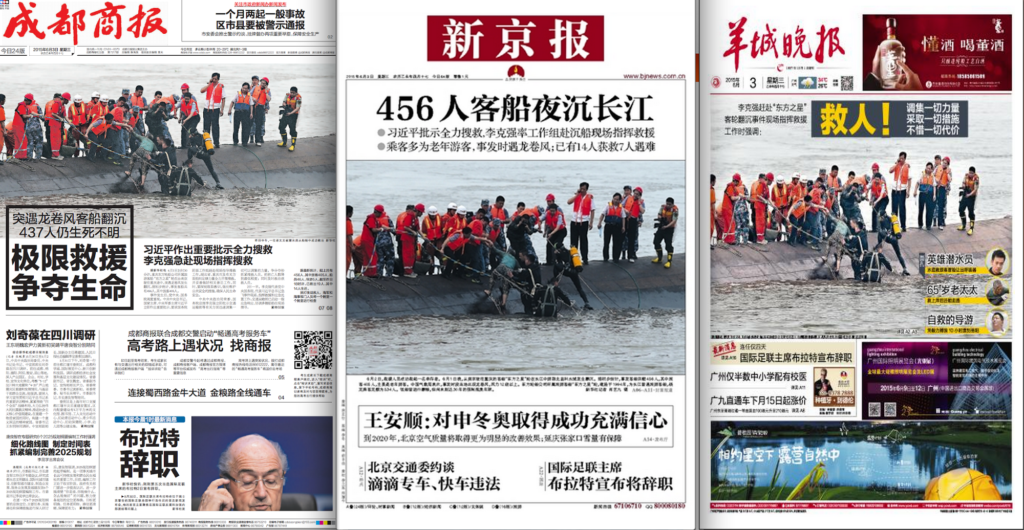
To understand the larger significance of the leadership’s information management over the past two weeks, it is crucial to recognize that this mirroring pattern is a relatively recent development in the modern history of Chinese media. The moment of pivot in the handling of disaster stories came in June 2015, by which time Xi Jinping had spent two and half years asserting an unprecedented level of control over the domestic news media. On June 1, 2015, the river cruise ship Oriental Star capsized on the Yangtze River during a thunderstorm, resulting in 442 deaths. As commercial media across the country ran the story the next day, they used identical Xinhua copy, with nearly identical page layouts — a practice that to that time had been witnessed only among Party dailies, which routinely parroted the read-outs appearing on the front page of the People’s Daily.
Stopping the Mouths
The Oriental Star cruise ship tragedy was a striking case study in news management. It showed that China’s commercial metro newspapers, which for years had developed a reputation for pushing the envelope on sensitive breaking news stories — from the 2008 Sichuan earthquake to the 2011 Wenzhou train collision — had largely been brought to heel. Once testing the lines on the periphery, they now played a primary role in amplifying the agenda from the center.
This shift, to a large extent, marked the unraveling of a consensus that had emerged in the aftermath of the 2003 SARS epidemic, the idea that information suppression carries its own catastrophic effects. Seven years before the capsizing of the Oriental Star, in the aftermath of the earthquake, Hu Jintao had built his media strategy around the idea that information must be released rapidly, with central Party-state media seizing the initiative — an approach the China Media Project at the time dubbed “Control 2.0.” This strategy, known as “public opinion channeling” (舆论引导), proved only intermittently effective during Hu Jintao’s second term. But Xi Jinping’s restraints on the commercial press, combined with draconian controls on cyberspace, arguably sealed the deal.
Xi Jinping’s formal media policy was announced like a hammer blow in February 2016, when he told journalists during a visit to the People’s Daily and CCTV that all media must be “surnamed Party” (必须姓党) — meaning they belong, unquestionably, to the Party family. This circle-the-wagons approach was stated clearly in one passage in particular:
All work of the Party’s news and public opinion media must reflect the will of the Party, mirror the views of the Party, preserve the authority of the Party, preserve the unity of the Party, and achieve love of the Party, protection of the Party and acting for the Party; they must all increase their consciousness of falling in line, maintaining a high level of uniformity with the Party in ideology, politics and action.
This work has been complemented by robust controls on the internet and social media. A more revealing example comes from a fire that broke out in April 2023 at Beijing’s Changfeng Hospital (长峰医院), killing 29 people. It took eight hours before any news of the tragedy reached news journalists and the public, despite the hospital’s location in a heavily populated district, where residents later told reporters they had posted eyewitness videos, images and accounts. The case suggested that internet controls had reached a level of sophistication capable of erasing nearly all trace of a breaking story. “In the past,” one local news reporter eventually told the Initium outlet, “at least you could see fragments of information.”
Insistent Voices
Controls on cyberspace, however insistent, can be messy, uneven and difficult to trace. In the case of the Tibet-Nepal tragedy, Chinese citizens showed the usual determination to share and discuss whatever information was available, and a good roundup of this push and pull can be found over at CDT.
Even so, we should not lose sight of the larger story: how completely and effectively first-hand information was controlled by the authorities at the central level. The personal voices of sources on the ground have been almost entirely absent from China’s narrative, part of a familiar playbook. In our timeline of coverage below, there is only one real exception: a report on August 26, the day of the tragedy, by Hunan’s Xiaoxiang Morning Herald (潇湘晨报), coming less than three hours after the initial Xinhua release. Citing basic facts from the state-run CCTV, it went on to offer exclusive reporting from a lone voice at the scene:
On the afternoon of the 26th, survivor Ms. Fang told a reporter from Xiaoxiang Morning Herald‘s Chenshipin video unit that she and her companions had planned to travel to Nepal that morning, setting out from Gyirong town. They’d originally intended to leave at 9am but were delayed until around 10am after oversleeping. Gyirong town is about 20 kilometers from Gyirong port, normally a 40-minute drive. When they reached a point about four kilometers from the port, she said: “The trees and power poles up ahead had all fallen. The floodwater came rushing at us, crushing everything in its path. We didn’t dare turn around, so we could only reverse.”
In the days that followed, this passage, shared in overseas media as well as outlets such as Phoenix Online, stood out as a rare and authentic account amid an official record built entirely from footage of self-sacrificing leaders and courageous rescuers. That a single fragment of independent reporting should stand out at all, amid the volume of central media coverage, is itself the measure of how far China’s information controls have progressed.
Over the weekend, after two weeks closely managing access to the scene in Tibet, China made its latest grand gesture of supposed openness. It invited a select group of foreign journalists on a curated tour of the area that for so many critical days had been strikingly inaccessible. In photographs released by the Foreign Ministry through foreign social media platforms blocked within China itself, journalists could be seen conducting group interviews at the scene — not with survivors, mind you, but with rescue workers.
___________________
The following interactive timeline is built on a selection of the key media reports we analyzed in our study.