Key Points
-
Warren Buffett guided the Berkshire Hathaway holding company to market-beating returns for 60 years.
-
He regularly said that everyday investors could do well by purchasing an exchange-traded fund that tracks a diversified index like the S&P 500.
-
In February 2014, Buffett specifically recommended the Vanguard S&P 500 ETF for its low fees and its ability to help young investors secure their financial future.
- 10 stocks we like better than Vanguard S&P 500 ETF ›
Warren Buffett is one of the world’s most iconic investors. He served as CEO of the Berkshire Hathaway (NYSE: BRKA) (NYSE: BRKB) holding company from 1965 to 2025, turning it into a $1 trillion conglomerate with numerous subsidiaries, a stock portfolio worth over $350 billion, and another $365 billion in cash.
Berkshire stock returned 19.7% annually during Buffett’s 60-year tenure, so an investment of $500 in 1965 would have grown to a whopping $24 million by the end of 2025. But he was a seasoned professional, so he always knew the average investor would struggle to replicate his performance. That’s why he consistently advocated exchange-traded funds (ETFs) that track a diversified index, like the S&P 500.
Missed Nvidia in 2009? This Rare Signal Is Flashing Again. In 2009, a “Double Down” signal flashed for a little-known chipmaker called Nvidia. For the first time in years, that same “Total Conviction” signal is flashing for a company 1/100th the size of Nvidia. Continue »
The Vanguard S&P 500 ETF (NYSEMKT: VOO) is one that Buffett specifically recommended in 2014 for its ultra-low fees. Here’s how it could help young investors in their 20s build a financially secure future.
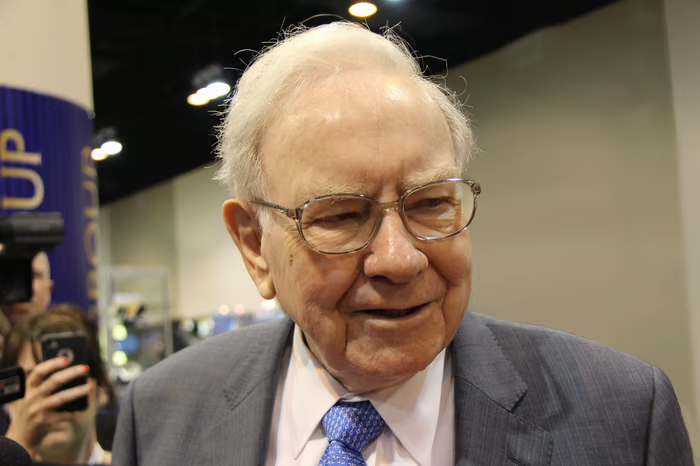
Warren Buffett. Image source: The Motley Fool.
America’s best stocks from 11 economic sectors
The S&P 500 is the most widely followed U.S. stock market index for a couple of reasons. First, it’s made up of 500 companies from 11 different sectors of the economy, so it’s highly diversified. Second, it has very strict entry criteria: its members must maintain a market capitalization of at least $22.7 billion and be profitable. But even after those boxes are ticked, a special committee ultimately decides which companies make the cut.
The S&P is weighted by market capitalization, so the largest companies in the index have a much higher representation than the smallest. Therefore, despite its diversified composition, the information technology sector has a massive weighting of 36.6% because it’s home to five companies worth $1 trillion or more (Nvidia, Apple, Microsoft, Broadcom, and Micron Technology).
Below are the 11 sectors that make up the Vanguard S&P 500 ETF, along with their weightings and the three largest companies in each.
|
S&P 500 Sector |
Sector Weighting |
Largest Companies |
|---|---|---|
|
Information technology |
36.6% |
Nvidia, Apple, Microsoft |
|
Financials |
12.5% |
Berkshire Hathaway, JPMorgan Chase, Visa |
|
Communication services |
9.9% |
Alphabet, Meta Platforms, Netflix |
|
Consumer discretionary |
9.4% |
Amazon, Tesla, Home Depot |
|
Healthcare |
9.1% |
Eli Lilly, Johnson & Johnson, AbbVie |
|
Industrials |
8.7% |
Caterpillar, GE Aerospace, RTX Corporation |
|
Consumer staples |
4.7% |
Walmart, Costco, Coca-Cola |
|
Energy |
3.4% |
ExxonMobil, Chevron, ConocoPhillips |
|
Utilities |
2.1% |
NextEra Energy, Constellation Energy, Southern Co |
|
Real estate |
1.9% |
Welltower, Prologis, Equinix |
|
Materials |
1.8% |
Linde, Newmont, Freeport-McMoRan |
Data source: Vanguard. Sector weightings are accurate as of July 31, 2026, and are subject to change.
The technology sector is exerting a particularly strong influence on the performance of the S&P 500 right now, thanks to the artificial intelligence (AI) revolution, which began to gain momentum when OpenAI’s ChatGPT application surpassed 100 million users in early 2023. In fact, if we exclude the sector’s contribution over the last three-and-a-half years, the S&P 500’s return drops from 101% to just 63%.

Simply put, the Vanguard ETF gives investors exposure to the fastest-growing area of the market in a diversified manner, which is why it’s a popular long-term investment option.
Taking Buffett’s advice could yield spectacular results
The S&P 500 has returned 10.7% since its inception in 1957 (assuming all dividends were reinvested). But it has delivered an accelerated return of 13.9% since Buffett recommended the Vanguard S&P 500 ETF in 2014, primarily thanks to the tech sector.
Past performance isn’t always a reliable indicator of future results, but a 25-year-old investor could build a very nice retirement fund using the Vanguard ETF if its historical returns persist. Below are two potential outcomes.
|
Starting Balance at Age 25 |
Compound Annual Return |
Balance at Age 65 |
|---|---|---|
|
$20,000 |
10.7% |
$1,166,634 |
|
$20,000 |
13.9% |
$3,647,362 |
Data source: Calculations by author.
Those results don’t include costs, but with an expense ratio of just 0.03%, investors would incur an annual fee of just $3 for every $10,000 they have parked in the Vanguard ETF.
To conclude, investors probably shouldn’t sell their entire position at retirement age, because compounding yields the greatest benefits over time. With a large enough balance after 40 years, the subsequent annual returns could provide a significant income to fund life after employment.
Should you buy stock in Vanguard S&P 500 ETF right now?
Before you buy stock in Vanguard S&P 500 ETF, consider this:
The Motley Fool Stock Advisor analyst team just identified what they believe are the 10 best stocks for investors to buy now… and Vanguard S&P 500 ETF wasn’t one of them. The 10 stocks that made the cut could produce monster returns in the coming years.
Consider when Netflix made this list on December 17, 2004… if you invested $1,000 at the time of our recommendation, you’d have $421,997!* Or when Nvidia made this list on April 15, 2005… if you invested $1,000 at the time of our recommendation, you’d have $1,413,876!*
Now, it’s worth noting Stock Advisor’s total average return is 978% — a market-crushing outperformance compared to 213% for the S&P 500. Don’t miss the latest top 10 list, available with Stock Advisor, and join an investing community built by individual investors for individual investors.
*Stock Advisor returns as of September 8, 2026.
JPMorgan Chase is an advertising partner of Motley Fool Money. Anthony Di Pizio has no position in any of the stocks mentioned. The Motley Fool has positions in and recommends AbbVie, Alphabet, Amazon, Apple, Berkshire Hathaway, Broadcom, Caterpillar, Chevron, Constellation Energy, Costco Wholesale, Eli Lilly, Equinix, GE Aerospace, Home Depot, JPMorgan Chase, Meta Platforms, Micron Technology, Microsoft, Netflix, NextEra Energy, Nvidia, Prologis, RTX, Tesla, Vanguard S&P 500 ETF, Visa, and Walmart. The Motley Fool recommends ConocoPhillips, Johnson & Johnson, and Linde. The Motley Fool has a disclosure policy.