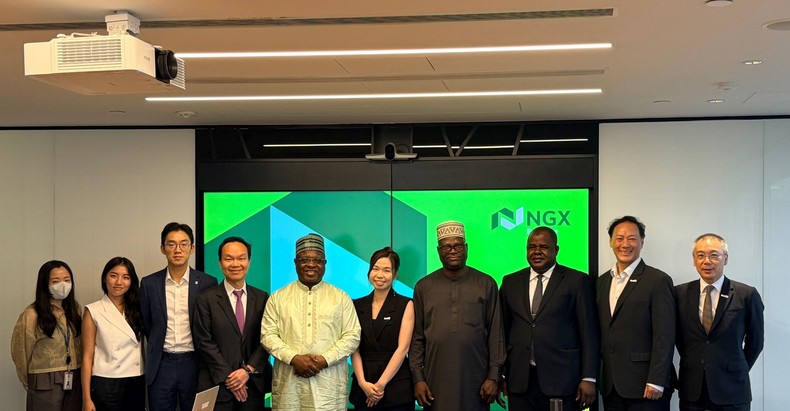
Umaru Kwairanga, chairman of Nigerian Exchange Group, presented the proposal during meetings with Hong Kong Exchanges and Clearing, Invest Hong Kong and Bank of China International on Wednesday.
Kwairanga said Chinese companies operating in Nigeria, particularly in construction and mineral resources, could pursue dual listings on the Nigerian Exchange to raise capital locally and give Nigerian investors ownership stakes in their businesses.
“NGX would be willing to listen and assist any interested companies,” Kwairanga said in a summary of the meetings.
The proposal could mark an important shift in Nigeria’s commercial relationship with China. Chinese companies have secured major contracts and investments across the country, but much of that economic presence is not represented on Nigeria’s public equity market.
A dual listing would allow shares of an eligible Chinese company already traded on another exchange to be bought and sold in Nigeria. Beyond providing another source of capital, the arrangement could give local investors greater exposure to companies earning revenue from Nigerian projects.
However, the Hong Kong engagements remain preliminary. No Chinese company has publicly committed to an NGX listing, and the plan would require cooperation between regulators, exchanges and prospective issuers.
Nigeria looks beyond domestic capital
The push comes as Nigeria’s stock market expands rapidly but continues to attract a comparatively limited share of foreign participation.
Transactions on the NGX reached approximately ₦9.6 trillion, about $7 billion, during the first half of 2026, according to the exchange’s domestic and foreign portfolio investment data.
Domestic investors accounted for ₦8.44 trillion, or nearly 88% of trading, while foreign transactions stood at about ₦1.16 trillion, representing just over 12%.
Foreign inflows also remained weaker than outflows in June. Overseas investors brought approximately ₦71.7 billion into the market while withdrawing ₦115.1 billion, leaving a monthly net outflow of ₦43.4 billion.
That imbalance illustrates the challenge behind the Hong Kong outreach. Nigeria’s equity market has grown substantially, with its capitalisation crossing ₦100 trillion in January, but the rally has been funded mainly by pension funds, asset managers, institutional investors and other domestic participants.
Attracting Hong Kong institutions could broaden the investor base and increase the foreign currency available to Nigerian companies, while reducing the market’s reliance on local liquidity.
NGX also proposed a formal Nigeria–Hong Kong capital corridor, joint investor roadshows and a listing-readiness programme to help Nigerian companies meet international requirements covering governance, disclosure and investor relations.
Kwairanga urged Hong Kong financial institutions to establish representative offices in Lagos and develop financing products for Nigerian businesses that import machinery and other goods from mainland China and Hong Kong.
China is already Nigeria’s biggest source of imported goods. National Bureau of Statistics data showed that it remained the country’s leading import partner in the first quarter of 2025, underlining the importance of trade-finance and foreign-exchange links between both economies.
Dangote Refinery could test Asian demand
NGX is also using the proposed listing of the Dangote Petroleum Refinery to pitch Nigeria’s market to Asian investors.
Kwairanga described the refinery’s planned initial public offering as a transaction with an international dimension that could interest investors in Asia.
The $20 billion refinery has a processing capacity of 650,000 barrels per day and has begun reshaping fuel supply and trading across West Africa. A successful listing would bring one of the continent’s largest industrial assets onto Nigeria’s public market.
It could also provide an early test of whether NGX can translate its Hong Kong outreach into meaningful Asian participation.
For now, the initiative is a strategic proposal rather than a completed capital-market agreement. Its success will ultimately depend on whether NGX can secure regulatory coordination and persuade large Chinese businesses that a Nigerian listing offers enough liquidity, investor demand and commercial value to justify the additional compliance burden.