[The content of this article has been produced by our advertising partner.]
Well before dawn, vans begin to pull up along Flower Market Road. Buckets of lilies and roses are lifted onto the street, hands moving quickly before the heat sets in. Later in the day buyers drift between shops, some with lists, others guided by scent and colour. These daily rituals have shaped the Flower Market’s identity as Hong Kong’s most vibrant floral destination.
Day after day and year after year, that constancy has also exposed the limits of an ageing setting. Buildings are worn, streets are congested due to a lack of parking spaces, and narrow pavements struggle to cope with foot traffic and deliveries at the same time. Over time, the question of how the market can continue to develop under these conditions has become harder to ignore.
In response, the Urban Renewal Authority has taken a district-based approach to renewal, intended to create more workable conditions for the Flower Market while keeping its existing character intact.
A blended approach to renewal
In doing so, the URA has adopted the Integrated Approach to renewing the Flower Market area, covering redevelopment, rehabilitation, preservation and revitalisation works. The focus is on improving the built environment while enhancing existing economic and social activity.
Over the past two years, efforts have been made to maintain activity in the district as plans progress. Seasonal decorations and festive installations were introduced during peak periods, alongside joint promotions with market merchants to draw visitors into the area. These initiatives aimed to support footfall and increase spending in the region.
Earlier this month, a significant experiment took place. The “Flower Market Festival: Coffee Blossoms”, the first of its kind in the Flower Market, was held in the open area of the Mong Kok Stadium adjacent to the Flower Market, attracting around 9,100 visitors over the weekend.
Co-organised with the GDCD Association and supported by community partners, the event featured over a dozen coffee and dessert stalls. More than 20 flower shops from the Flower Market offered discounts to visitors who crossed between the market and the festival site.
Traders reported increased foot traffic compared to an ordinary weekend, with some seeing corresponding rises in sales. The event demonstrated how place-making activities, supported by community participation, could help the area keep vibrant while longer-term changes are prepared.
New operating space for flower shop operators affected by redevelopment
Provisions have been made to allow affected shop operators to remain in the area throughout redevelopment.
The Sai Yee Street/Flower Market Road Development Scheme has recently entered the acquisition stage. With businesses facing relocation during this phase, a designated operating space is planned along Flower Market Road, located at the heart of the Flower Market.
Designed to accommodate all affected flower businesses together, the space allows them to continue operating within the district rather than disperse elsewhere.
The layout has been planned to address some of the everyday frustrations faced by florists at the Flower Market. Ground-level display areas will allow flowers to be shown without spilling onto pavements, reducing friction between shop operations and passing customers.
The space is also intended to host fairs and small-scale performances, helping to draw visitors and support street activity during redevelopment. Alongside this, the URA plans to work with operators to explore business opportunities that reinforce the Flower Market’s character and support its longer-term direction.
At the same time, discussions with the Transport Department have focused on providing additional loading and unloading bays on Flower Market Road, where limited stopping space has long caused operational difficulties.
Planning for future growth
Looking ahead, the redevelopment will include a large underground car park to address illegal parking and road blockages that have made access difficult for drivers purchasing flowers in bulk. Easier access is expected to benefit both traders and customers, particularly during busy seasons.
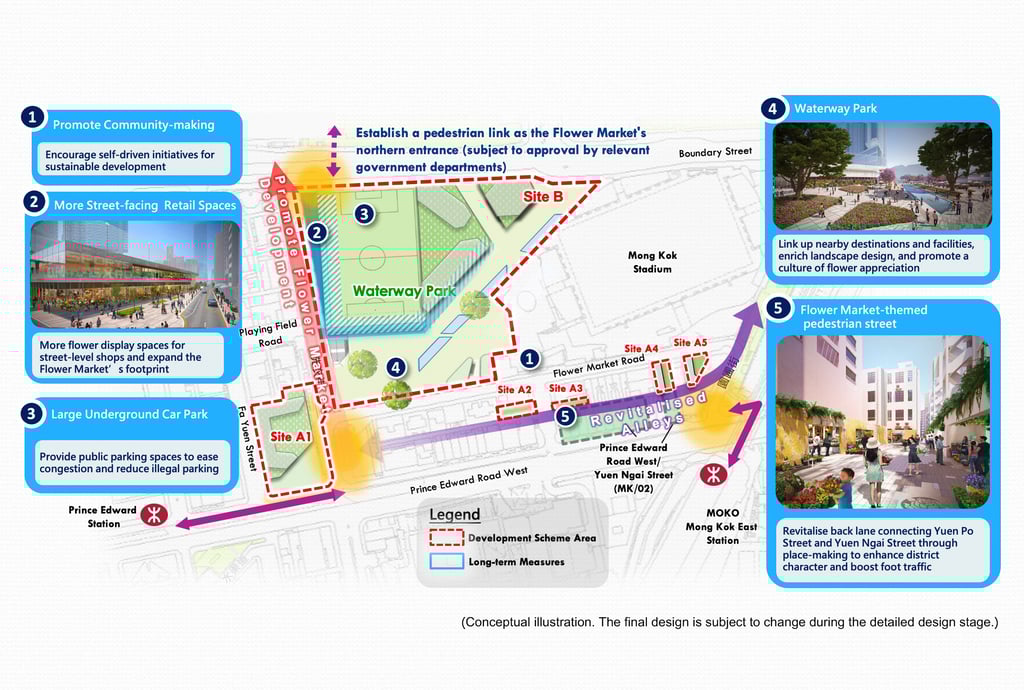
A multi-purpose complex is also planned. To the north of Sai Yee Street, new street-front shops themed around floristry and horticulture are expected to form part of the ground-level frontage.
By increasing the available space for flower-related trade, the physical footprint of the market will expand, allowing activities to spread out rather than becoming further compressed into the already narrow streets.
Community participation and shared ownership
Community participation is regarded as an essential part of sustainable development, alongside physical and environmental improvements.
Drawing on experience from the URA’s Staunton Street/Shing Wong Street revitalisation project, the URA has engaged the Hong Kong Social Venture Fund as a consultant, whose role is to support residents, florists and district groups in the Flower Market as they explore ways to initiate and guide renewal efforts on their own, with a view to sustaining the area over the longer term.
Humanising urban renewal
Renewal of the Flower Market is being approached as a long-term response to the pressures facing the area, with the intention of supporting a larger and more sustainable marketplace over time.
Concerns that the initiative could damage or erase the market’s character have been raised. The renewal, however, has been planned to retain the features that define how the Flower Market operates, while improving access and resilience.
Early morning deliveries and familiar daily exchanges are expected to continue, even as the physical setting becomes easier to move through and better able to adapt to future demands. In this way, regeneration reflects how people live alongside, depend on and care for the places they use every day.