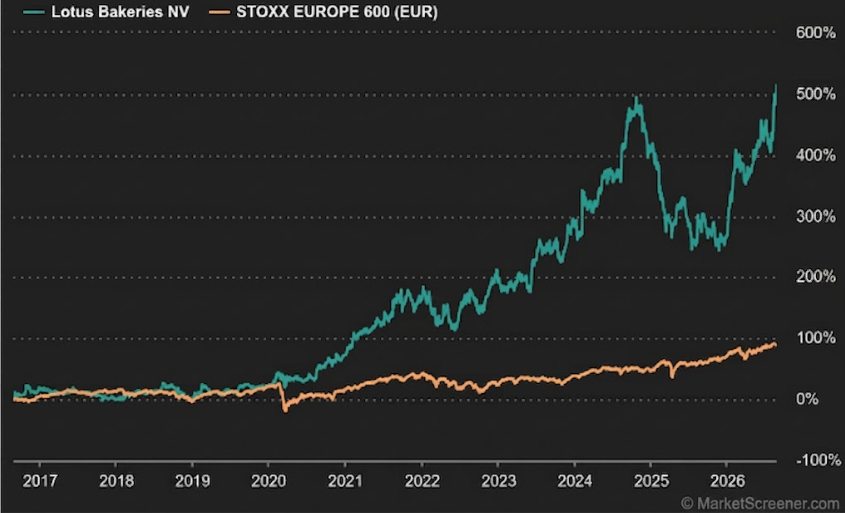
Lotus Bakeries shares topped the EUR13,000 mark this week to set a new record. The Belgian company is not only one of the most expensive stocks on European exchanges, it is also one of the richest-valued: 52x this year’s expected earnings. That’s the same multiple as names such as Robinhood, Salesforce and Dell.
52x earnings is already fairly expensive for the tech sector. However, it’s really taking the biscuit for a cookie maker. Because Lotus Bakeries is best known for its speculoos, those brown-sugar biscuits from Flanders that go with coffee just about everywhere worldwide. This valuation is not the result of a temporary dip in profits: investors have long paid top dollar to buy a Lotus Bakeries share. The stock has traded at an average P/E of 40x over the past 10 years.
The group primarily leans on Lotus Biscoff, whose speculoos has established itself as a global brand. This strong position, difficult to attack, enables it to combine steady growth, robust margins and high brand recognition. But Lotus Bakeries is not resting on its flagship product. The group has diversified into healthy snacking with Natural Foods and built a portfolio of local specialties in Europe. Added to these growth drivers is international expansion, which still offers significant runway in many markets.
Do not confuse speculation with speculoos
This strategy has enabled Lotus to deliver double-digit annual growth over the past seven fiscal years. With margins that are remarkably solid (around 15% operating margin), profits have posted a nice upward slope, consistently steady. That is the main reason for investors’ passion for this stock, which defies gravity and traditional valuation models.
Even so, caution is warranted: 2025 (-27%) was a reminder that at these valuation levels, the slightest misstep is punished immediately. But the long track record argues in favor of a story that has seen only two declines over the past 25 years.
Nota Bene: the most expensive stock on European exchanges is Swiss chocolatier Lindt (CHF 92,800, or nearly €100,000), ahead of Eurofins Cerep (€16,300, but with near-zero liquidity).