Key Points
SpaceX (NASDAQ: SPCX), Tesla (NASDAQ: TSLA), and Intel (NASDAQ: INTC) recently broke ground on the Terafab, the world’s largest vertically integrated chipmaking factory. The massive plant is located in Grimes County, approximately 70 miles outside of Houston.
The initial phase of the Terafab will cost $16.8 billion, while its total costs across all phases could surpass $119 billion. Upon completion, the 100-million-square-foot facility will meet SpaceX and Tesla’s projected computing demand of more than 1 terawatt per year.
Missed Nvidia in 2009? This Rare Signal Is Flashing Again. In 2009, a “Double Down” signal flashed for a little-known chipmaker called Nvidia. For the first time in years, that same “Total Conviction” signal is flashing for a company 1/100th the size of Nvidia. Continue »
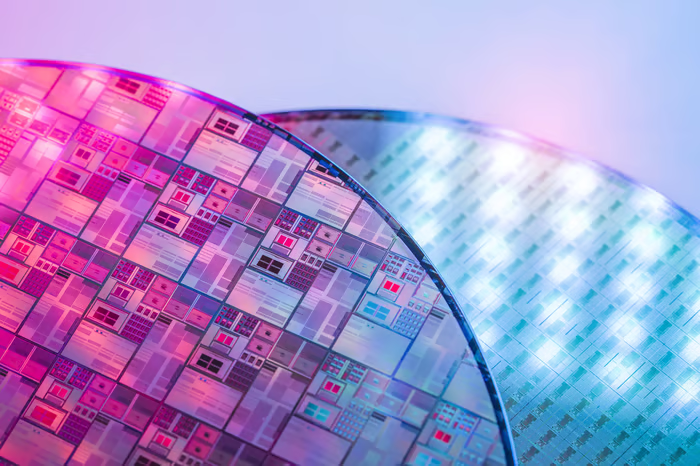
Image source: Getty Images.
What will the Terafab mean for SpaceX’s investors?
SpaceX and Tesla will fund the plant’s construction, while Intel will support its development with its licensed chipmaking process and foundry operations. SpaceX and Tesla haven’t disclosed the exact dollar-for-dollar equity split for the project, but SpaceX will absorb a larger portion of those costs because it will claim more of those chips. Approximately 75% of the Terafab’s chips will be allocated to SpaceX’s orbital data centers and satellite constellations, while the remaining 25% will power Tesla’s Optimus robots, self-driving vehicles, and Cybercabs.
Those chips could help SpaceX achieve Elon Musk’s ambitious goal of becoming the first company to generate over $1 trillion in annual revenue by 2030. To achieve that goal, SpaceX would need its Starlink, rocket launch, and AI businesses to grow exponentially.
But that expansion will be costly. Texas is supporting the Terafab’s construction with a $30 million grant and tax abatements, but that’s a drop in the pond compared to SpaceX’s capex. In the second quarter of 2026, SpaceX’s capex surged more than sixfold year over year, from $2.8 billion to $18.4 billion. It allocated $15.8 billion of that spending to expanding its AI business by buying more AI chips and building more data centers. Those expenses will rise even higher as it expands the Terafab over the next few years.
Is this a red flag or a green flag for SpaceX?
SpaceX’s stock still trades near its IPO price. But with a market cap of $1.84 trillion, it still looks expensive at 41 times this year’s sales. To justify that premium valuation, SpaceX would need to grow like a weed — and possibly hit Musk’s $1 trillion goal — through the end of the decade.
It can’t accomplish that with timid, cost-conscious moves. It needs to make massive, forward-thinking investments — like the Terafab — to sow the seeds for future growth. While Terafab’s price tag seems steep, it’s a necessary investment to consolidate its chipmaking supply chain and eliminate its dependence on third-party foundries. Therefore, I think it’s a smart move that makes SpaceX a better long-term play on the nascent space sector.
Should you buy stock in Space Exploration Technologies right now?
Before you buy stock in Space Exploration Technologies, consider this:
The Motley Fool Stock Advisor analyst team just identified what they believe are the 10 best stocks for investors to buy now… and Space Exploration Technologies wasn’t one of them. The 10 stocks that made the cut could produce monster returns in the coming years.
Consider when Netflix made this list on December 17, 2004… if you invested $1,000 at the time of our recommendation, you’d have $431,488!* Or when Nvidia made this list on April 15, 2005… if you invested $1,000 at the time of our recommendation, you’d have $1,279,584!*
Now, it’s worth noting Stock Advisor’s total average return is 958% — a market-crushing outperformance compared to 212% for the S&P 500. Don’t miss the latest top 10 list, available with Stock Advisor, and join an investing community built by individual investors for individual investors.
*Stock Advisor returns as of August 25, 2026.
Leo Sun has no position in any of the stocks mentioned. The Motley Fool has positions in and recommends Intel and Tesla. The Motley Fool has a disclosure policy.