July 21, 2026
We were best friends. Great neighbours. Our economies intertwined and we sold lots of things to one another. Crossing the border felt more like visiting a relative than entering a different country.
Canadians wanted to, and expected to, have a good relationship with the US. Friendly but independent.
Through Reagan, Bush, Clinton, Obama, and Biden, bilateral relations ran along a spectrum that was never cooler than cordial and mostly better described as warm.
We were never a big topic of conversation in America and we were happy enough with that.
If we didn’t always agree with what America was up to, we didn’t obsess about what America would do next, and that was okay, too.
All of that is gone now. Because there’s never been a president like Donald Trump.
Trump has trash-talked Canada relentlessly. His comments are aggressive, petulant, foolish, incoherent, uninformed and those are the kindest things one could say about them.
He’ll probably never realize it, but the damage he’s doing to his own country is real, and will endure for some time.
America is not the world’s “hottest country” as Trump likes to say. America is now a word uttered with a curled lip in many parts of the world.
Perhaps it’s some comfort that Canada is not the only target — the list of countries spared this treatment (Russia and North Korea come to mind) is short. Trump’s list of ‘shithole’ countries now includes most of Western Europe. But Trump lives right next door to us, and the insults hit differently.
In NFL football, there’s a 15-yard penalty for ‘taunting’. If there were a penalty in U.S. politics for taunting, Trump would be flagged every day.
Among the latest salvos from the U.S. president is the one about forest fires. Canadians know that climate change is increasing the risk and severity of wildfires. Trump thinks climate change is a hoax. Trump loves a culture-war distraction the way a junkie loves a narcotic.
It’s tempting to want a sharp retort from Canada’s Prime Minister. People want their feelings heard, and expressed, by their leadership. Some want more transparency from Carney when it comes to the relationship with the U.S., almost like a play-by-play coverage.
“When did you last talk? What exactly did you say to him and how did he come across? What are you willing to discuss in terms of our trade irritants and what are you ruling off-the-table? Why aren’t you demanding a meeting right now? What exactly happened with the Gordie Howe Bridge deal? Why won’t you tell Canadians all of the details of each interaction? Why aren’t your elbows up? Why aren’t you more conciliatory?”
All normal and healthy questions. It would be a weakness of our democracy if this wasn’t part of the conversation in Canada today.
This is what makes the job of leading more complicated now.
While a lack of transparency can be an awkward look, sometimes it’s the best among less-than-ideal options.
Spell Canada’s position out publicly, and Trump will use it against us. That’s true for our negotiating options around CUSMA, and also the interplay of the original Gordie Howe deal and its side agreement.
Nothing is final in Trump’s world, and Canada must be willing to play by those rules too, at least to a degree.
In NFL football, there’s a 15-yard penalty for “taunting”. If there were a penalty in U.S. politics for taunting, Trump would be flagged every day.
Part of the job of being Canadian Prime Minister today is to exert a duty of care in how you respond to that taunting. To hold cards close to your chest, and choose when and how to engage.
Our polling suggests a broad majority (70%) is satisfied with the way the Prime Minister is handling the relationship.
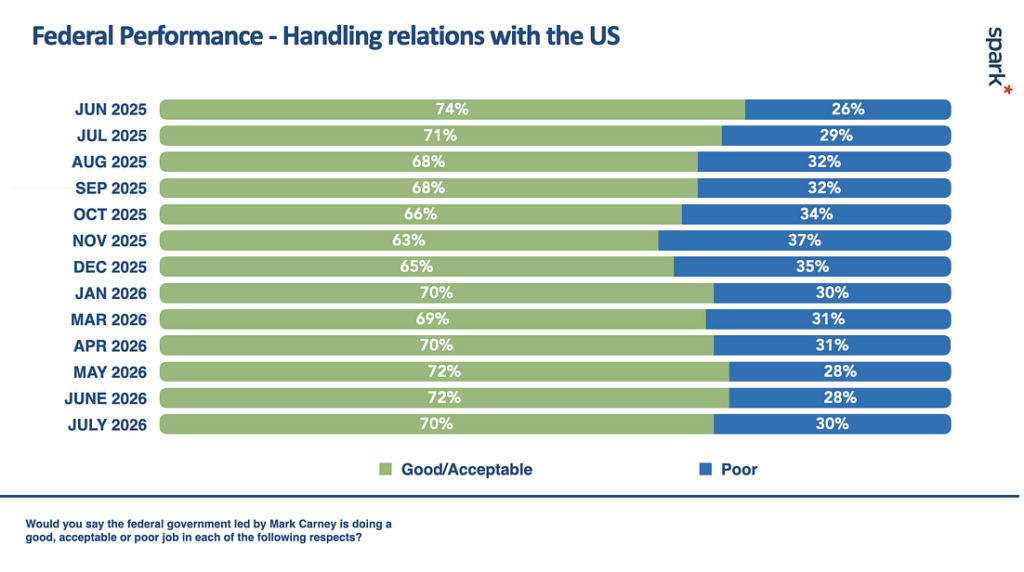
They may not be happy but they can’t imagine a better approach than the one they see Carney taking. They can see where the problem lies — the unpredictability, irrationality and temperamental behaviour is on display daily. Canadians are willing to be patient to get better results.
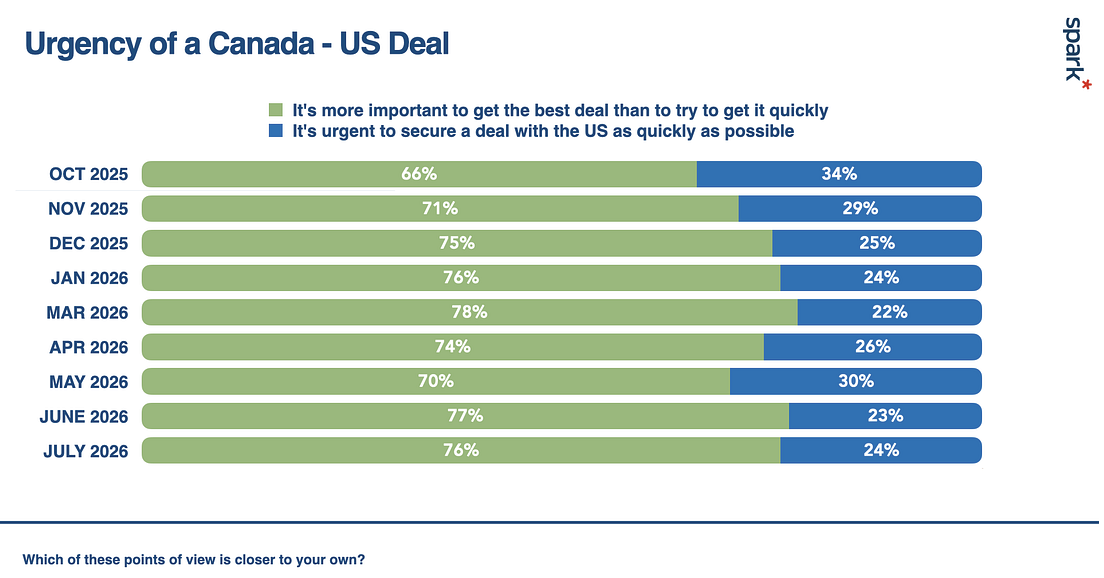
When it comes to what should guide the country’s choices — the political performance doesn’t matter, the job is about the outcome. Canadians would rather wait for the right trade deal than rush to resolve the friction.
Hopefully, there will be another day when America’s leader wants a solid, neighbourly relationship again. When repairs to what’s been damaged are a priority, and both countries meet in good faith to start that work.
Canada’s political leaders are expected to imagine that opportunity will come, and represent our country in a way that allows for that outcome, down the road.
Policy Contributor Bruce Anderson is Founding Partner and Chief Strategy Officer of Spark Advocacy. He has been a pollster, political strategist and communications advisor for more than 40 years and is a regular on The Bridge podcasts. He was an active supporter of Mark Carney during the Liberal leadership campaign and federal election.