It’s not like watching Brazil. Not the one we saw in grainy colour at the Azteca in 1970. Nor is it what the ad agencies call jogo bonito either, the marketing strategy and flair associated with the Brazil teams from the late ’90s and early ’00s when they last won the World Cup.
So what is it?
When Carlo Ancelotti isn’t answering questions about Neymar’s fitness or what Endrick has to do in order to start for Brazil, he is repeatedly asked about the team’s identity. What’s his big idea for Brazil? Where’s the philosophy? Should Brazil have a brand of football?
“We only pay attention to one team when we watch the game,” Folha de Sao Paulo columnist, Idelber Avelar, noted.
Ancelotti has tried to be romantic about it. Before the World Cup began, he spoke about how the Rio carnival serves as an inspiration, a metaphor for the nation.
“You see Brazil in the carnival,” he said. “It comes across first of all in the allegria; the boundless energy and desire to be together; and the superb organisation, because the carnival — especially the one in Rio — is a perfectly-oiled machine in terms of timing, event planning and stage design. This is Brazil. I’d like to add a note on humility too because this is what characterises a truly wonderful country.”
The challenge, as he saw it, was to reflect this spirit in the team and win. Because winning, more than anything, is Brazil’s identity. Ancelotti’s son, Davide, understood this during his brief spell in charge of Botofogo.
“The average tenure of a coach in Brazil is four months,” he told Il Tripletta podcast. Clubs are demanding. Fanbases are used to success. Five of the last six Copa Libertadores finals have been all-Brazilian affairs. The country expects the sexta; a sixth World Cup. How are they going to do it, though? And is by any means possible OK? Ancelotti believes it should suffice. Often portrayed as diametrically opposed, Brazilian and Italian culture have this in common.
“Brazil has many identities,” Ancelotti said. “I don’t want a clear identity for the team, because my team has to do many things. I want my team to be able to do many things: defend with a low block, attack, make the most of the players’ quality, be aggressive up front, drop back, be defensive in their own area…” Did it satisfy Ancelotti’s detractors, the ones calling for more definition and conformity to the Brazil inhabiting our collective imagination? It did not.
But Brazil are beginning to take form. There is a shape to their games. Vinicius Junior has stepped up, finding the net in every group stage game. Clean sheets have been kept against Haiti in Philadelphia and Scotland in Miami. The scoreline — 3-0 — was also symmetric. For those wanting patterns of play, have you seen the goals Brazil score? A lot of them are the same.
“Many of the goals we scored in this match came from tackles and regaining possessions,” he said
Watching Ancelotti’s Brazil is not exactly like tuning into a gegenpressing side from Germany. The “humility” Ancelotti talks about is discernible in their willingness to stand off opponents and let them, at times, have the ball. Scotland, for instance, completed more than 400 passes at the Hard Rock.
Brazil pick their moments. They pick teams’ pockets time and time again.
For all the hand-wringing at Scott McKenna getting caught on the ball by Rayan in the lead-up to Vinicius Jr’s opener against Scotland or the way Vinicius stole possession from Jack Hendry for a disallowed second, this is what Ancelotti’s Brazil do. Written off as ineptitude on the centre-backs’ part, it is also targeted and coordinated.
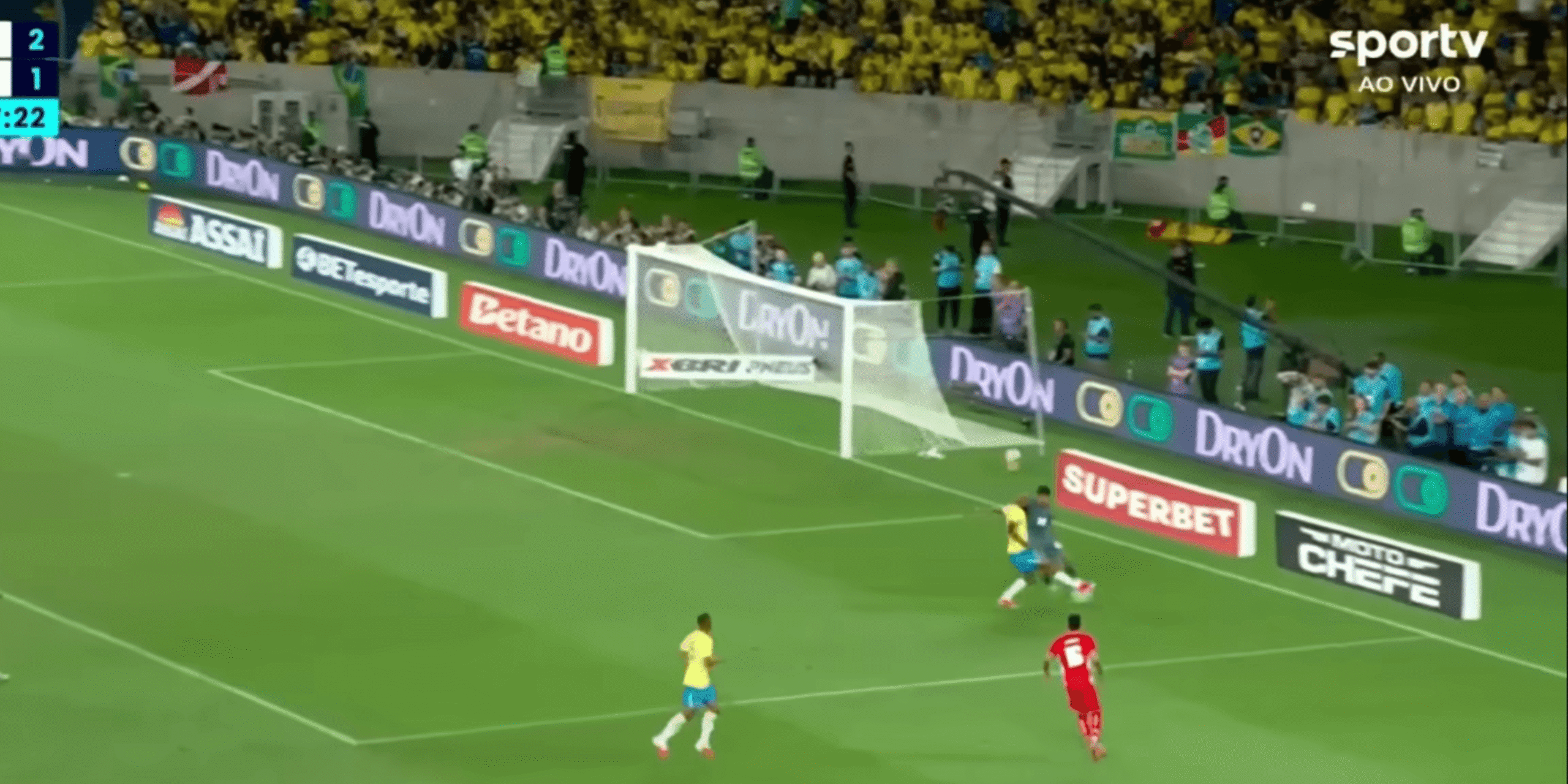
In the warm-up game against Panama in May, Rayan and Igor Thiago hunted down goalkeeper Orlando Mosquera, a swarm of Killer Bees from Bournemouth and Brentford.
Rushed into a pass by Thiago, the press forced Mosquera into a mistake.
And Rayan was only too happy to curl a shot into an empty net.

Against Egypt in their final friendly before the World Cup, Brazil pounced again. This time, Bruno Guimaraes hustled high up the pitch and was rewarded with a goal.

Later in the game, the winner came from Matheus Cunha leading another press. All Raphinha then had to do was play a cut-back for an Endrick tap-in.

“It’s going to be a World Cup of intensity,” Ancelotti claims. The heat and humidity were expected to make it very hard to keep that intensity high from kick-off to final whistle in the U.S. Over time, accumulated fatigue will play a role. For now, however, the length of time between games and the hydration breaks have helped Brazil, even if they continue to take a measured approach.
Two of their three goals against Haiti at Lincoln Financial Field were also the culmination of Brazil players’ reading their opponents’ intentions and making them pay. The first goal of Cunha’s brace was the result of him guessing a pass before releasing Vinicius and joining in the attack.

The second followed a familiar sequence, as Lucas Paqueta snuck up behind a Haitian midfielder, wrested the ball away from him and swiftly set Vinicius Jr free. It was Vinicius who then played in Cunha for an emphatic left-foot finish at the near post.

After progressing to the round of 32 as group winners, Ancelotti could sense the mood around the team has changed. He told everyone back in Brazil to stay calm, “very calm”. When it came to identity, he acknowledged the curiosity aroused by an Italian singing the Brazil national anthem.
“It’s difficult learning the words,” he said. “But I enjoy singing them.”
This was yet another show of respect for Brazil’s culture, their winning DNA. In 1994 and 2002, Ancelotti believes Brazil won World Cups not by being flashy, but by being solid. The first of those wins featured Dunga and Mauro Silva in midfield. The second Kleberson and Gilberto Silva.
Many still don’t believe, even with Vinicius Jr in this kind of scintillating form, that the current team has the same calibre of player up front or between the lines as in those cases. But today, maybe Brazil’s best playmaker is their press. It worked against Haiti and Scotland. It also, lest we forget, left something to be desired against Morocco.
Ultimately, the seven points Brazil collected in the group stage meant far more to Ancelotti than style points in the papers. “The goal is not to play well,” he said. “The goal is to win.”
Get free access to the most comprehensive World Cup coverage in The Athletic app