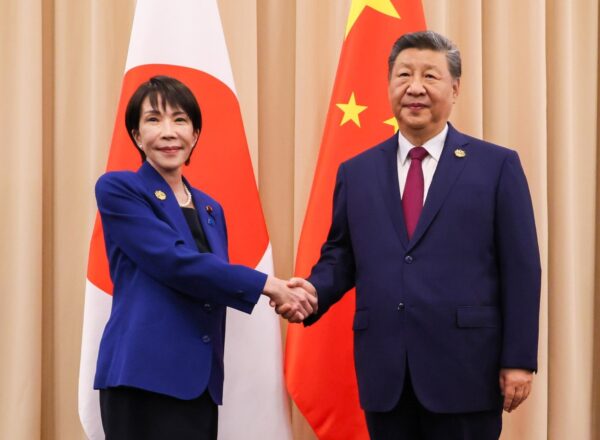
Since Japanese Prime Minister Takaichi Sanae’s remarks on November 7, 2025, Japan-China relations have continued to deteriorate, with no signs of a return to normalcy. The APEC summit is scheduled for November 2026, and while Takaichi and Chinese President Xi Jinping are likely to attend, the likelihood of an actual bilateral meeting is very low. With personnel changes expected at the National Congress of the Communist Party of China in the fall of 2027, Japan-China relations are not likely to change dramatically, at least until these changes are finalized. On the contrary, given the structure of China’s foreign policy, U.S.-China relations, and Japan-China relations, there is a real possibility that the current deterioration will become the new normal.
This is a difficult reality for Japan, which seeks stable relations with its neighbors and a secure strategic environment. But accepting the new normal, and working to manage the situation while preventing further deterioration, is now the more prudent course.
First, there is the underlying thrust of China’s foreign policy. China aims to achieve the “great rejuvenation of the Chinese nation” by 2049, effectively seeking to catch up with the United States; 2035 is set as an intermediate milestone. Beijing opposes the U.S.-centered world order and takes a critical stance toward Western values and the U.S.-led approach to security, while supporting the United Nations Charter (at least as interpreted by Beijing), international law, and the U.N. and its subsidiary organizations. China states that it will independently construct an international order based on concepts such as a “new type of international relations.” From the Chinese perspective, the central axis of global conflict is between developed and developing nations. Viewed in this light, Japan, as a U.S. ally, becomes a target for structural criticism; and Japan, which hosts more overseas U.S. troops than any other country and serves as a key U.S. military hub in the Western Pacific, faces particularly intense scrutiny.
Second, U.S.-China relations. While China aims to catch up to the United States and pursues a foreign policy directed at Washington, it also seeks to avoid a direct clash. This is why U.S.-China relations are described as a “competition.” Under Biden, the relationship was characterized as competitive, with the understanding that the two sides would not clash, would cooperate where possible, and would manage relations appropriately. Under Trump’s second term, the May 2026 U.S.-China summit produced the formulation “constructive strategic stability relationship”: competitive in premise, but maintaining the same basic tone of avoiding direct clashes, cooperating where necessary, and managing the relationship. If U.S.-China relations remain relatively stable, China will be freer to adopt a tougher stance toward U.S. allies. With China’s strategic focus on the Western Pacific and Taiwan as a key objective, Japan, with its strong U.S. security ties and historically close relationship with Taiwan, faces growing Chinese wariness. The main focus of Beijing’s criticism of Takaichi lies with Taiwan and her security policies; China is significantly intensifying its propaganda, both domestically and internationally, on both counts.
Third, structural changes in Japan-China relations. The disparity in national power is now stark: the two countries’ positions are almost completely reversed from 20 years ago, with China’s economy now more than four times the size of Japan’s. While China is one of Japan’s largest trading partners, Japan is not particularly significant to China. And as economic security takes center stage, the old separation of politics and economics no longer holds. Even in Japan, where nearly 90 percent of the population is critical of China, more than 60 percent recognize that the relationship matters. In China, by contrast, both sentiment toward Japan and perceptions of its importance have deteriorated sharply in recent years. Under these conditions, the impetus to normalize relations is unlikely to come, least of all from the Chinese side. There is a further complication: the four basic documents governing Japan-China relations, including the 1972 Japan-China Joint Communiqué, were all negotiated when China’s economy was smaller than Japan’s. No framework reflecting the current balance of power has been established; the relationship, as it actually exists today, has yet to be defined on paper.
Fourth, domestic political conditions in both countries. In Japan, any call to prioritize dialogue with China is quickly denounced on social media as “pro-China,” creating a significant disincentive for politicians and businesses to push for normalization. In China, criticism of Japan and of Takaichi, often framed around “new militarism,” is being disseminated more widely than ever, through both state propaganda and social media. Under these conditions, making the case for the importance of Japan-China relations, let alone for normalization, has become considerably harder on both sides.
Other factors are at play as well, but the structural picture alone makes normalization of Japan-China relations extremely difficult to foresee. As such, the more pragmatic approach for Japan may be to accept the situation as given and focus on preventing a further escalation or worst-case outcome. This approach would entail a broad range of measures: strengthening security capabilities, yes, but also maintaining direct lines of communication and deepening cooperation and information-sharing with Japan’s neighbors.