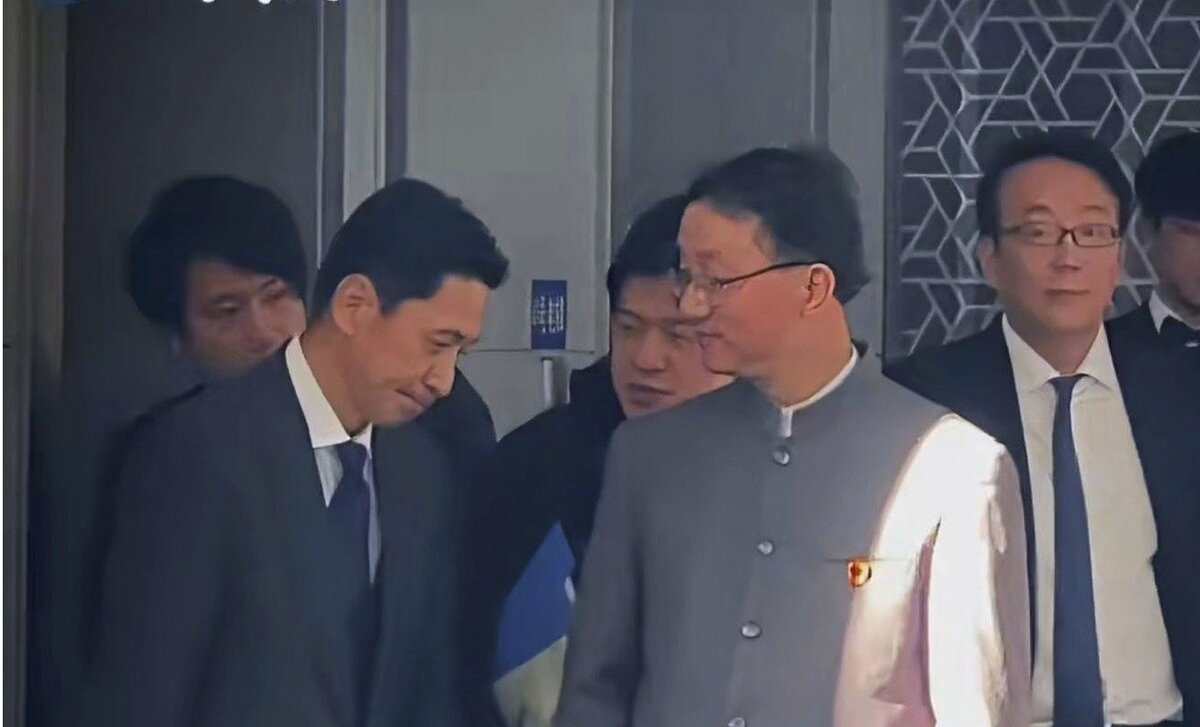
BEIJING – Images of a senior Japanese official appearing to bow before his Chinese counterpart have gone viral on Chinese social media, prompting Tokyo to lodge a complaint with Beijing on Wednesday over “uncoordinated” press arrangements.
The shots show Masaaki Kanai, head of the Japanese Foreign Ministry’s Asian and Oceanian Affairs Bureau, standing with his counterpart, Liu Jinsong, following their talks Tuesday at the Chinese Foreign Ministry.
Japanese Chief Cabinet Secretary Minou Kihara said in Tokyo the Japanese side had not been informed about press coverage of the postmeeting scenes, which show Liu, head of the Chinese Foreign Ministry’s Asian Affairs Department, with his hands in his pockets.
In the meeting, the two failed to bridge the two countries’ differences over Japanese Prime Minister Sanae Takaichi’s recent remarks on Taiwan that triggered a bilateral diplomatic row.
Some Chinese social media users reacted to the images, commending them as “the best shots” this year and saying Liu “looks like a teacher scolding a student who failed an exam.”
Meanwhile, China and Japan traded barbs at the United Nations on Tuesday. A Chinese envoy lambasted Takaichi’s remarks and claimed Tokyo is “totally unqualified to seek a permanent seat on the Security Council,” according to the official Xinhua News Agency.
A Japanese representative countered the comments by Fu Cong, China’s permanent representative to the United Nations, saying they were groundless and that Tokyo has contributed to maintaining peace and prosperity in the world.
The war of words took place at the U.N. General Assembly’s annual debate on Security Council reform. Japan aims to expand the current permanent membership of five nations — the United States, Britain, China, France, Russia — and become a new member.
Takaichi’s comments made at Japan’s parliament on Nov. 7 suggested a potential response by Japanese defense forces in the event of a Taiwan contingency.
China regards the self-ruled democratic island as a renegade province to be unified with the mainland, by force if necessary, insisting that the Taiwan issue is purely an “internal affair.”
The escalating diplomatic spat has begun to affect personnel exchanges, tourism, education and the entertainment sectors between the two Asian neighbors.
