Imagine this: you’re at a bookstore, and Norah Jones, or maybe The Cranberries, is playing softly in the background. You stand on your tippy-toes and stretch for a book, only for your hand to brush against that of a beautiful stranger reaching for the same niche paperback. You lock eyes, feel excitement flutter in your belly and, well… the rest is history, isn’t it?
Except it isn’t, because sadly this is real life, not a 00s rom-com. From Notting Hill to You’ve Got Mail, the fantasy of meeting someone in a bookstore is one of the most familiar romantic tropes out there, even if it’s not particularly realistic. Books are ripe for romance and discourse; it’s one of the reasons Dua Lipa and Callum Turner’s love story has become so idolised, after the pair discovered they were reading the same novel when they reconnected, and why “performative men” toting copies of All About Love have prompted so much online dissection in recent years. The idea of connecting with someone over literature is a dream scenario that brand strategist Emily Segal knows well, and one that served as inspiration for Readme, the new dating app “for people whose love language is language”.
Launched this September, Readme is the latest in a growing sea of niche dating apps, and comes from the team behind the enormously popular astrology app Co-Star; Segal, Co-Star’s Head of Brand, founded it alongside Banu Guler, Co-Star’s CEO. For bookish types, Readme’s premise – literature for love – is undeniably intriguing. But in an era of extreme dating app fatigue, is matching over books really enough to make us want to swipe again?
According to Segal, the answer is obviously a resounding yes. “To us, books are the most enduring romantic thing,” says the co-founder. Alongside her work as a trend forecaster, Segal is also the author of the 2020 novel Mercury Retrograde, which examined culture and technology through the lens of astrology. The book was partly how she first crossed paths with Co-Star’s Guler, now her business partner. Though people had been asking for a Co-Star dating app from the start, Segal says Guler was hesitant, feeling that astrology was only one way of examining compatibility. As the pair began discussing what a dating app could look like, they realised that the books you give a partner, the poems someone sends you, or even the experience of scanning a lover’s bookshelf the morning after staying over felt more emblematic of real connection. “These [moments] represented the polar opposite of the super transactional, super disposable dating app culture that people hated,” says Segal. “It’s just diametrically opposed to that.”

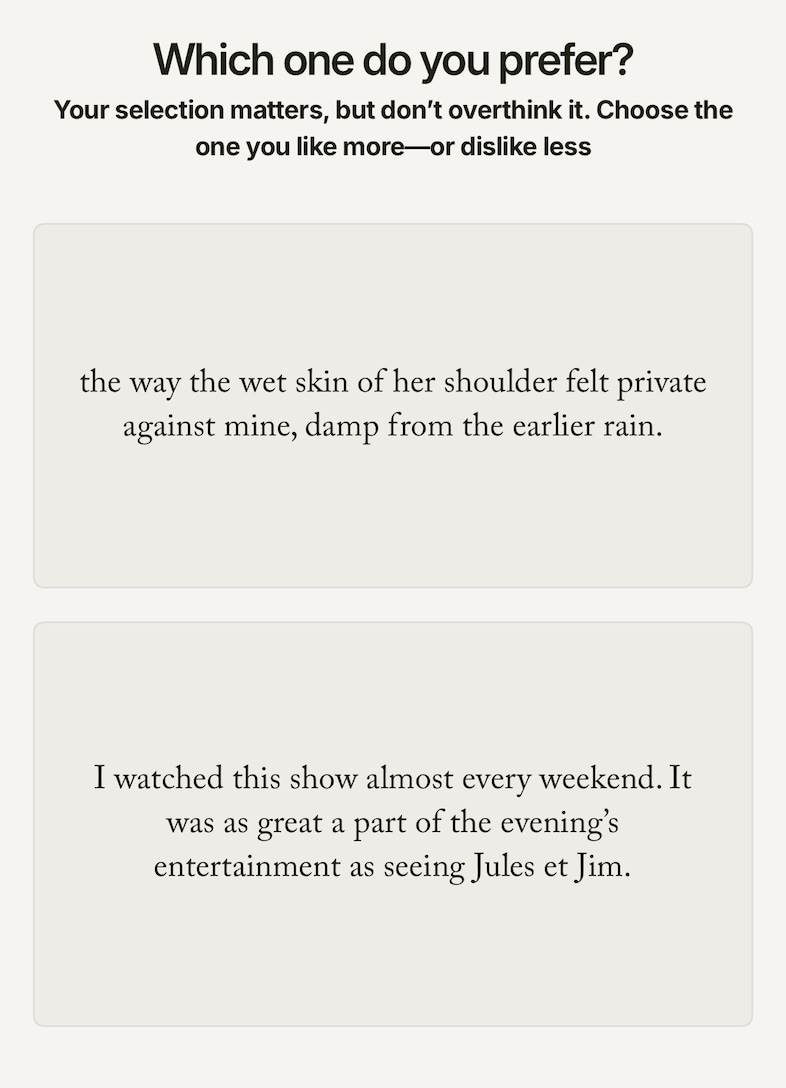
Despite what you might assume, Readme doesn’t simply match you with people who have similar reading tastes to yours. Instead, as I learned when I downloaded the app last week, the platform collects information about how you relate to language, then uses it to try and understand how you might show up in a relationship. It does this through a 25-part quiz that asks a mix of literature-related questions, like “How do you feel about your own writing?”, and personal-ish questions, like “Which of these things are you surprisingly bad at?”. Most of the quiz, though, consists of pairs of quotes, asking you to choose which one you prefer. Think Margaret Atwood’s “Can a heart leap? Can a person be dizzy with relief?” versus Peter Schjeldahl’s “The tone of his through-line may be treble-register, slight, and reedy, but if you stood in its way it would flatten you.”
To back up for a moment, it’s important to note that I consider myself both the best and worst possible candidate for something like Readme. On one hand, I’m a retired book blogger, write for a living and regularly fantasise about getting an MFA. On the other, I’m deeply sceptical of dating apps, if not of dating in general. Still, although I created a Readme profile solely for the sake of journalism, completing the quiz brought me something I’ve never experienced on a dating app: actual fun, not to mention emotion. After all, it’s hard to read lines like “the way the wet skin of her shoulder felt private against mine, damp from the earlier rain,” and not feel at least a little stirred.
After finishing the quiz, your responses to literature are used to map you across three different axes: how you relate to desire, how you communicate it and how you make sense of it. This helps the app sort you into one of twelve archetypes; mine, for those wondering, is “Utopia in our Lifetime”, which, according to Readme, means that I feel “outside of the social pact,” that my communication is motivated by “the impossible hope” that I’ll one day make perfect sense and that I “rely on structures and systems to make sense of the world.” (All in all, fair enough.) Though the app doesn’t filter your matches based on archetype, once you match with someone, you’re shown a brief description of theirs, a few bullet points explaining what it supposedly says about them and an estimated percentage of your similarity.
“We tried to go a little deeper… It’s more about what you can learn about yourself through how you relate to writing, rather than trying to signal taste in this performative way, which you have opportunities to do all over the internet”
“We think [these archetypes] can tell you something interesting and important about the way you relate to other people, the way you can fall in love or how you might be in a relationship,” says Segal. “There’s no astrology on the app, but it’s the equivalent of your horoscope.” And though the app does offer book recommendations, it’s not exactly Letterboxd for lovers. “We tried to go a little deeper and avoid the whole performative ‘These are my top 10 books’ thing,” says Segal. “It’s more about what you can learn about yourself through how you relate to writing, rather than trying to signal taste in this performative way, which you have opportunities to do all over the internet.”
Like other niche dating apps, Readme, it feels safe to say, has its work cut out for it. Aside from the dominance of giants like Tinder, Hinge and Bumble, it’s no secret that many young people are fatigued by dating apps altogether. In a 2024 survey by Forbes Health/OnePoll, 79 per cent of Gen Z dating-app users reported feeling mentally and emotionally exhausted by them. According to Segal, what’s missing from the market is something that provides “a deeper picture” of who someone is, a gap Readme is hoping to fill. The co-founder also notes that there’s somewhat of a precedent for the app, pointing to examples like Nerve.com’s dating service in the early 2000s, which matched users through detailed profiles and questions about their tastes, and The New York Review of Books’ classified dating ads, which have been around since 1968.
Though there are plenty of other interests to bond over – music, films, art – Readme’s bet that there’s something uniquely powerful about the written word is a thesis that even a dating cynic like myself can get behind. In any case, even if you don’t find love on the app, you’ll at least walk away with new books and writers on your radar, which is more than most platforms can say. “Books, poetry, writing and language are just part of the human spirit and are super romantic,” says Segal. “It’s definitely not the only thing you connect on – it’s just where we’re starting.”