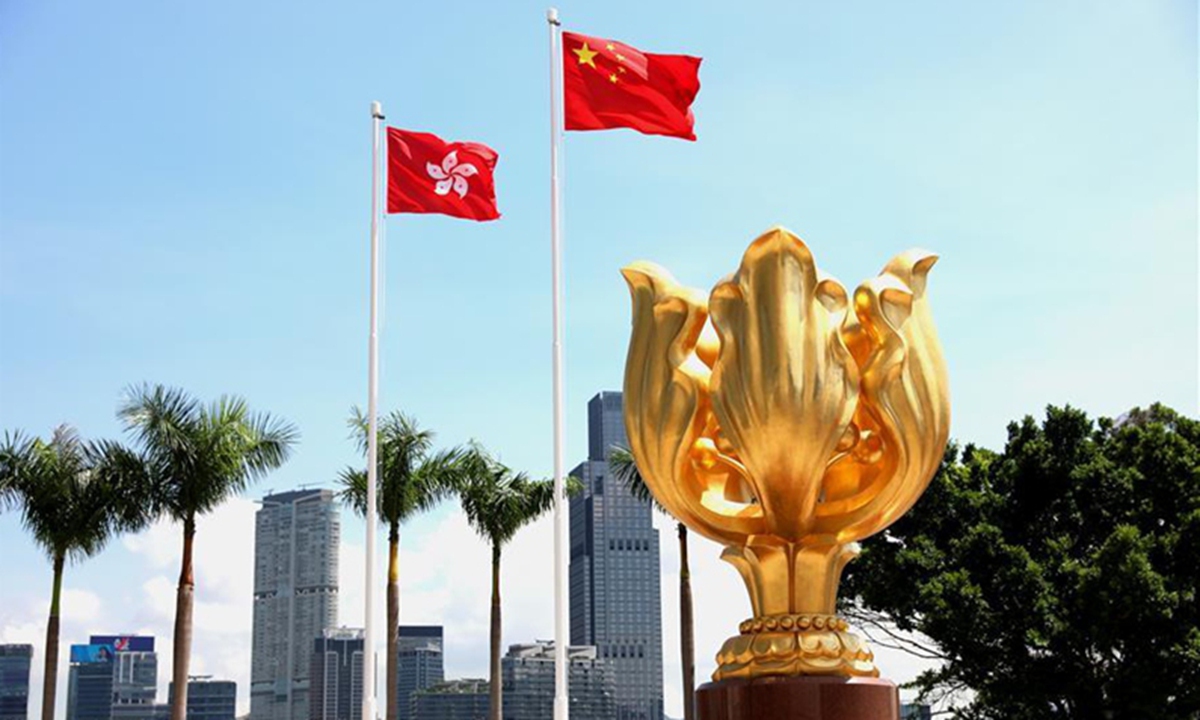
Hong Kong file photo
This represents a major transformation in Hong Kong’s governance and marks a milestone in the in-depth implementation of the “one country, two systems” principle. The introduction of the first five-year plan reflects the HKSAR government’s enhanced governance effectiveness and signals Hong Kong’s entry into a new phase of development, accelerating the transition from stability to prosperity.
The Hong Kong Special Administrative Region (HKSAR) unveiled its first five-year plan for economic and social development (2026-30) and the Chief Executive’s 2026 Policy Address on Wednesday. This marks the first time since Hong Kong’s return to the motherland that a medium- to long-term plan for local economic and social development has been formulated. It outlines five core development goals: achieving new breakthroughs in economic development; persistently enhancing international competitiveness and influence; boosting the efficiency of the Northern Metropolis development; improving people’s well-being; and making major strides in integrating into and serving the overall national development strategy. Some Hong Kong media commentary has noted that, in this context, the “five-year” timeframe represents not merely a span of time, but a new, elevated level of governance thinking.
The plan is ambitious in vision yet pragmatic in its measures, characterized by foresight, scientific rigor, systematic coherence, and innovation. It reflects a shift in the HKSAR’s governance from a past emphasis on “short-termism” toward “long-termism.” Beyond simply addressing the question of “where Hong Kong is headed,” the plan charts a clear development path, sets firm goals, and boosts confidence. This represents a major transformation in Hong Kong’s governance and marks a milestone in the in-depth implementation of the “one country, two systems” principle.
As the first five-year plan for the HKSAR, it has drawn attention both locally and internationally. Observers across the board are watching closely to see how a highly market-oriented economy like Hong Kong formulates and implements medium- to long-term plans, and whether it is abandoning the market economy, a particular point of interest for Western media. Indeed, the five-year plan, a hallmark strength of China’s governance model, can only be successfully implemented as a long-term strategy if the governance system ensures policy continuity and stability. This stands in stark contrast to the Western tendency of focusing on short-term metrics or engaging in policy “flip-flopping.” The introduction of the first five-year plan reflects the HKSAR government’s enhanced governance effectiveness and signals Hong Kong’s entry into a new phase of development, accelerating the transition from stability to prosperity.
Hong Kong is one of the freest economies in the world, with a highly open market environment and a business environment that aligns smoothly with international rules. The plan clearly calls for strengthening Hong Kong’s functions as a global offshore yuan business hub, an international asset and wealth management hub, and an international risk management center, while deepening the mechanisms of Bond Connect and Stock Connect, and developing a commodity trading ecosystem. Amid a complex and volatile global environment, multinational corporations have an even greater need for open, transparent, rules-based and efficient platforms for international cooperation. International capital places great value on wealth-management safe havens characterized by the rule of law, alignment with international rules and the free flow of capital. It is not hard to predict that under the five-year plan, Hong Kong’s distinctive role as a “super-connector” and “super value-adder” will be further consolidated and amplified.
Hong Kong’s past prosperity was, to a large extent, built on its role as an intermediary hub for international capital entering the mainland, allowing it to benefit enormously from the dividends of the mainland’s opening-up. At the same time, this objectively confined Hong Kong to a relatively narrow functional role for a long period. One of the key breakthroughs of this five-year plan is to promote Hong Kong’s transformation from a traditional cross-border conduit into a comprehensive platform for resource allocation. While consolidating its existing strengths as an international financial center, international shipping center, international trade center and international aviation hub, the plan places particular emphasis on developing Hong Kong into an international innovation and technology center and a global hub for high-caliber talent. The aim is for Hong Kong to become more than simply a transit point for capital and goods, and instead emerge as a key node for attracting global innovation resources, allocating high-quality resources worldwide and creating incremental value. Hong Kong is steadily moving from a prosperity shaped by historical opportunities toward sustainable prosperity underpinned by strategic foresight and modern governance capabilities.
At present, what Hong Kong’s residents want most is a better quality of life. They hope for more spacious homes, more opportunities to start businesses, better education for their children and better care for the elderly. The first five-year plan reflects a people-centered approach. It devotes a separate section to safeguarding and improving people’s livelihoods, laying out comprehensive measures covering quality education, healthcare reform, diverse housing options, labor protections, elderly care, the development of women and young people, support for disadvantaged communities, and the creation of a green and livable city. In particular, it sets clear and concrete targets, including basically resolving the problem of substandard subdivided units by 2030 and reducing the public housing waiting time to less than four years. These “hard” targets directly address the issues that concern residents most urgently.
Hong Kong is ushering in its best period of development. With the full support of the central government and the strong backing of the motherland, Hong Kong is well positioned to take its first five-year plan as a new starting point, advance steadily and sustainably in the practice of the “one country, two systems” principle, and write a new chapter in the story of the Pearl of the Orient.
We look forward to people from all sectors of Hong Kong working toward common goals and pooling their efforts to turn this promising vision into a vivid reality. Hong Kong’s tomorrow will be even better.

