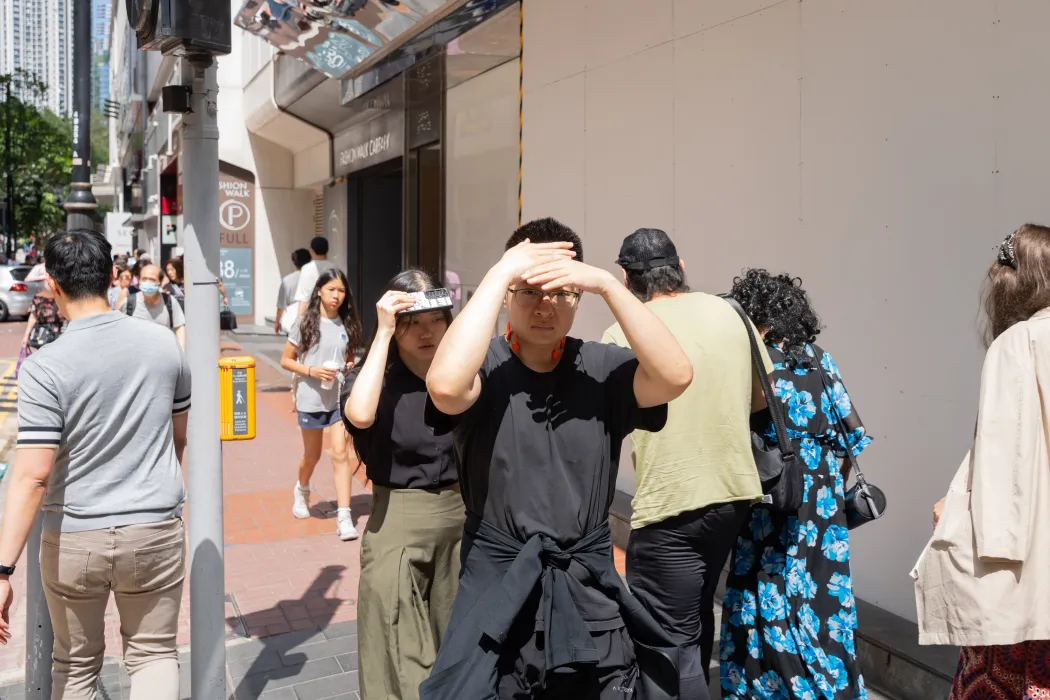
Hong Kong’s Labour Department will revamp the city’s heat stress warning system, its chief has said, after a former weather official called the mechanism “decorative” for issuing only the lowest alert during record-breaking heat.

Commissioner for Labour Sam Hui said on Tuesday that his department will work with the Observatory to improve the warning system’s sensitivity to “unusually high temperatures.”
Hui said he and his colleagues were puzzled when recent high temperatures failed to trigger a higher alert under the Labour Department’s Heat Stress at Work warning system.
“When we saw the Heat Stress at Work warning system hadn’t been raised as the temperature changed on Saturday and Monday, we also had a lot of questions,” he said in Cantonese.
Hui’s remarks come after Hong Kong saw the highest temperature on record on Sunday, with the Observatory reporting 36.9 degrees Celsius at its Tsim Sha Tsui headquarters under the influence of Tropical Cyclone Dolphin.

Despite the heat, the Labour Department’s heat stress warning system remained at its lowest “amber” level over the weekend, prompting former Observatory chief Lam Chiu-ying to criticise the mechanism as “baffling” and “decorative.”
‘Hot and humid’
The warning system consists of amber, red and black alerts and recommends different rest arrangements for employees working outdoors or without air conditioning. None of the recommendations are legally binding upon employers.
The system recommends rest arrangements depending on the type of work and the heat warning in force. The red and black warnings trigger work suspensions for workers with heavy physical workloads, though they have never been activated.
Hui said on Tuesday that the system was sensitive to Hong Kong’s “hot and humid” conditions, but far less responsive to direct heat.
The labour commissioner said his department will work with experts from the Observatory to study how to improve the warning system’s sensitivity to extreme heat. The revamp is expected to be completed this summer, he added.

A reading of 30 on the Hong Kong Heat Index triggers the amber warning, and for the red or black warning to be issued, the index must reach 32 and 34, respectively.
In addition to air temperature, the index also takes into account other factors that determine how hot it actually feels, including humidity, wind speed, and solar radiation. Weightings for those factors in the calculation of the index are determined based on hospital admission figures.
The Intergovernmental Panel on Climate Change has warned that the intensity and frequency of heatwaves have continued to increase since the 1950s due to human-caused climate change. The prevalence of greenhouse gases like carbon dioxide – which trap heat in the atmosphere – raises the planet’s surface temperature, with hotter, longer heatwaves putting lives at risk.
See also: How extreme heat became the deadliest silent killer among world weather disasters
Hong Kong has already warmed by 1.7 degrees Celsius since the Industrial Revolution, research NGO Berkeley Earth says. Heat and humidity may reach lethal levels for protracted periods by the end of the century, according to a 2023 study, making it impossible to stay outdoors in some parts of the world.