
Google Pixel 11 Pro Fold
Our verdict
While the Google Pixel 11 Pro Fold has moved beyond being a mid-tier phone in a foldable body, it is still lagging behind other foldables on the market.
From $2,799 RRP
What we love
- Mostly excellent photography
- Great battery and performance
What could be improved
- The crease is still creasing
- Split screen UX is buggy
The essentials
No complaints.
Tracks towards 5.5 hours of screen time per charge. Should easily last you the day.
You can’t ignore the crease, but otherwise the displays are nice.
Generally great, but has the same issues as many mid-tier devices.
Foldable phones inherently come with compromises, but those compromises look different now. Rather than needing to pick between a foldable screen or a good camera, you now have to make decisions based around aesthetics, screen size, and whether you’re okay with your phone being a two-handed affair. The chapter where foldable phones are mid-tier devices that happen to fold has ended, and we’ve entered a place where their prices are closer to justified by what the phone can do, not just how the screen packs away.
Still though, when it comes to the Pixel 11 Pro Fold, you will be making compromises. It isn’t the most polished or the prettiest foldable on the market, but Google’s point-and-shoot cameras make for some of the most reliable photography in the product category. Looks aren’t everything, but when the competition is looking as good as Samsung and OPPO, I can’t help but do a double take.
Still not ironed out

By now, foldable phones have all but lost their novelty. In their eighth generation for Samsung, fourth for Google, and various bits and bobs in between for other manufacturers like Huawei and OPPO, a folding phone screen has become relatively normal to see. With the tech so proliferated it is even spilling into gaming, it does make me wonder why the Pixel’s crease is still so bad.
Opening the phone, you’ll be met with a decent dent in the centre of the screen and a noticeable distortion of the screen at the fold. Manufacturers like OPPO and Samsung have all but eliminated this crease, so to see it still taking centre stage on the Pixel 11 Pro Fold is disappointing. Coupled with large bumpers around the edge of the internal display, unfolded, the Pixel looks kind of cheap. Or at least, cheaper than its competitors like Samsung that have made aesthetic design more of a priority.
It bothers me particularly because there is something about the Pixel 11 Pro Fold that makes you want to open it. Even though the external display is a good size and works just as well, if not more intuitively than the unfolded internal one, the phone begs to be opened.
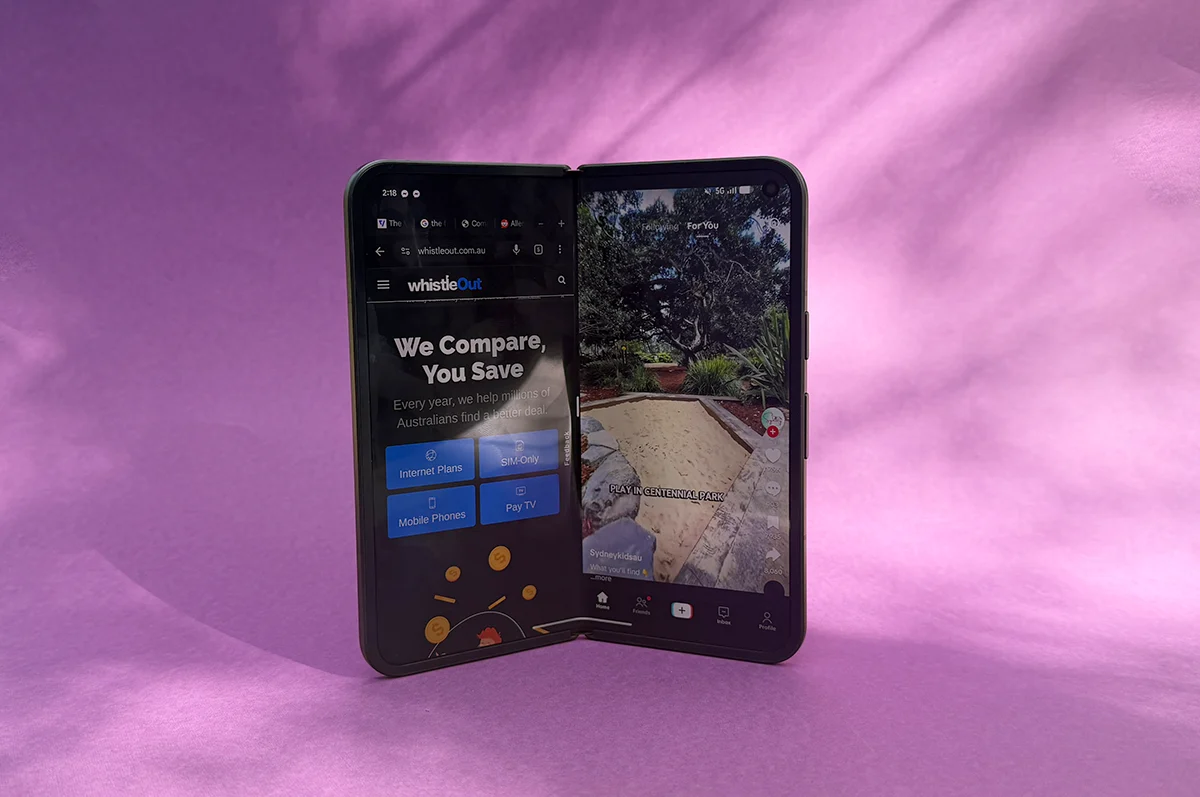
Even when leisurely scrolling through social media, I found myself drawn to the split-screen setup. Having TikTok on one side and Messenger on the other felt like I was using my time more productively. Which is, of course, an achievable and reasonable thing to want to do with your spare time. But for work purposes – which plenty of people seem to be drawn to book-style foldables for – it makes a lot of sense. I could see a world where I use one side of the screen to read through emails and the other side to take notes.

There are still bugs to work through, however. Meta apps tend to load strangely when the phone is in tablet mode. Instagram will initially respond by blowing reels up to 100% the width, which makes them impossible to watch while open. At times, when you have two apps open on split screen and close the phone, the external display will split horizontally down the centre – which isn’t a thing it is supposed to do. And at times Google’s own apps will get stuck on one side of the screen but not register that it is in split-screen mode, so you get one side of the screen that is entirely unusable. Some of these are app-owner problems, and Meta being weird about tablet apps is nothing new, but others are things Google really should have figured out by now.
Why would an AI summary be there?
Powered by the Tensor G6 chipset, the Pixel 11 Pro Fold’s performance is simply snappy. Apps open quickly, on-device games run smoothly, and day-to-day usage is totally fine. No complaints here.
Google is pushing the idea that this chipset will get you the best on-device AI experience. Admittedly, I’m not a big Gemini user, but testing it out on the Pixel, it sends responses just as quickly as on my MacBook. However, as you might expect, Gemini is more heavily embedded within the Pixel operating system. For example, you’ll now find AI summaries in things like battery settings. Gemini generated a summary telling me that I have used 20% of my battery in approximately one hour of screen time. Which I guess would be useful if that information wasn’t already showing in the graphs beneath the summary.
Anyway, based on the graphs, battery performance is pretty standard. The Pixel 11 Pro Fold tracks towards five hours of screen time in daily use, which should easily get you through a full day without needing to top up.
Point and shoot

Pixel phones are known to have excellent point-and-shoot phone cameras, and for the ability to cram plenty of functionality into a small setup. It’s singular 12MP lens used to rival Apple’s dual cameras back in 2022. Now, kitted out with a 48MP wide, a 10.5MP ultrawide and a 10.8MP telephoto lens, it should come as no shock that the Pixel 11 Pro Fold takes solid pictures. It is still half a step behind what you’d want to see from a phone with this price tag, however.
It has excellent detail across the board, which is utilised well by using a wide focus on the primary lens. It allows for the full subject to remain sharp, where other phones like the iPhone 17 Pro tend to pick a smaller area to keep fully crisp.
The zoom lens handles up to 10x optical zoom before jumping to digital zoom to get to 30x. Once again, the Pixel manages detail quite well while using optical zoom, but the returns diminish the further you push out.
Motion is the Pixel’s low point, however. Every snap with any kind of motion, be that a person or a car, ends up with some kind of motion blur around the subject. Mid-tier phones tend to have this same struggle, so considering the Fold and the standard Pixel 11 share the same camera set-up, I’m not surprised this is where it stumbles. Ultimately, though, I do think this comes down to the software behind it more than the actual lens.
Apple, for example, picks the best shot when it detects motion, and the user can fiddle around and select a preferred frame. Whereas the Pixel simply picks one for you. This means that compared to something like the iPhone, the motion capture looks worse, but it might just be the frame you land on. It is tricky to properly compare, but if we’re just considering the point-and-shoot nature of the photography, then the Pixel 11 Pro Fold’s performance is still closer to a mid-tier than a flagship. You can watch the video above for a more visual explanation with some examples.
All around, the photography is great, but the most expensive model of the family having the same cameras as the entry-level irks me. When you’re paying close to $3,000 for a phone, you should get the Pro experience. Pro in name doesn’t mean Pro in cameras, I guess.
Google Pixel 11 Pro Fold camera samples
Check out these camera samples taken on the Pixel 11 Pro Fold. Click or tap on any photo to see a larger version.
Google Pixel 11 Pro Fold – Final Thoughts
Foldables are a growing category, and with even more cresting on the horizon, Google needs to make some changes to remain in the competition. The Pixel 11 Pro Fold is a solid device – good performance, nice cameras, slightly buggy but otherwise fit-for-purpose software – but in the foldable landscape it is also forgettable. OPPO stands out because of its creaseless display, Samsung is doing interesting things with size and shape, Huawei is going for the tri-fold, and Motorola is still bringing a sense of play to their devices. Next to these, the Pixel 11 Pro Fold looks ordinary.
There is nothing wrong with ordinary, but if you’re going to ask people to shell out close to $3,000 for a phone, they deserve more than that.
Anula Wiwatowska

Read full bio