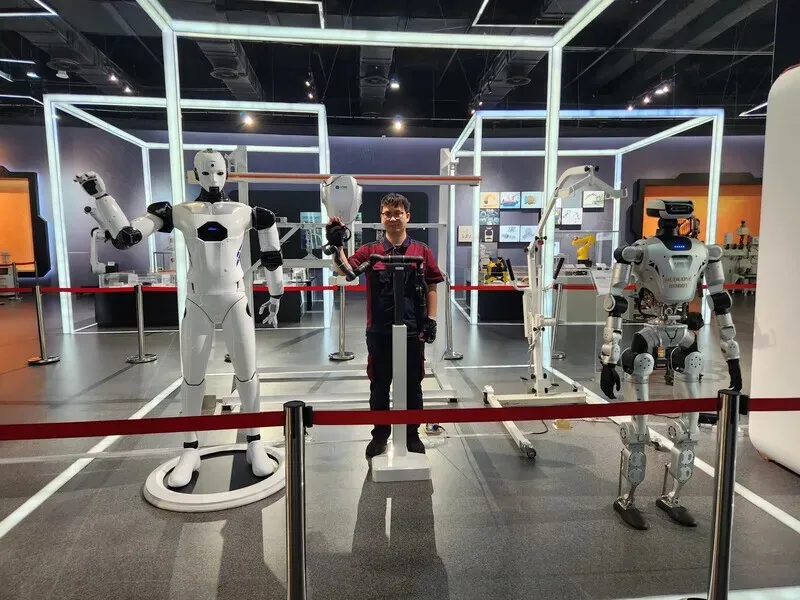
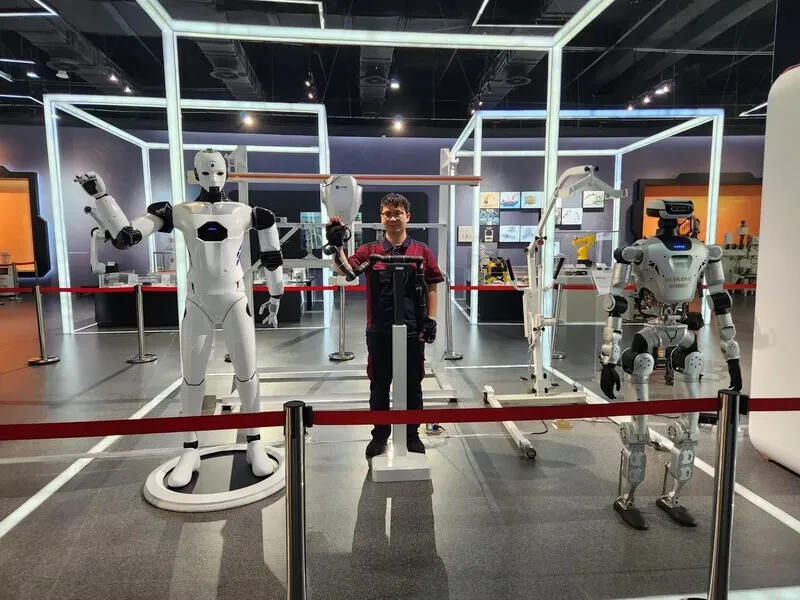
Humanoid robots mimic the gestures of a human at Anhui Innovation Pavilion in Hefei, in China’s Anhui Province, on June 13, 2026. (Park Min-hee/Hankyoreh)
The orange-colored robots are in constant motion, handily raising the vehicle chassis and welding it in a ceaseless shower of sparks. On the floor, white-colored automated carts are constantly shuttling vehicle parts back and forth. Human workers are seldom seen.
The F2 factory operated by China’s top-end electric vehicle brand NIO (Chinese name: Weilai) at Xinqiao NeoPark in Hefei, a city in China’s Anhui Province, leverages robotics and artificial intelligence to produce one electric vehicle a minute. Once the parts are assembled, the vehicle drives itself to a test area where it checks over a thousand functions on its internal systems.
Around 1,300 production robots and 500 automated cars are “working” at the factory.
“We have an internet network installed in the factory basement that collects around 1.5 terabytes of process data every day. Our goal is to automate the decision-making process at some point down the road,” a company employee said.
This state-of-the-art factory, which is expanding with the goal of becoming the world’s biggest EV manufacturing hub, demonstrates how Hefei, an inland city in China, is becoming a city of cutting-edge technology.
Ten years ago, Hefei was a backwater often referred to as a “huge farming village,” but now it has experienced explosive growth from the confluence of strategic investments led by the Hefei municipal government and the central government’s strategy for the integrated development of the Yangtze River Delta — a strategy for the integrated development of Shanghai, Anhui, Jiangsu and Zhejiang.
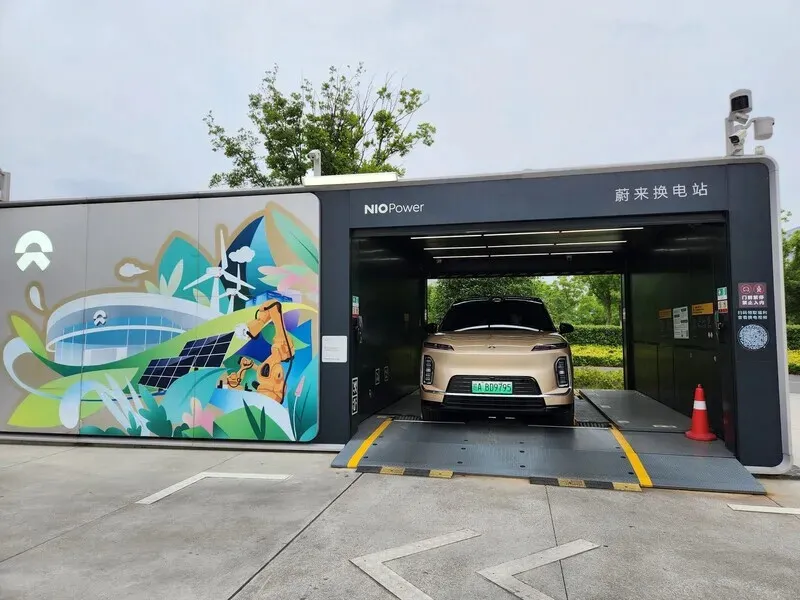
A vehicle has its battery changed at NIO’s Neo Park factory in Hefei, in China’s Anhui Province, on June 12, 2026. (Park Min-hee/Hankyoreh)
In the first quarter of 2026, Hefei grew by approximately 6.8% year-over-year, ranking first in growth rate among China’s 29 major cities.
Mirroring how “Shenzhen speed” and the “Shenzhen model” were highlighted in the 1980s after Shenzhen, located in southern China, became known as a laboratory for capitalism and the symbol of the Chinese economic reform, “Hefei speed” and the “Hefei model” have recently come to symbolize a new path forward for the Chinese economy.
If the Shenzhen model represented growth led by the private sector amidst the Chinese economic miracle and trend of globalization, the Hefei model illustrates China’s new strategy in an era of national security and the end of globalization, all the while engaged in a cutthroat contest with the US over advanced technology.
The first key point is the central role played by the government. The city of Hefei operates five investment funds under its jurisdiction, including Hefei Industrial Investment and Xingtai Capital. In 2008, the city temporarily suspended subway construction and poured one-third of its local fiscal revenue into attracting BOE, a display manufacturer that was, at the time, running a deficit of over 1 billion yuan.
Now, BOE is the world’s largest display manufacturer, ranking first globally in LCDs and second in OLEDs. In 2013, the city secured a 37% stake in the semiconductor company ChangXin Memory Technologies (CXMT) through a large-scale investment.
After the US imposed sanctions related to chips on China, self-reliance in the semiconductor sector became a key priority for China, and CXMT grew to become one of its leading chipmakers.
Hefei went a step further in 2020, investing 7 billion yuan in NIO, an electric vehicle company that was on the brink of bankruptcy, to host its headquarters and manufacturing facilities, a move that led to the establishment of electric vehicle plants in the region by companies such as BYD and Volkswagen.
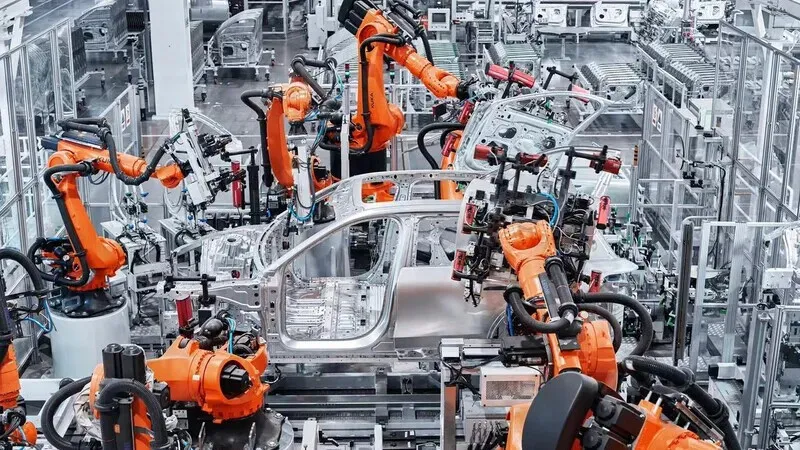
Robots assemble a vehicle at the NIO Second Advanced Manufacturing Base in Hefei, east China’s Anhui Province. (courtesy NIO)
The growth of battery companies allowed a major ecosystem for the EV industry to take shape.
“Because the city government has had remarkable success with its investments and has driven rapid growth in high-tech industries, many people now refer to Hefei as a ‘gambler city’ and highlight ‘Hefei speed.’ But Hefei’s success is not the result of some lucky bets; it’s based on meticulous research and review in which we pored over whether each investment aligned with our development strategy,” commented Lu Xiaomei, the deputy director of the city’s foreign affairs office.
This shows that investments were made in accordance with a core strategic blueprint known as “Chip-Display-Auto Integration,” a plan for development that integrates semiconductors, displays, automotives and AI.
The second key point is talented human resources. Even in the middle of the night on June 12, students milled around at the University of Science and Technology of China (USTC) campus, which is in the old downtown area north of Hefei, and buildings remained bright, their light penetrating the dark.
People can enter the campus only after their identities are verified by the facial recognition devices at the main gate. This campus is one of the core centers for research into China’s next-generation future industries, such as AI, quantum technology, nuclear fusion energy, aerospace, semiconductors, brain-computer interfaces and more.
Previously based in Beijing, USTC sought refuge to escape the turmoil of the Cultural Revolution in the 1970s, and Hefei cooperated closely by providing the city’s prime land for the campus and establishing national-level laboratories.
In 2022, the university and the municipal government jointly created a special zone for science and technology dubbed the “USTC Silicon Valley.”
According to a report by the Beijing News, 30% of USTC graduates remain in Hefei each year to start businesses or find employment, serving as a talent pool for the city’s innovation ecosystem.
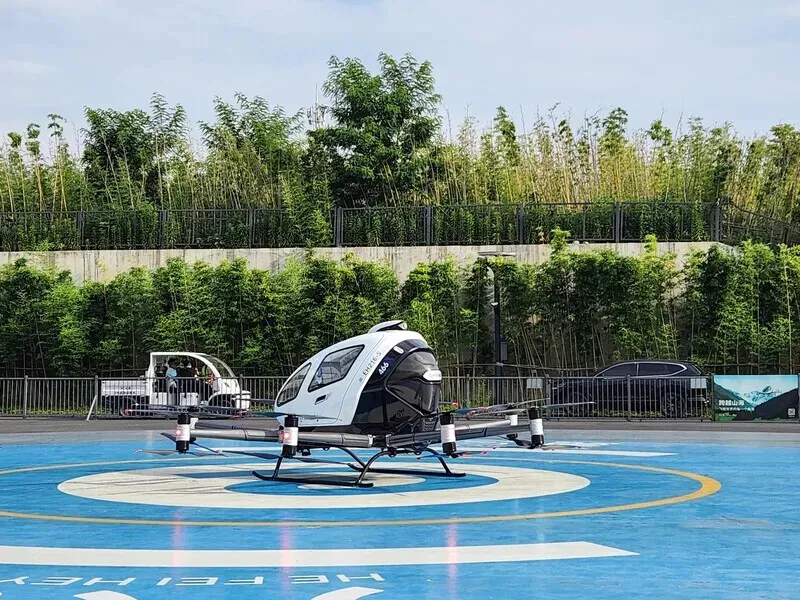
EHang, an autonomous aerial vehicle company, runs an urban air mobility hub at Luogang Central Park in Hefei, China. (Park Min-hee/Hankyoreh)
iFlytek, the world’s trailblazing voice recognition AI company, also came to life in a USTC language and communications lab in 1999. The company was started by Liu Qingfeng, now its chairperson, who was a PhD student at the time, with his fellow researchers.
The Chinese characters “科大,” which are featured in iFlytek’s Chinese name (科大讯飞), refer to USTC.
The third is the supply chain ecosystem. The massive supply chain ecosystem revolving around EVs, solar energy and batteries that took shape in the city has become a fertile soil for a veritable garden of high-tech that includes robots, autonomous aerial vehicles, and energy storage systems.
Gotion High-tech, which was founded in 2006, is one of China’s flagship battery manufacturing companies that became emboldened by Hefei’s efforts to foster the battery industry and support research and development. In the first quarter of 2026, the company shipped over 30 GWh of batteries, ranking fifth globally in terms of battery installation volume.
An official working at Gotion’s headquarters, whom I met on June 11, explained that the German automaker Volkswagen has invested approximately 1.1 billion euros to acquire a 24%-25% stake in the company, and that Gotion has a fully integrated supply chain ranging from battery raw materials to energy storage systems.
Sungrow, a company founded by Cao Renxian, a former professor at Hefei University, began its journey by manufacturing solar inverters and has since transformed into a comprehensive energy solutions provider covering wind power and solar energy storage systems.
Ehang, (Guangzhou Ehang Intelligent Technology Co. Ltd), a company that manufactures autonomous aerial vehicles, also joined forces with Hefei’s state-owned platform to establish Hefei Hey Airlines in the city’s Luogang Park for the very same reason.
“We based our company here because of various factors: the investment and support from the Hefei municipal government, the abundant pool of science and engineering talent as well as the proximity of USTC, and the supply chain ecosystem of the region, which included battery and components manufacturers necessary for drone development,” Gu Yong, the Huadong regional head for Ehang, said on June 11.
Luogang Park, a former airport site, houses Huawei’s R&D center, Hey Airlines’ UAV test and operation facilities, and other complexes after its redevelopment. Hey Airlines conducts test flights of its passenger-carrying unmanned flying taxis here, leaving me impressed as I saw the propellers of a passenger-carrying drone spin rapidly, push off the ground with a roaring sound, and soar to a height of 120 meters in a matter of moments.
Advances in the battery and drone industry have laid the foundation for China to produce the supply chain of components needed for the humanoid robot industry in the most cost-effective and efficient manner. The New York Times recently published an article titled “Why it’s nearly impossible to build a robot without China,” which noted how “Chinese manufacturers dominate the humanoid robot supply chain.”
The final key component of the Hefei model is achieving technological self-reliance while the US and China compete over technology. When I visited iFlytek’s headquarters on June 13, a wide array of AI products that could be used for everyday applications and industrial settings were on display, including tools using Spark, the company’s self-produced AI model, translators capable of interpreting 83 languages, earphones, translation glasses, and acoustic sensors designed to detect anomalies in industrial settings.
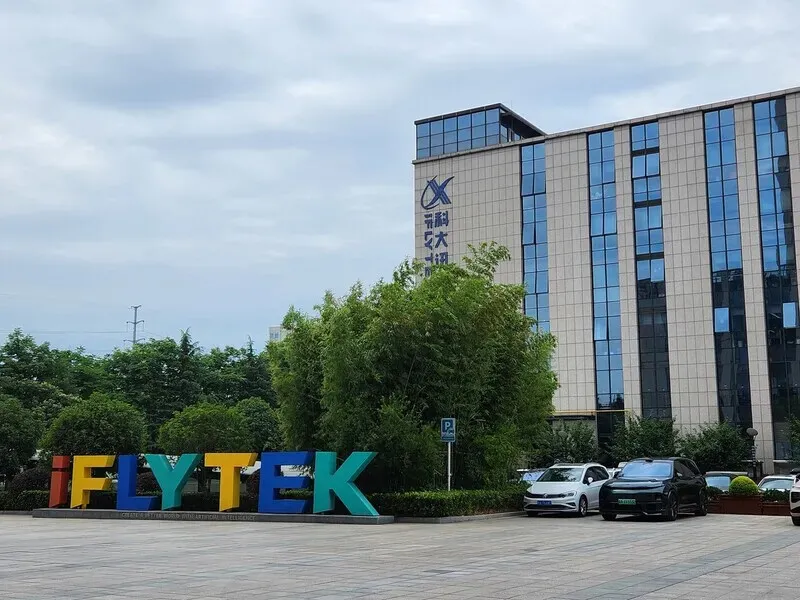
The headquarters of iFlytek, a Chinese artificial intelligence company specializing in voice recognition and language technology, in Hefei, China. (Park Min-hee/Hankyoreh)
iFlytek wound up on the US government’s blacklist in 2019, when trade and technology competition between the US and China was boiling over. By 2018, it had developed a voice translation technology that matched the level of human professional interpreters, but the blacklisting meant that it was unable to get its hands on the AI chips it needed from the US starting the very next year.
The US had targeted iFlytek because its technology could potentially be put to use by the Chinese military or used for surveillance. That prompted it to join forces with the similarly US-sanctioned Huawei, whose Ascend chips it used to accelerate its AI development.
By 2023, it had worked with Huawei to release a computing platform called FlyingStar One for training large AI models, and today its developing its own AI and robotics.
“US sanctions forced us to take this path,” said Qing Tian, the head of AI translation at iFlytek. “We’re showing that sanctions can’t stop the development of Chinese tech.”
Amid intensifying US-China competition, China’s government-backed strategic industries are advancing rapidly, while barriers aimed at preventing the transfer of advanced technologies are also becoming increasingly stringent.
All the government and private sector officials I spoke to while in China from June 9-13 said that Korea needs to open its door to Chinese cutting-edge goods, but almost none of them had much of anything to say about technological cooperation or investment opportunities with Korea.
Before I went into any factories, they placed a sticker over my phone camera. One place didn’t allow any questions at all.
In this era of state strategic industries meant to help China achieve global dominance in advanced technologies, it’s hard to see where, if anywhere, Korea fits into China’s plans. South Korea finds itself in an increasingly difficult position as both the market for Chinese products, produced at an enormous scale and with exceptional price competitiveness, and a competitor that must be contained.
By Park Min-hee, senior staff writer
Please direct questions or comments to [english@hani.co.kr]