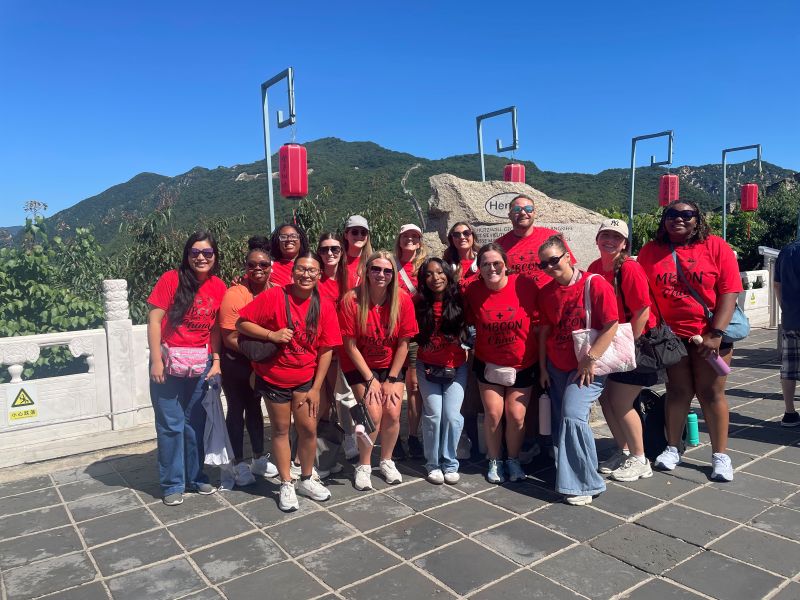
Nursing student Lakeya Spicer-Lynch traveled a lot during her 23-year military career but a summer trip to China with her fellow nursing students was her first trip that wasn’t a deployment.
“I’m such a nerd. I absolutely love history and love learning about other people’s cultures,” Spicer-Lynch says. “Being a Black woman, and not being able to always reach back into my lineage, has taught me how to really embrace and enjoy other people’s and learn why they do the things they do and about their different customs and traditions.”
The 11-day trip was led by Lindsay Grainger, assistant professor of nursing, and nursing instructor Lina Shu. The two teachers and 12 Upstate students shadowed doctors and nurses at Dong E Hospital in Liaocheng, Shandong Province, learning about health care in China and observing medical procedures.
Grainger set up the trip after meeting one of the hospital staff at a nursing conference last year. An invitation to visit the hospital soon followed and included an offer of free food and lodging for the USC Upstate group. Though Grainger wasn’t sure what interest would be, she knew it was an incredible opportunity for students.
The slots filled almost immediately. Senior nursing student Ke’Ana Smith had traveled abroad before and couldn’t wait to visit another new country. As a first generation student, she has made travel a priority in her college life.
“I feel like studying abroad just helps me grow as a person and I learn something new every time I go,” Smith says.
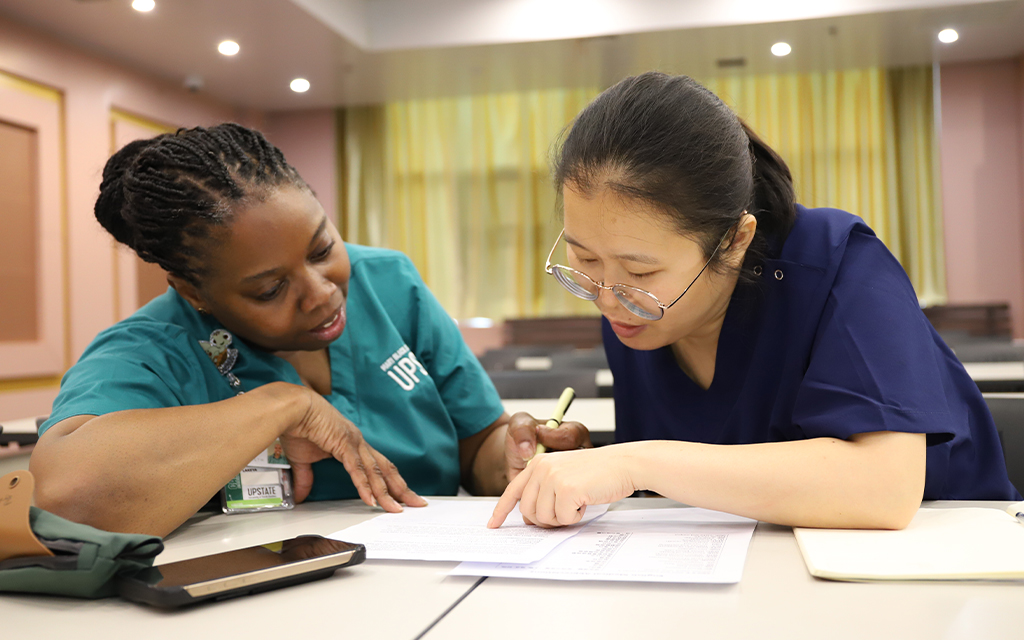
Though the 800-bed public hospital is located in a somewhat remote region of China, it has worked hard to build its reputation as a place for international partnerships, Grainger says. Doctors and preceptors went out of their way to show their visitors whatever they wanted and took time to answer all questions.
Students were assigned a preceptor to follow based on the area of nursing they are interested in. They were invited to observe a live birth and open-heart surgery and were encouraged to ask doctors questions afterwards. Grainger and Shu interviewed medical staff in all departments and spent time in each ward observing how care is provided.
Although many of the hospital staff spoke only limited English, they and the students used translation apps and earbuds to help communicate with each other, with Shu interpreting too. The system was at times imperfect, but students loved connecting with staff and exchanging knowledge about methods of care.
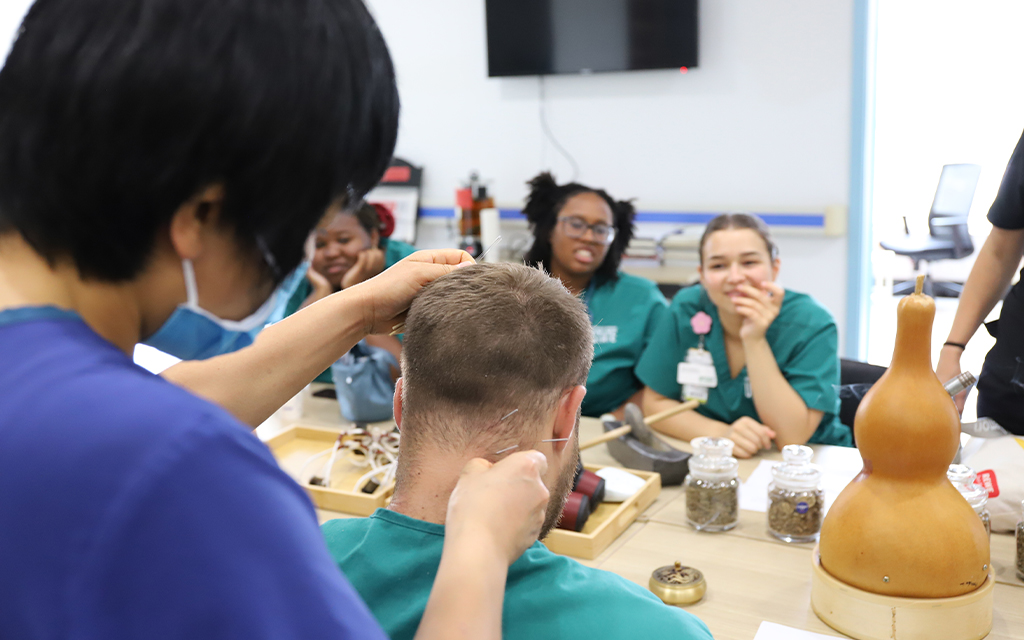
Like any modern hospital, Dong E primarily employs biomedicine to treat patients, but many students were interested by the traditional Chinese medicine clinic that shares the campus. The proximity allows hospital physicians to consult with traditional medicine doctors and get recommendations for treatments, mainly of chronic conditions, Shu explains. The students tried cupping and acupuncture and were even evaluated by a traditional medicine doctor who suggested different herbal medications for each of them. “It’s a very individualized type of practice,” Shu says.
The Upstate group also was struck by families’ involvement in patient care. Family members would actively engage with doctors and nurses about treatment and provide personal care to their loved ones. In the evening, after visiting hours were over, families would spread out mats in the hallways to stay close by.
“I don’t know how many family members I saw giving their mom or dad a bath or brushing their teeth,” says Sarah Jerkins, a senior at Upstate. “That was just incredible to me.”
Also impressive to Jenkins and the other nursing students was how well doctors and nurses worked as a team. Not only did the doctors do rounds with the nurses, they would often consult them about cases. “Doctors are pretty intimidating, especially as a nursing student,” Jenkins said. “But all the doctors I talked to were so friendly. If the nurses needed something, they’d just run in their office and tell them.”
Hospital days were rigorous, but in the evenings, the Upstate group’s hosts showered them with hospitality. They sampled local cuisine, including donkey meat; went to evening markets; visited a karaoke bar; and joined in nighttime square dancing on the plaza with local senior citizens. Everywhere they went, they were welcomed warmly by residents, some of whom had never seen a foreign visitor in their city.
After the success of the trip, Grainger and Shu hope to do another, given the high level of interest in the first one. The visit was not only a valuable opportunity to learn about health care in another country, Grainger says, but also to connect with people on a personal level.
“Being in health care, we’re here to care for individuals,” she notes. “At the end of the day, we all had the same mission, so that creates an instant bond between the students and those nurses. And that’s pretty special.”