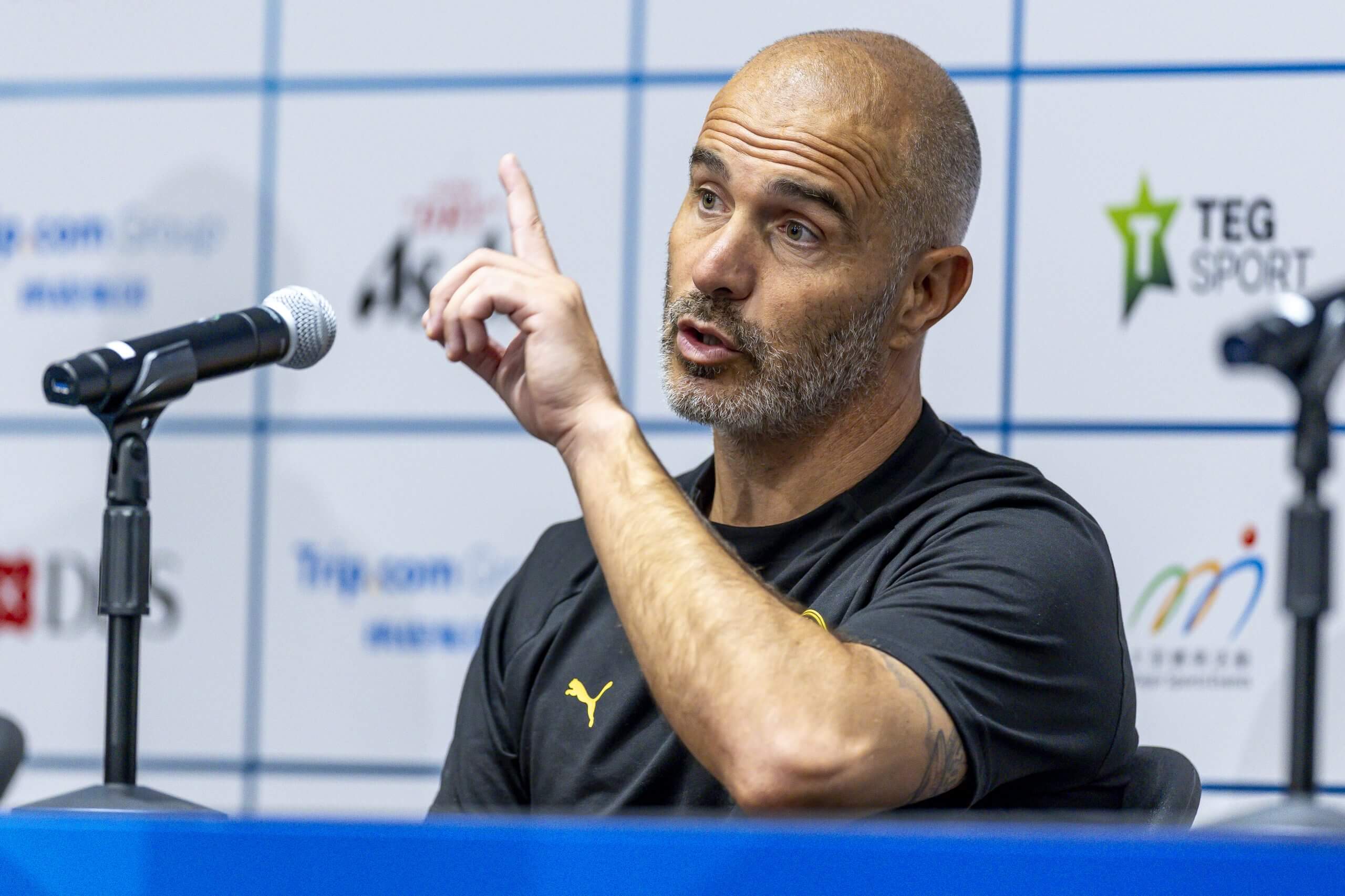
Enzo Maresca sits back in his chair at the Four Seasons hotel in Seoul, South Korea, pondering who he will choose as Manchester City captain for next season. Erling Haaland’s name comes up as an option.
“That is a good one,” he says. “At Leicester and Chelsea, I had a rule that when we scored, the captain had to come to the bench, not to celebrate, for instructions. But if the captain scores, then he can celebrate. If Erling is the captain, f***ing hell! We have a problem, can you imagine?
“Even if it is two or three minutes, there is always something to adjust. We have three or four (captains) and we are missing one. In the case of Rodri, see what happens.”
Across an hour with the journalists who have followed the team to the Far East, Maresca sits and discusses various topics around the job he has on his hands at City, the aesthetic merits of the modern Premier League, his chats with Pep Guardiola and, to some extent, transfers.
Less serious subjects are on the agenda, too, such as the initiation songs that started spontaneously one night in the team’s Rosewood hotel in Hong Kong.
“I don’t sing,” he says. “They all sing, the manager doesn’t sing.”
Seven of his backroom staff took the mic to help break the ice, but few impressed the boss. “They were all s***,” Maresca laughs. “Javi, the analyst — it was a disaster. He was singing My Way, Frank Sinatra — you are already bad, go for an easy one.”
It may come as some surprise to those who have followed Maresca’s public media interactions at Leicester City and Chelsea, and in his first few weeks at City, but he is a warm, funny character.
For whatever reason, he appears to keep that side of himself hidden when he speaks to the press, but behind the scenes he comes across very differently. On his first day at City he introduced himself to staff at the club’s first-team centre and the main takeaway was how relaxed and friendly he is.
Sources around the first team on City’s tour of Hong Kong and South Korea say that the vibe on the trip was the best it had been for years. It was a more relaxed environment, largely due to some of the stricter elements of the Guardiola era leaving with him.
Guardiola has been one of football’s great characters, and is particularly beloved at City not just because of his winning record but also because of how he transmitted his personality to the world, especially in times of strife.
Maresca seems intent on letting his team’s football do the talking, but perhaps one day that will change.
To the football, then.
The Premier League has become more physical in recent seasons and the players at Maresca’s disposal have been recruited with that in mind. Even had Guardiola stayed on, City would probably be playing a more direct brand of football next season, with players more suited to beating a man and covering ground than playing a thousand million passes.
“Compared to three years ago, the big difference is the set pieces,” Maresca says of English football, and you can tell he is not a huge fan of this development. “Back then you could not say that it wasn’t a physical league. It was still strong. Set pieces is the big change, and now everyone goes man-to-man.”
That was the theme of last season. Former Newcastle United winger Anthony Gordon spelt it out perfectly before a Champions League game, saying that European teams “try to play” while English football had become “more physical than I’ve ever known it to be”. One experienced Premier League manager privately described the league as “brutal”.
Maresca is in his element when discussing playing styles. After leaving Chelsea in January, he watched many football matches specifically with an eye on man-to-man marking. He spent time doing online masterclasses in technical and tactical approaches to football and another in artificial intelligence due to its boom in popularity.
“You need your players creating overloads against the man who is marking him,” he says, going back to the football. “For instance, if you see PSG — why are PSG so good? Because all teams go man-to-man and they have Achraf Hakimi at full-back — good one against one. Nuno Mendes at full-back — good one against one. The wingers, the midfielders, most of their players are not physically strong — you don’t see Nuno Mendes or Hakimi or Desire Doue or Bradley Barcola as beasts, but they are good because they can beat their man and are free to carry the ball.”
An espresso arrives as he speaks. He has already had three americanos in the morning, as he regularly does. Like most of the players and staff, he struggled to sleep in Asia, though he does not fare much better back home, kept up at night by thoughts about tactics and team dynamics.
(Yu Chun Christopher Wong/Eurasia Sport Images/Getty Images)
“That’s why PSG in the last two or three years have been the best team because they have players who beat their man one against one,” he continues.
“It’s not just one position — against a team that goes man-to-man, you need the full-backs and players who can beat their man.”
For all that, though, Maresca does not believe that man marking will be so prevalent for much longer. The Italian, who was hired as City’s under-23s manager in 2020 partly due to the way he studied football tactics and trends across the globe, believes the best teams have already started to adapt to it and exploit it.
“I’m not sure it’s going to continue like that,” he says. “For instance, if you see last season when Newcastle played Barcelona and it was 6-1. Atalanta and Bayern Munich was 6-1. Chelsea tried to go man-to-man with PSG when I left and they destroyed them.
“Usually the team that was defending found the solution by going man-to-man. Now the teams that try to build up are trying to find solutions against man-to-man. I don’t know when but there is going to be a bit of change.”
He notes how Chelsea recruited set-piece coach Austin MacPhee from Aston Villa this summer as teams look to leverage set pieces, in the way that propelled Arsenal to the title last season — they scored a record 19 goals from corners.
“Probably Arsenal rely on set pieces a lot,” he says. “They use different strategies to win games. We are going to try to improve, even the set-piece numbers, because you can win or lose with them.”

Kai Havertz scores a header for Arsenal against Burnley at the end of their title-winning season (Julian Finney/Getty Images)
Maresca, though, does not appear to have much taste for the Premier League’s lurch towards balls into the box. He hopes the World Cup’s five-second rule on throw-ins will stop teams taking half a minute or more to restart matches while they bring their centre-backs forwards.
Before he left Chelsea, he saw Antoine Semenyo launch two long throw-ins into the penalty area to earn Bournemouth a 2-2 draw at Stamford Bridge but, like Guardiola, he has no intention of harnessing that weapon now that Semenyo is at City. Rather than it being a question of height, Maresca believes City would be lacking the battling qualities of midfielders to maximise second balls in the box.
Besides, spending time on set pieces in training steals the focus from other areas, particularly as he is trying to get his ideas across in the first weeks of his tenure.
The focus in the Far East was on playing out from the back — he acknowledges that Gianluigi Donnarumma struggles with intricate build-up play and needs to keep things simple and avoid easy mistakes — as well as getting the ball wide and generating dribbling situations for the wingers. Semenyo seems set to thrive in that sense.
Before arriving in Manchester, Maresca flew to Barcelona to meet Guardiola. The Catalan told City he was going to leave the club around the Carabao Cup final at the end of March, formalising plans to put Maresca in place. The two men were very close during Maresca’s time in charge of the under-23s and then as assistant manager in the 2022-23 campaign, and planned to meet before the end of last season, then during the summer, but could not find the time.
“He was here for 10 years, so it was useful for me,” he says. “I like to go in empty sometimes to see things for myself, but he was here so long, he has his opinions. But also you have to arrive and see things for yourself, see the whole picture.”
Guardiola told Maresca not to worry if he says something that is misconstrued by the press as criticism of his predecessor, and gave him an insight into the character of his players, which ones are ‘good guys’ and which ones react badly to being left out.
Maresca is not hiding from the size of the challenge he faces — though this summer he said he has no concerns about the outcome of the 115 charges levelled against City by the Premier League. At his official unveiling, he discussed the need to avoid the mistakes made by Manchester United and Arsenal when they replaced iconic figures Sir Alex Ferguson and Arsene Wenger and accepts that comparisons to his illustrious predecessor are inevitable.
“It’s something that I know — after 10 games, if we’ve got 10 points, 20 points, 30 points, people will be comparing it to Pep after 10 games,” he says. “But it is what it is.
“It doesn’t put pressure on me. I’ve said many times while I was at Leicester or Chelsea, he’s the best manager in the world over the last 15 or 20 years. When he started in Spain, everyone wanted to play like Barcelona. He moved to Germany and everyone wanted to play like Bayern. He comes to England and everyone wants to play like City.
“Someone asked me if it’s the impossible job to follow him — maybe, but at the same time it’s a privilege.”
Maresca knows that some players need a fresh start for various reasons, which is why James Trafford moved on, despite his close relationship with the Italian from their time together in the under-23s. In his post-match press conference after City beat Atletico Madrid 3-1 on Sunday, Maresca revealed that Omar Marmoush is in a similar position.

Omar Marmoush celebrates after scoring against Atletico Madrid on Sunday (Chung Sung-Jun/Getty Images)
He also acknowledges that Phil Foden needs to turn over a new leaf, and he planned to bring Jack Grealish on tour, only for the winger to get injured beforehand. It sounds unlikely that Grealish will be welcomed back into the fold fully, though, after two difficult seasons at City and an up-and-down loan spell at Everton.
Then there is Rodri. Maresca’s line, in public and in private, is that he will ‘wait and see’ what happens, but he acknowledges that the club have been well aware that the Spain midfielder could leave this summer, with just one year left on his contract.
Barcelona are trying to sign him, having persuaded him to reject Real Madrid’s advances, and if he leaves then the group of players that Maresca worked with when he was Guardiola’s assistant shrinks even further.
“Erling was one of the first to send a message when I joined the club,” he says. “Now there is Phil, Ruben Dias, Erling, Rodri and Rico Lewis from the treble. These five. I was still in contact with them, with Erling, with Jack also, Rodri at the beginning.
“The squad has completely changed. It’s been very quick.”
It provides Maresca with an opportunity for as close to a clean slate as you can get for somebody who is familiar with the club’s set-up. He has moved into Pep’s office, but not the one you may expect — he has taken over Pep Lijnders’ space, who served as Guardiola’s No 2 last season. Guardiola’s old office has been turned into a meeting room, with his successor not wanting players to retrace their old steps.
Maresca arrived with a fully formed backroom staff, including former City goalkeeper Willy Caballero as an assistant. He also brings Danny Walker back to City. Walker was his assistant for the under-23s, a hire imposed upon him by former director of football Txiki Begiristain, and he impressed so much that the Italian wanted to take him with him to Parma in 2021.

Pep Guardiola’s assistants in 2022, Carlos Vicens, Enzo Maresca and Rodolfo Borrell (Lindsey Parnaby/AFP via Getty Images)
City blocked that, though, as they also rated him highly, so Maresca promised to take him to his next job. That turned out to be as Guardiola’s assistant at City, so another path was blocked. When Maresca went to Leicester in 2023, he stuck to his word, and Walker is now an important part of the Italian’s setup.
“F***ing hell, Danny Walker! He is the Englishman in my staff. We go for breakfast and it is beans on toast. We go for dinner — it is a beer! When I joined the under-23s, I had a guy working for me (Denis Silva), but speaking with Txiki, he said we don’t allow the under-23s coach to have staff. He was a Catalan guy from Barcelona and now he is working with me.
“Even the Catalan (Txiki) said no! So when I joined the under-23s, Danny was there, he was previously under-16 coach and they moved him to become my assistant. Since then, we are always together, he knows Nico O’Reilly and Rico Lewis, he had them from under-six to under-12. He knows all of them.
“He is very good. He is good at extra work at the end when we keep players doing something extra. I have six, seven people with me and not one of them is there because I feel they are just a friend. It is demanding. If we don’t win games, we are all going home. That is good.”
Maresca knows he has taken on one of the biggest challenges in football and he is ready to do it his own way.