Chelsea’s first clash with Manchester City in the post-Pep Guardiola era, slated in the Premier League fixture list for December 12, promises to be spicy.
The mere sight of Enzo Maresca in City colours will be triggering for some at his former club. Chelsea have moved on by appointing Xabi Alonso as manager, but the memory — not to mention the consequences, both sporting and financial — of a disastrous 2025-26 season will linger for some time, and the Italian’s acrimonious departure at the turn of the year is widely pinpointed as the start of the grand unravelling.
Note the fact that in their statement, timed to coincide with City’s announcement of Maresca’s arrival on Monday, Chelsea do not once refer to the Italian by name. “Due to recent developments, we consider that it is important to explain to our supporters what happened and why our former head coach left the club on 1 January 2026,” they said.
“In autumn last year, the club was informed by our former head coach that there might be an opportunity for him to succeed Pep Guardiola at the end of the season. It became clear to us that it was his strong desire to succeed Guardiola and that he was fully committed to pursuing the opportunity, despite the fact he was under a long-term contract which he had no right to terminate.
“In December 2025, our head coach unexpectedly and abruptly resigned from his position. Obviously, we felt let down as we believed that his head and heart were focused on another club and another opportunity, despite having just arrived at Chelsea the year before.
“No club wants to change its head coach midway through a season. However, in light of his decision not to continue fulfilling his responsibilities through to the end of the season, the club was left with no choice but to protect our players, our supporters, and the badge and accept his resignation.”
Chelsea had won just one of their previous seven Premier League games when Maresca’s exit was announced on New Year’s Day, less than 48 hours after he had ducked his media duties following a 2-2 draw with Bournemouth at Stamford Bridge. Yet they were still fifth in the table, only three points behind fourth-placed Liverpool. There was concern at the trajectory of results and performances, but no appetite to immediately part with a head coach who had masterminded a Club World Cup final upset victory over Paris Saint-Germain six months earlier.
Maresca drove the timing of the divorce. By then, as The Athletic reported in January, he had already informed Chelsea twice in late October and again in mid-December that he was talking to people associated with City about his candidacy for the managerial position if and when a future vacancy arose, as he was contractually obliged to do.
Chelsea sources say that in an attempt to manage a situation that was becoming untenable, the London club granted Maresca permission to talk to City about succeeding Guardiola at the end of the season. But he remained on a long-term contract, and the strength of their position has been underlined by the fact City are understood to have agreed to pay £17million ($22.5m) in compensation. Maresca has also agreed to pay an undisclosed amount, and apologised in a statement posted on his Instagram account for the “disruption” his mid-season exit caused at Stamford Bridge.
“At the end of December 2025, I made the difficult decision to leave Chelsea,” he said. “The decision was only mine. My resignation from Chelsea opened a path for me to join Manchester City, which is a club I knew very well. I am ecstatic that I have now joined Manchester City. I recognise that my departure from Chelsea in the middle of the season caused disruption for the club and I apologise for that. It was neither my intention nor my wish. I was treated well by everyone at Chelsea and together we achieved great success and memories that I will always treasure.
“I am grateful to the club, the owners and the fans for giving me the opportunity.”
Maresca left Chelsea four days before a trip to face City at the Etihad Stadium, the start of a run of 13 matches in 40 days across all competitions between January 4 and February 13.
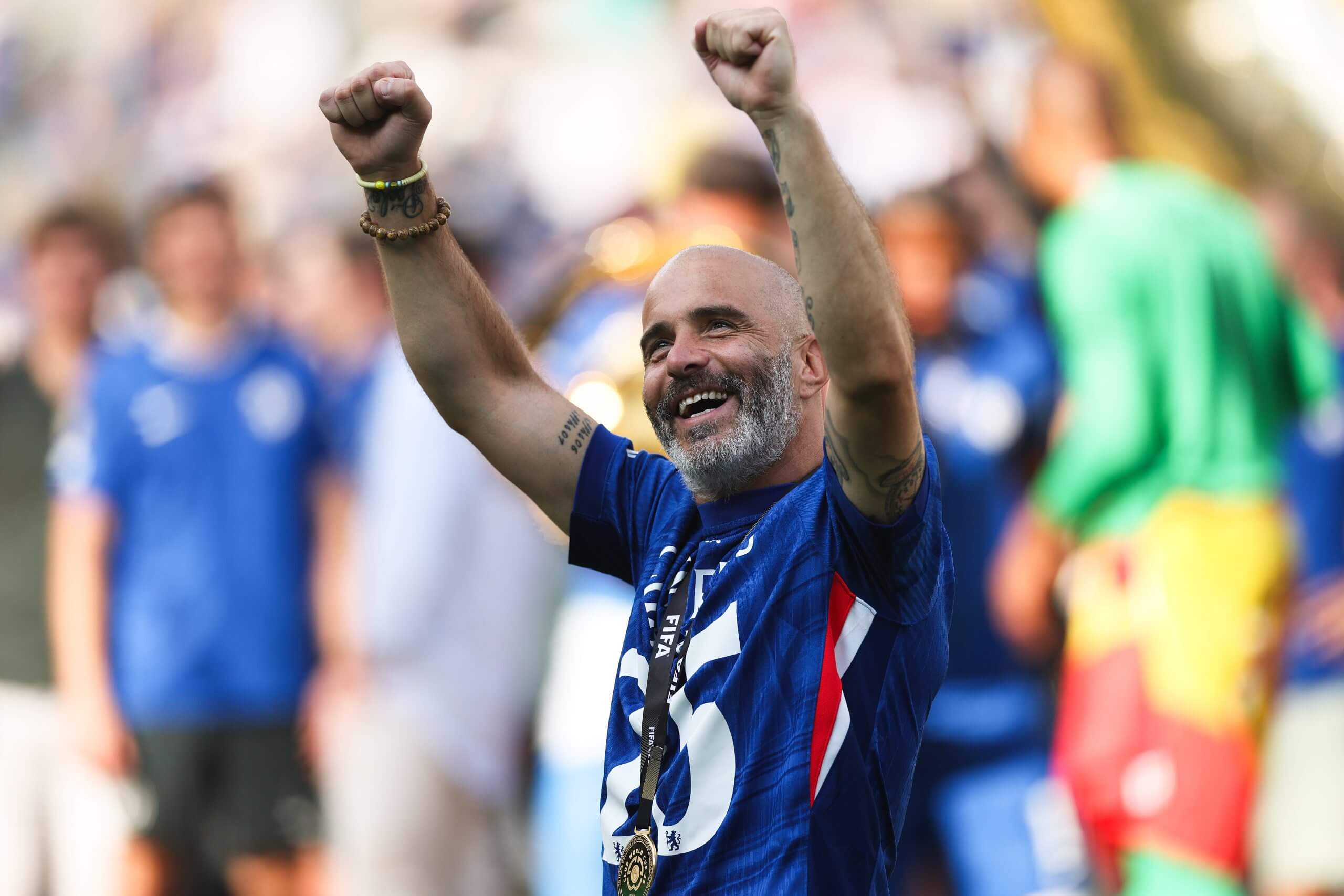
Maresca won the Club World Cup with Chelsea (Buda Mendes/Getty Images)
Chelsea actually came through that stretch reasonably strongly, losing only to Fulham under then-interim head coach Calum McFarlane — who took over again before the end of the season — and Arsenal in both legs of a Carabao Cup semi-final. The first public cracks in the tenure of BlueCo’s chosen Maresca replacement, Liam Rosenior, appeared shortly afterwards and rapidly began to widen following a 5-2 defeat by PSG at Parc des Princes in the Champions League round of 16 in the second week of March.
It was after a 3-0 loss in the second leg of that tie that Enzo Fernandez appeared to lay the blame for Maresca’s departure at Chelsea’s door in an interview with Mexican broadcaster TUDN, and lamented the team’s loss of “identity” without the Italian. Marc Cucurella struck a very similar tone in an exclusive interview with The Athletic while on Spain duty during the March international break, admitting he did not agree with the decision to let Maresca go.
The intimation that they were in any way responsible for Maresca’s exit is utterly rejected by Chelsea, but the mindset of Fernandez, Cucurella and others in the squad was a significant reason why Rosenior never stood a realistic chance of carrying the dressing room with him. By the time he was sacked in April, the tensions between the players still pining for Maresca and those more inclined to look forward were every bit as palpable as the lack of faith in the head coach.
How do you replace Pep Guardiola?
Sam Lee and Reuben Pinder
The view at City is it is not as simple as being able to say Maresca’s exit ruined Chelsea’s season, since other factors such as these contributed to their slide down the Premier League table. However, the Manchester club did release a statement on Monday which said “we recognise that his departure mid-season was disruptive to Chelsea’s season”.
Maresca posted a holiday picture on Instagram in April as Chelsea spiralled and his name was even sung by some anti-BlueCo protesters outside Stamford Bridge — a surprising development, given that his lack of outward charm and a devotion to slow, heavily structured possession football made him an unpopular figure with many supporters during his tenure.
There is no doubt the timing of Maresca’s exit served his own career ambitions extremely well. Untarnished by proximity to the unfolding catastrophe at Stamford Bridge, he gave City no reason to question their confidence that he offers the best hope of continuity operating the unprecedented winning machine that Guardiola built in Manchester. The strength of their conviction is underlined by the size of the compensation package they have agreed to pay to bring him back to the Etihad Stadium.
But the brevity of his Chelsea chapter also adds to the sense that Maresca still represents something of a gamble for the club that has grown used to dominating the Premier League.
He has coached only 159 games at senior professional level, of which 14 were in a brief, failed stint at Parma and 53 were in charge of Leicester City, where he won the Championship in a season that subsequently saw the club docked six points for breaching the EFL’s financial rules.
Maresca’s overall 59.8 per cent win rate in 92 games in charge of Chelsea ranks seventh among the club’s coaches this century, and is the best by some distance of any BlueCo hire. But that record is significantly impacted by a dominant Conference League campaign in 2024-25; he won just 28 of 57 matches (49.1 per cent) in the Premier League.
It is reasonable to point out no other Chelsea coach before or since has fared better with this core of players. Maresca is the only BlueCo appointment to deliver Champions League qualification and won two trophies to boot. Anything less than Conference League glory would have been an embarrassment, but beating PSG at MetLife Stadium to win the inaugural expanded Club World Cup is a legitimately impressive signature achievement.

Rosenior replaced Maresca but only had a short spell in charge (Warren Little/Getty Images)
There were other moments in which Maresca demonstrated his talent for crafting smart, sophisticated modern game plans to beat high-level opponents, most notably against Liverpool and Barcelona at Stamford Bridge in the first half of the 2025-26 season. Fernandez was not wrong when he pointed out that the Italian had given Chelsea a clear identity, albeit one that did not inspire excitement or affection in many match-going supporters.
City’s interest in anointing him as Guardiola’s successor came as no surprise; sources at Chelsea cited the possibility two years ago as one reason why Maresca was handed a five-year contract with a club option for a further 12 months. If this was always going to be the outcome, their preference would surely have been an orderly parting after an uninterrupted 2025-26 season.
Why getting Alonso is a ‘big coup’ for Chelsea
Liam Twomey
It is also fair to wonder if Chelsea would have compounded the destabilising effect of Maresca’s departure with the misguided appointment of Rosenior in the relative calm of summer, freed from the pressure of a relentless fixture schedule. In the midst of the winter grind, it was easier to be convinced that Strasbourg’s coach was the safest continuity pick, particularly in a smaller pool of available options. Real Madrid did not sack Alonso until January 12.
Chelsea eventually found a manager with the elite pedigree to command the respect of their players and fans. “Looking forward to next season, in Xabi Alonso, we have a manager who has an exceptional football mind and is a professional of the highest integrity,” their statement said. “He has all the attributes to deliver the success the club’s supporters deserve and expect.”
Maresca also got the big job he really wanted. “City is an incredibly well-run football club,” he said. “Everything they do is innovative, planned and purposeful. For a manager, that is a dream situation. It provides the consistency I need to do my job effectively.”
Relations between the clubs have not been adversely affected but the damage done at Stamford Bridge in the intervening months will ensure the Italian finds few friends in west London when he next returns with City.