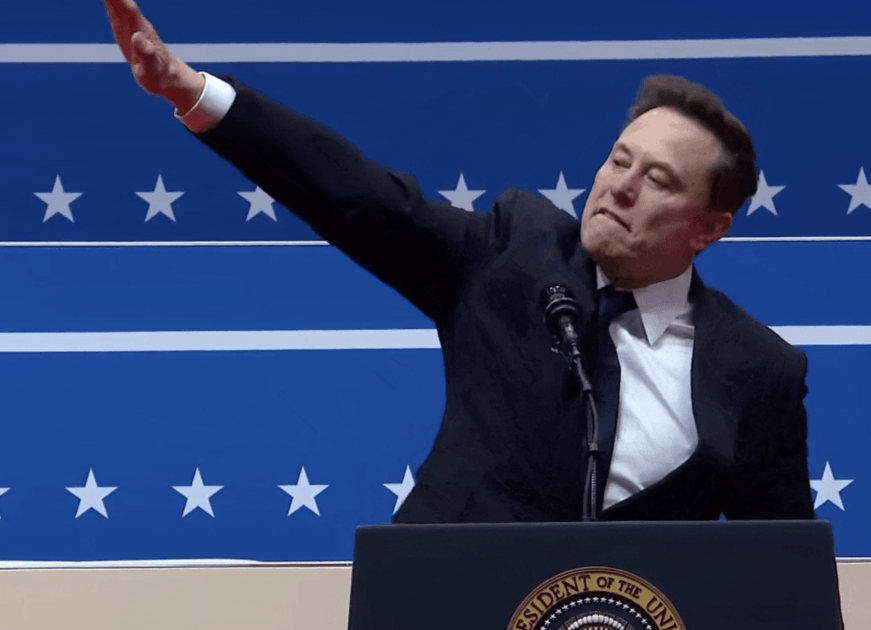
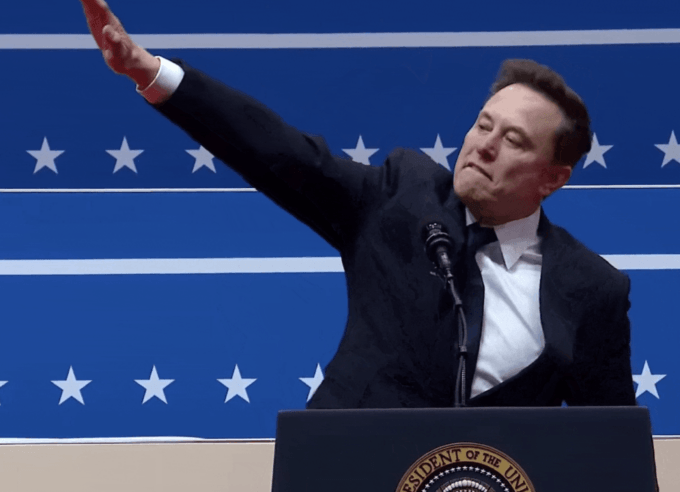
Musk giving a Roman (fascist) salute at the second inauguration of Donald Trump before saying “My heart goes out to you. It is thanks to you that the future of civilization is assured.” Public Domain.
You can’t have capitalism without racism.
–Malcolm X
Elon Musk is less an aberration than the grotesque byproduct of a capitalist order that converts inequality into virtue, exploitation into spectacle, and mistakes its own deepest failures for its greatest successes. The media frenzy surrounding the prospect of Musk becoming the world’s first trillionaire is not a celebration of human progress or individual initiative. It is a symptom of a deeper social and political crisis, one that exposes the power of class privilege, the corrupting forces of gangster capitalism, and a culture increasingly incapable of distinguishing wealth from worth or exploitation from human flourishing.
Musk is symptomatic of the rot of a capitalist system that generates staggering inequalities while concentrating wealth and power in the hands of a tiny elite whose fortunes depend not simply on markets, but on public subsidies, collective labor, social institutions, and shared resources, all sustained by an authoritarian culture animated by white supremacy, ultranationalism, and the mobilizing passions of fascist politics, especially in the age of Trump. As Dan Dinello argues, Musk has become an “avatar of chaos, cruelty, and death.” The description is difficult to dismiss. How else are we to understand his role as Trump’s chief enforcer?
In this case, the world’s richest man played a crucial role in closing and slashing aid for the U.S. humanitarian assistance agency (USAID). To be sure, USAID embodied the contradictions of American power. While it funded vital global health and humanitarian programs, it also functioned as an instrument of U.S. soft power, advancing development agendas and political arrangements often aligned with American geopolitical and economic interests. Its history reminds us that humanitarianism under capitalism has frequently been entangled with empire, shaped as much by the imperatives of power and profit as by the demands of justice and human need. Yet acknowledging these contradictions does not diminish the catastrophic consequences of dismantling the agency. The consequences have been almost unimaginable. Becky Ferreira states that:
According to monitoring models, the collapse of USAID may have already caused 762,000 preventable deaths, 500,000 of which are children, while the cuts could lead to more than nine million preventable deaths by 2030, according to a study published in February 2026….[In addition], after USAID closed, there was a rapid increase in the likelihood of violence, the severity of conflict, and the lethality of conflict, in nearly a thousand administrative regions across Africa.
Yet the mythology surrounding Musk erases these social foundations. The self-made billionaire is transformed into a heroic figure, while the workers, public investments, and democratic institutions that made his fortune possible disappear from view. Jenni Krithara is right in stating that “Elon Musk has become a symbol of success! In reality, however, he is nothing more than a symbol of inequality and exploitation. No billionaire created the wealth he possesses alone. Behind every corporate empire are workers, public infrastructure, universities, research programs, natural resources and entire societies.”
At the same time, Musk’s ascent reveals the power of a culture and public pedagogy that normalizes and celebrates massive inequities in wealth and power. In a society saturated by myths of entrepreneurial genius and limitless success, extreme concentrations of wealth and power are legitimated as objects of admiration rather than outrage. The scandal is not simply that one person can possess more wealth than entire nations while millions struggle to survive and are relegated to life-threatening poverty and lack of adequate health care.
As Thomas Piketty makes clear in Capital in the Twenty-First Century, people are taught to view the grotesque imbalance and staggering levels of inequality and power as natural, inevitable, and even desirable. At work here is a politics that normalizes economic injustice, while depoliticizing any attempt to analyze it and hold a system and individuals responsible for propagating it. It is hardly surprising that Musk regards empathy as a threat to the authoritarian ethic of white Christian nationalism and treats free speech as a disposable principle, useful only when it serves the interests of power.
Under these conditions, inequality becomes a spectacle sustained by a lethal public pedagogy in which exploitation is rebranded as achievement and democracy itself is endangered as economic power increasingly shapes politics, public discourse, and everyday life. The media’s celebration of Musk’s wealth is not innocent reportage. It teaches people to admire concentrations of wealth that earlier generations would have regarded as obscene. It transforms plutocracy into aspiration and dispossession into a private failing rather than a public injustice. Under such conditions, private issues rooted in a celebrity discourse are severed from the broader systems of power and inequality that produce them. To understand Musk’s appeal, however, requires examining the spectacle through which his power is organized and legitimized.
Spectacle in the age of Musk no longer functions simply as distraction. It has become a mode of governance. Musk understands that power today depends less upon persuading people than upon occupying the circuits of attention through which people experience reality itself. The billionaire is no longer merely an owner of capital. He is an engineer of attention, a curator of affect, and an architect of the public imagination.
What Debord once called the society of the spectacle has entered a new phase. Spectacle is no longer confined to television screens, political rallies, or advertising campaigns. It is now embedded in algorithms that organize desire, shape perception, and reward outrage. In Musk’s universe, visibility itself becomes power. Every provocation, conspiracy theory, racist insinuation, or theatrical gesture feeds an economy of attention in which shock displaces thought and notoriety becomes indistinguishable from authority.
The spectacle no longer hides domination. It glamorizes it. Wealth appears as genius, cruelty as authenticity, and the dismantling of democratic institutions as evidence of courage. Politics becomes performance while the public sphere collapses into a marketplace of emotions organized around fear, resentment, and manufactured grievance.
Yet Musk’s wealth is inseparable from the politics it enables. Economic power at this scale does not merely influence public life; it reshapes the very conditions under which democracy can survive. Musk’s politics intensify these dangers.He has used his immense wealth and control over digital platforms to amplify conspiracy theories, attack democratic institutions, and lend support to far-right and nationalist movements in the United States and abroad. He has embraced the language of racial panic, amplified antisemitic and white nationalist narratives, promoted accounts trafficking in racist conspiracy theories, and used X to normalize forms of hatred once relegated to the political margins. Wealth at this scale is not simply economic. It is political, cultural, and pedagogical. It shapes public consciousness while insulating itself from democratic accountability.
Musk represents something historically new: the fusion of celebrity culture, algorithmic power, and authoritarian politics into a single figure whose influence extends across nations and institutions. He is not simply a capitalist with political opinions. He is a spectacle unto himself, a brand organized around excess, provocation, and the performance of transgression. The appeal of such figures cannot be understood through economics alone. It must also be understood aesthetically.
As I have argued throughout this book, Susan Sontag once argued that fascist aesthetics transforms politics into an intoxicating drama of style, ritual, and emotional intensity. The attraction lies less in ideas than in sensations: the thrill of power, the seduction of force, the glamour of transgression. Musk updates this tradition for the digital age. He stages himself as the outlaw billionaire, the rebellious genius unconstrained by norms, laws, or democratic accountability. What he offers his followers is not merely a politics but an affective experience: the pleasure of belonging to a movement that mistakes cruelty for courage and domination for freedom.
The spectacle’s greatest deception is that it draws attention to Musk the personality while obscuring Musk the architect of a new political economy. Behind the oscillating images of genius and martyr lies a project aimed not merely at dismantling parts of the public sphere but at reorganizing them around private power—integrating his companies into state and military infrastructures, weakening the institutions charged with regulating them, and converting public resources into engines of oligarchic wealth and influence.
The spectacle’s greatest deception is that it draws attention to Musk the personality while obscuring Musk the architect of a new political economy. Behind the oscillating images of genius and martyr lies a project aimed not merely at dismantling parts of the public sphere but at reorganizing them around private power—integrating his companies into state and military infrastructures, weakening the institutions charged with regulating them, and converting public resources into engines of oligarchic wealth and influence.
Musk’s rise is not a triumph of individual initiative or entrepreneurial genius. It is the product of a social order in which public resources, state subsidies, collective labor, and technological infrastructures are privatized and redirected toward the enrichment of a tiny oligarchic elite. He despises the social contract because it places obligations on wealth and imposes democratic limits on power. As Quinn Slobodian and Ben Tarnoff note in Muskism: A Guide for the Perplexed, in its place, Musk advances a far-right vision that fuses state power with technological control, elevates algorithmic governance over democratic accountability, and normalizes racialized exclusion as a principle of social order. Musk’s political project promises freedom while producing new forms of dependence, claiming to democratize technology even as it concentrates unprecedented power in private hands.
Will Bunch is right in stating that Musk has transformed X into a global amplifier for racial resentment and white nationalist politics. Under the guise of defending “free speech,” he has repeatedly elevated far-right influencers, reinstated accounts banned for hate speech, and promoted narratives that depict immigrants and racial minorities as existential threats to Western civilization. Just before the Belfast anti-immigrant riots in 2026, Musk amplified calls by the far-right agitator Tommy Robinson for people to “hit the streets,” adding his own exhortation: “Only by protesting REPEATEDLY and LOUDLY will there be any change!!” The consequences were immediate and terrifying: attacks on immigrant communities, immigrant addresses posted online and homes set ablaze, and an online culture of racial hatred legitimated and endorsed by the world’s richest man.
Zadie Smith has observed that the propaganda machinery of fascism once relied on posters, radios, and megaphones, crude instruments compared to what Elon Musk now commands. The comparison is instructive. The danger today lies not simply in extremist messages but in the infrastructures that circulate them. Algorithms reward outrage, synchronize emotions, and impose forms of conformity that often operate invisibly. The propaganda machine no longer shouts at citizens from a distance. It lives in their pockets, curates their desires, and quietly organizes their fears.
Musk presides over precisely such a machinery. X functions not simply as a platform for communication but as an apparatus for manufacturing attention, resentment, and ideological belonging. The result is a culture in which people increasingly surrender the burdens of judgment and critical thought to the emotional rhythms of the feed. Spectacle becomes a form of social organization, teaching individuals to react rather than reflect and to experience political life as an endless theater of outrage and enemies.
X is no longer merely a communication network. It has become an infrastructure of authoritarian politics, normalizing racism, rewarding outrage, and converting white grievance into a global spectacle of resentment and cruelty. The richest man on the planet has become one of the chief architects of a politics of white victimhood, one in which white people are perpetually under siege by dangerous invaders who happen to be Black, Brown, and immigrants. How else to explain his barrage of racist posts and conspiratorial rhetoric, along with his support for far-right anti-immigrant movements such as Restore Britain?
X has become one of the most powerful pedagogical apparatuses of the digital age, teaching millions to equate cruelty with courage, racial hierarchy with common sense, and hatred with truth. What is marketed as free speech increasingly operates as a machinery of authoritarian desire that erodes the civic and ethical foundations of democratic life. The symbolism surrounding Musk has become increasingly ominous. After making a gesture at a political rally that was widely condemned as echoing a Nazi salute, Musk responded to the ensuing criticism with mockery rather than reflection. The episode was revealing because it exposed an authoritarian politics in which provocation becomes spectacle, cruelty becomes a public virtue, and historical amnesia becomes a precondition for making fascist ideas appear ordinary, even commonsensical. Fascism rarely begins with concentration camps or military coups. It begins with the normalization of contempt, the trivialization of violence, and the celebration of power unmoored from ethical responsibility.
Musk’s growing influence has become a warning sign of a new form of oligarchic rule in which immense wealth, technological power, and political influence converge to hollow out democratic life from within. The danger lies not only in his embrace of far-right movements and authoritarian figures abroad, but in the extraordinary capacity of a single billionaire to distort public debate, destabilize democratic institutions, and shape political life across national borders. Musk is not the real issue. He is the symptom. The larger question is whether any vestige of democracy can survive when private wealth acquires such immense power over the institutions and cultures that sustain public life.
The spectacle of the world’s richest man accumulating unimaginable wealth while endorsing politics that deepen social divisions and undermine democratic norms exposes the moral bankruptcy of a gangster capitalism that rewards accumulation while abandoning social responsibility. Trillionaire politics is not simply the concentration of wealth. It is the concentration of power, influence, and the capacity to shape the stories societies tell about themselves.
The gravest danger is not Musk himself but the culture that celebrates him. Citizens are increasingly schooled to applaud the very forces that diminish their agency and erode their social protections. They are encouraged to admire those who dominate them, to mistake cruelty for strength, and to equate democracy with the freedom of billionaires to exercise unchecked power. Trillionaire politics is the end point of a society inhabited by what might be called the walking dead: citizens politically numbed and morally anesthetized, taught to applaud their own dispossession, embrace loneliness as freedom, and accept misery as the price of greatness.
The first trillionaire is not a monument to human achievement. He is an indictment of a corrupt social order that mistakes accumulation for greatness, toxic masculinity for leadership, and domination for success. Is it any wonder that Musk views empathy as a weakness and free speech as a disposable principle? Both stand in the way of the politics of cruelty, white nationalism, and unchecked power he increasingly champions.
Musk is the product of a culture that worships wealth, mistakes spectacle for truth, and increasingly confuses domination with freedom. He represents the emergence of a new authoritarian formation in which capitalism, digital technologies, and fascist sensibilities converge in unprecedented ways. He is the avatar of a techno-fascist order, an updated form of neoliberal gangster capitalism in which state power, digital technologies, and oligarchic wealth converge to erode democratic institutions and remake society in the interests of a predatory elite.
The danger he poses lies not only in the policies he supports or the movements he amplifies. It lies in the world he helps create: a world in which algorithms replace judgment, cruelty becomes entertainment, racism is repackaged as realism, and democracy is hollowed out by spectacles of resentment and manufactured consent.
If Trump embodies the theatrical politics of authoritarianism, Musk represents its technological future. He is the engineer of a new machinery of spectacle, one capable of shaping consciousness on a planetary scale. In this sense, Musk is not simply the world’s richest man. He is among the most powerful public pedagogues of the twenty-first century, educating millions in the pleasures of unfreedom and the aesthetics of authoritarian desire.
Musk is not an exception to our time. He is the most visible symptom of a society in which cruelty is celebrated as strength, democracy is hollowed out by oligarchic power, and freedom is reduced to the prerogatives of the rich. This is more than a failed society. It is capitalism stripped of its myths and revealed in all of its gangster, authoritarian, and fascist impulses.