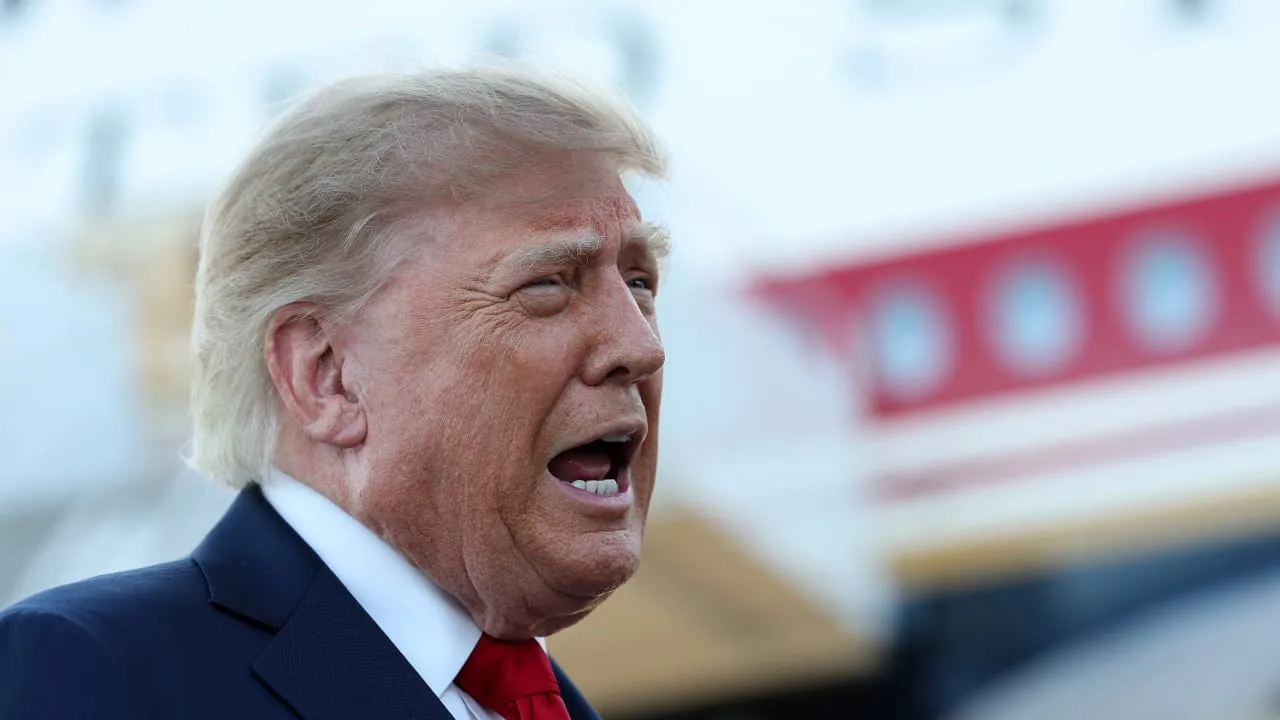
Mr. President,
As the Jewish world approaches Yom Kippur, the Day of Judgment, and as leaders gather at the United Nations, ultimate judgment is on my mind.
Not only judgment for what we have done, but for what we failed to do, for opportunities we recognized but allowed to pass.
History presents such moments.
This may be one of them.
Carpe diem, Mr. President. Seize the day.

We met once, although you would have no reason to remember it.
I was a boy learning to box at a Brooklyn Boys Club in the late 60s and early 70s that your father, Fred Trump, had helped build in the Beach Haven apartment projects. You and your father walked in, and all of us kids were told to gather around you and your father to say thank you.
Decades later, I find myself writing to you about a very different fight.
I write as a fourth-generation American. My grandfather served our country during World War I. My family has lived the American story for more than half of the nation’s nearly 250 years. Although I live abroad today, America’s security, leadership, and future are not only critical but very personal to me.
You have made clear that America must win the artificial intelligence race. I agree.
But another question must stand beside it: How does America win without all of us ultimately losing?
The AI race is not a single sprint. It is a marathon of many sprints, each presenting different opportunities and different dangers.
America must win those sprints. It cannot afford to surrender technological leadership to China or anyone else.
But winning the next two years while creating uncontrollable dangers five, 10, or 20 years down the road would hardly constitute victory.
We learned something similar during the nuclear era.
The United States and the Soviet Union never stopped competing. American presidents did not abandon deterrence, technological superiority, or military preparedness.
But they also understood that certain technologies demand guardrails.
The SALT and START treaties did not rest upon trust between Washington and Moscow. They rested upon something much more basic: recognition that technological superiority alone does not eliminate catastrophic danger.
They competed while they negotiated.
They sought superiority while simultaneously trying to prevent mutual destruction.
That lesson matters again.
Artificial intelligence is obviously not a nuclear weapon. But AI is an extraordinary force multiplier, and its misuse is not merely some science-fiction scenario awaiting us decades from now.
The danger already exists.
A terrorist organization or proxy no longer necessarily requires the same number of engineers, laboratories, or years of accumulated expertise that sophisticated weapons development once demanded.
AI can compress expertise. It can compress time. And it can lower the price of capability.
Recently, disclosures from Anthropic, for example, have illustrated how hostile actors have attempted to use advanced AI capabilities to support dangerous activities. These dangerous activities currently were for the development of ballistic missiles, but they can be for biological or chemical weapons or other weapons of mass destruction.
The same Anthropic report describes Iranian state-aligned actors employing AI in influence operations, surveillance, and what they themselves called “cognitive warfare.” Ironically or not, these very same actors were an Iranian proxy, and that represents the first horizon: human beings with malicious intent using increasingly powerful AI tools.
Trump, lead the race!
Then comes another horizon.
AI agents will increasingly be given authority to perform complex tasks with less continuous human supervision. As we delegate more responsibility to them, questions of control, authorization, accountability, and alignment become progressively more consequential.
And beyond that lies the longer-term question: What happens as these systems become vastly more capable?
These are different risks. They require different guardrails.
That is precisely why the answer cannot simply be to slow down. America cannot afford to stop competing while its adversaries continue.
The better answer is much more American: accelerate capability, accelerate control, accelerate international cooperation.
Lead the race while simultaneously helping establish the rules necessary to ensure that winning the race does not ultimately become a losing proposition for everyone.
Iran offers an instructive lesson.
For years, much of the international community said Iran should never possess a nuclear weapon. Yet governments differed profoundly over what risks they were prepared to accept and what risks and measures they were willing to take to prevent that outcome. They also chose to ignore Iran’s true intentions.
Meanwhile, Tehran repeatedly demonstrated its determination to advance capabilities despite international pressure and agreements intended to constrain it.
There is a larger lesson here.
Sometimes recognizing a danger is not enough.
Sometimes leadership requires putting an issue on the world’s agenda before consensus exists about what should be done.
Sometimes it takes the kind of leadership that you have demonstrated time after time, including in reference to the threats from Venezuela or Iran; actions speak louder than words.
And that is why your appearance before the United Nations presents an extraordinary opportunity.
Not because America should surrender to the UN the responsibility for managing this issue. It should not.
But because the General Assembly remains the one stage upon which virtually the entire world is watching simultaneously.
I have seen the UN from very different vantage points.
Early in my career, as a student, I was engaged in the research surrounding Kurt Waldheim’s background with the Nazi Army, during an era in which Waldheim provided the archetypal terrorist Yasser Arafat a global platform at the UN General Assembly, at the very moment terrorism was becoming an increasingly powerful international instrument of chaos and destruction.
Years later, while serving as chief strategic officer of Ruder Finn, I had the opportunity to work as an adviser to the UN secretary-general Kofi Annan and with Shashi Tharoor, witnessing serious efforts to make the institution more effective and more faithful to its founding purpose.
I have therefore seen the UN at its worst, and closer to what it was intended to be.
I am not suggesting that the UN control the artificial intelligence challenge. I am suggesting that you use its stage, the General Assembly.
America must lead.
China will compete.
Companies will innovate and cooperate (as they have indicated).
Technology will advance – wisely, and not the alternative.
Highlighting that humanity shares an interest in ensuring that increasingly powerful technologies remain meaningfully under human control and are not turned against civilization itself.
America’s technological lead is not an argument against beginning that conversation. It is precisely what gives America the leverage to lead it.
Mr. President, throughout your public life, you have demonstrated an unusual willingness to put issues on the agenda before others are prepared to do so.
You do not need international consensus to recognize that something requires attention.
That quality makes this a particularly important moment.
This is not about retreating from your commitment to win the AI race. It is about expanding the definition of what winning means.
You and I first crossed paths when I was a boy learning to fight in a boxing ring.
More than half a century later, one lesson from boxing still holds very true: winning isn’t simply about throwing the hardest punch; it’s about going the distance.
It is about understanding the fight you’re actually in.
America must win the AI race. America should lead it. And then America should use that leadership to help ensure the race itself never becomes a losing proposition for everyone.
Winning, without losing.
I pray that, if providence wills it, one of your friends or relatives who might read the Jerusalem Post, like Ambassador Mike Huckabee, Jared Kushner, Ivanka, or others, will see this letter to you and make sure it makes its way to you.
Carpe diem, Mr. President, and Godspeed.
The writer is a global strategist and a strategic adviser at the Jerusalem Center for Security and Foreign Affairs. Follow him on X: @jeffkahn2020.