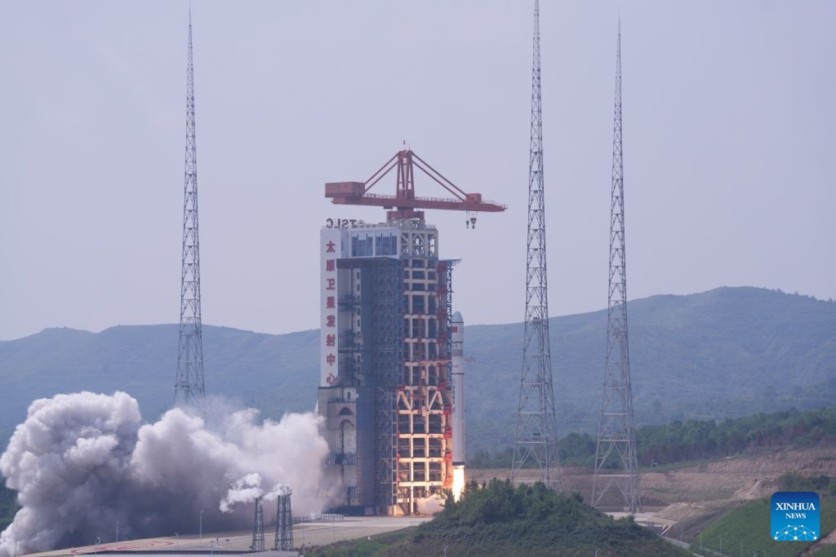
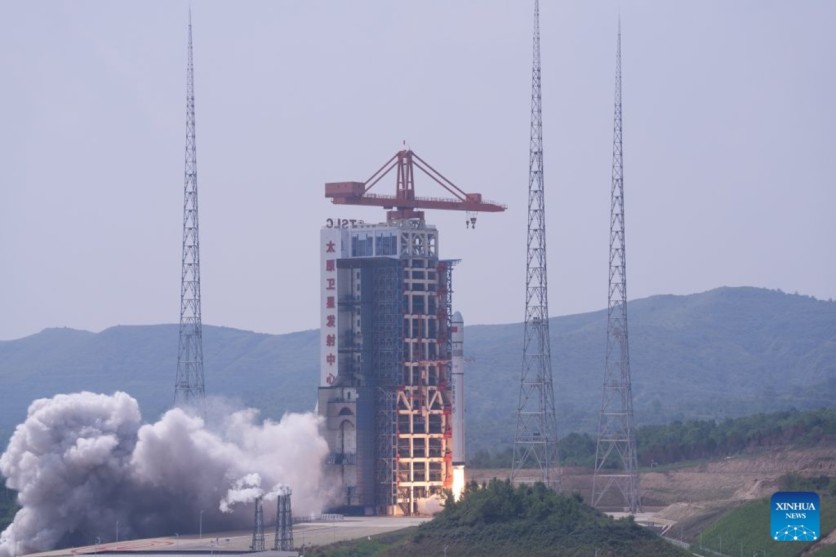
A Chinese private commercial space firm delivered its first complete satellite-plus-ground-system package to a foreign government on Tuesday, orbiting a Thai remote-sensing CubeSat aboard a Long March 6C rocket and establishing a new template for how China’s commercial space sector intends to compete across the developing world.
The payload — the Lingzhi-09 Thailand CubeSat, built by Beijing-based GalaxySpace for Thailand’s Geo-Informatics and Space Technology Development Agency (GISTDA) — is modest in size but significant in scope. GalaxySpace did not sell GISTDA a satellite; it sold GISTDA a national space capability: spacecraft, ground tracking station, telemetry and control systems, and a structured personnel-training program for Thai engineers and university students. According to GalaxySpace, it is the first time a Chinese private commercial space firm has delivered that combination to a foreign user, and the first time any Chinese commercial enterprise has executed the full package — satellite development, launch, and in-orbit handover — for a Southeast Asian government.
The launch — the 665th Long March carrier mission — lifted off from the Taiyuan Satellite Launch Center in Shanxi Province at 11:21 a.m. Beijing Time on Tuesday (11:21 p.m. ET on Monday, August 24), successfully placing all seven satellites into their planned sun-synchronous orbits.
Long March 6C: Second Flight for China’s Newest Cryogenic Workhorse
Tuesday’s mission marked only the second flight of the Long March 6C — a vehicle that made its maiden flight on May 7, 2024, and represents the most recent addition to China’s Long March family of medium-lift rockets.
Developed by the Shanghai Academy of Spaceflight Technology, the two-stage rocket stands 43 meters (141 feet) tall with a body diameter of 3.35 meters (11 feet) and lifts off at a gross weight of approximately 215 metric tons (237 short tons). Its three engines — two YF-100 units on the first stage and one YF-115 on the second — burn liquid oxygen and kerosene, a cryogenic propellant combination that provides higher specific impulse than solid-fuel alternatives while avoiding the more complex handling requirements of liquid hydrogen. The 6C can deliver 2.4 metric tons (2.6 short tons) of payload to a 500-kilometer (310-mile) sun-synchronous orbit, or 4 metric tons (4.4 short tons) to a 300-kilometer (186-mile) low-Earth orbit, per China Daily’s specifications summary.
The 6C’s distinguishing design feature is what it lacks: the four strap-on solid rocket boosters that define the Long March 6A variant. That boosterless configuration reduces manufacturing complexity and makes the 6C better suited to flexible rideshare missions — where the payload mix changes mission to mission — than the higher-lift but more constrained 6A. Tuesday’s seven-satellite rideshare demonstrated that flexibility directly.
What GalaxySpace Actually Delivered to Thailand
Sun-synchronous orbit (SSO) is the standard track for Earth observation satellites: by maintaining a constant angle relative to the Sun as the satellite completes each orbit, SSO ensures that any given patch of ground is imaged at consistent local solar times across successive passes. That consistency is essential for change-detection applications — agricultural monitoring, flood mapping, deforestation tracking — because it removes the variable of changing illumination angle between images. GISTDA stated the Lingzhi-09 will collect data for land management, agriculture, and environmental monitoring, which is precisely what SSO was designed to serve.
The turnkey scope of the delivery is what makes the transaction strategically notable. Previous Chinese satellite export deals — including state-entity exports to Nigeria, Algeria, and Pakistan through China Great Wall Industry Corporation — bundled spacecraft, launch, and financing into single government-credit packages. GalaxySpace’s contract with GISTDA follows a different structure: a private commercial firm (not a state entity) delivering an end-to-end operational capability to a government agency, including organized training programs in China for Thai engineers and on-site technical instruction dispatched to Bangkok.
GalaxySpace co-founder Liu Chang described the scope of the delivery explicitly: “This cooperation has demonstrated GalaxySpace’s end-to-end overseas delivery capabilities and represents an international application of our engineering and systems capabilities. Building on this achievement, we will focus on expanding markets in Belt and Road Initiative partner countries, steadily broaden our overseas industrial layout, and promote space technology globally,” Liu Chang told the Global Times.
Wang Yanan, editor-in-chief of Aerospace Knowledge magazine, characterized the offering as a “turnkey solution” in which the Chinese firm provides not just hardware but software support, launch services, ground tracking, telemetry, personnel training, and technical assistance — and predicted that demand for such packages is growing, particularly in developing countries that need space resources for disaster monitoring, agriculture, and communications infrastructure, according to the Global Times.
How GalaxySpace’s SAR Satellites Work — and Why Onboard Processing Changes the Equation
Two of Tuesday’s seven satellites — AirSat 14 and AirSat 15, built by GalaxySpace for satellite operator AirSat — carry a technical capability that distinguishes them from conventional remote-sensing satellites: dedicated onboard cloud computing payloads that process Synthetic Aperture Radar (SAR) data in orbit before transmitting results to the ground.
SAR is a form of radar that uses the motion of the satellite across a target region to synthesize a large effective antenna aperture — producing high-resolution imagery regardless of cloud cover or daylight conditions, a significant advantage over optical sensors that require clear skies and sunlight. The same imaging capability that identifies flood boundaries and agricultural boundaries also images military installations and naval vessels; SAR data is inherently dual-use. U.S. authorities sanctioned Chang Guang for dual-use imagery provided to hostile actors — a precedent that shapes how Western governments assess commercial SAR operators broadly.
The architectural distinction in AirSat 14 and 15 is where the processing happens. In a conventional remote-sensing satellite, raw sensor data is downlinked to a ground station, where computing infrastructure processes it into usable imagery and analysis. That pipeline introduces latency — potentially hours between capture and usable output — and requires substantial ground-station bandwidth. AirSat 14 and 15 move the compute into orbit: the satellites receive, process, and analyze the data on board, then downlink the result. GalaxySpace stated this cuts disaster response times to minutes in flood or earthquake scenarios and significantly reduces bandwidth demand.
The broader implication is that the satellite delivers processed intelligence rather than raw radar returns — reducing the technical burden on the ground operator while also reducing ground-side visibility into what, specifically, the satellite is analyzing.
Why Hasn’t GalaxySpace Already Beaten Starlink?
GalaxySpace is positioning itself explicitly as an alternative to Starlink and Western satellite providers in developing nations. According to GalaxySpace, more than 2.5 billion people worldwide lack internet access and the company believes the global market is large enough to accommodate alternatives to Starlink.
That ambition collides with a structural constraint that no amount of engineering ambition has yet resolved: launch cost.
According to a February 2026 MERICS orbital geopolitics analysis, China’s commercial launch costs run approximately CNY 150,000 per kilogram — roughly $22,300 per kilogram at current exchange rates — compared to SpaceX’s Falcon 9, which costs $2,700 to $3,000 per kilogram. That gap — approximately seven to eight times — exists because SpaceX’s Falcon 9 is reusable, recovering and reflying first-stage boosters routinely, while China’s Long March family relies on expendable vehicles. GalaxySpace cannot match Starlink’s per-unit economics until China fields a reliable reusable launch vehicle, which multiple Chinese commercial firms are developing but none has yet demonstrated at commercial scale.
MERICS also documented that the Guowang and SpaceSail megaconstellations — China’s state-backed broadband ambitions — remain far behind deployment targets, with only approximately 260 LEO satellites launched combined against a requirement of over 2,600 to retain their ITU spectrum rights by the end of 2026. GalaxySpace is a key supplier to both programs.
The ecosystem immaturity extends to international users: GalaxySpace’s ground station documentation, technical support infrastructure, and regulatory coordination for international operations are not at the level of Starlink’s commercial subscriber offering. Companies purchasing a turnkey GalaxySpace solution are accepting a relationship with a firm still in an early phase of international scaling — one that had, until Tuesday, never completed a full overseas delivery.
What Thailand’s Ground System Agreement Actually Means
The piece of Tuesday’s announcement that received the least attention in GalaxySpace’s own characterization is the ground system — and it is the piece that carries the most significant long-term implication for GISTDA and other governments that follow the same model.
China’s 2017 National Intelligence Law requires “all organizations and citizens” to “support, assist, and cooperate with national intelligence work” when requested by the state. The law does not limit this obligation to Chinese territory, and Western governments and legal scholars have consistently argued that any Chinese company operating globally remains subject to its requirements, regardless of where the company’s servers are located or what its own privacy policies state. China’s Data Security Law and Cybersecurity Law add further government-access provisions that apply to Chinese firms’ data operations.
The practical consequence for GISTDA: the ground tracking station, telemetry and control systems, and operational software delivered by GalaxySpace are products of a company legally compellable by Beijing to assist intelligence operations involving that infrastructure. This is not a contested allegation about GalaxySpace’s intentions; it is a fixed condition of the legal framework under which every Chinese company operates. GalaxySpace has not been sanctioned and there are no documented incidents of the company providing data to Chinese intelligence services.
China’s civil-military fusion doctrine further integrates commercial space firms — including private companies — into defense planning frameworks, meaning that GalaxySpace’s growing portfolio of satellites and its expanding international ground infrastructure exist within a national strategic context that is broader than its commercial contracts reflect.
For governments evaluating the turnkey export model — the “satellite-ground system-training” bundle that GalaxySpace delivered to GISTDA — the legal framework is a fixed condition that competitive pricing and technical quality do not change.
Before Buying the Bundle: A Decision Framework
GalaxySpace has now demonstrated that a Chinese private commercial space firm can execute an end-to-end satellite export. For policymakers in developing nations evaluating whether to replicate Thailand’s arrangement, four considerations belong in the analysis alongside price and capability:
Performance relative to Western alternatives. GalaxySpace’s constellation capabilities are real but still maturing. The company’s launch track record, satellite reliability data, and on-orbit performance history are not publicly documented at the same depth as established providers. Independent benchmark verification of claimed capabilities by a third-party auditor has not been publicly completed.
Ecosystem and operational maturity. International customers are accepting a first-of-kind delivery from a company that had no prior full overseas export on its record as of yesterday. Documentation, technical support channels, spare-parts availability, and long-term mission-extension options for international customers are not at the operational depth of established satellite operators.
The launch cost gap. At current Chinese launch costs (approximately $22,300 per kilogram to LEO, per MERICS), GalaxySpace cannot yet match Western launch pricing for large constellations — though the per-satellite cost for a single CubeSat export is a different calculation than megaconstellation deployment.
The National Intelligence Law. Beijing’s legal authority over every Chinese company is a fixed condition of every contract. A government that accepts Chinese-built ground infrastructure with embedded telemetry and control systems is accepting infrastructure that China’s own laws empower the state to compel access to.
None of these considerations makes GalaxySpace’s offer noncompetitive. For a nation like Thailand that already operates a ground station partnership with Landsat, has existing Chinese technology relationships, and is evaluating space capability as an educational and developmental tool, the turnkey model delivers concrete value. The analysis is complete only when all four dimensions are present alongside the cost and capability comparison.
Currency conversions in this article use a mid-market CNY/USD rate of approximately 6.72, as of August 25, 2026. Conversions are approximate.
Frequently Asked Questions
What does “turnkey” mean for a satellite contract, and why does it matter that GalaxySpace delivered one to Thailand?
A turnkey satellite contract covers everything a buyer needs to operate a satellite independently — the spacecraft itself, the ground station for controlling it and downloading its data, the tracking and telemetry systems, and the training for local personnel to run it. Previous Chinese satellite exports typically went through state entities like China Great Wall Industry Corporation, which bundled spacecraft, launch, and financing under government credit arrangements. GalaxySpace’s delivery to GISTDA is the first time a Chinese private commercial space company has completed the full package — satellite, ground system, and training — for a foreign government, and the first time any Chinese commercial entity has done so in Southeast Asia. The significance is that it establishes a new commercial model distinct from the state-entity export model, potentially more accessible to mid-tier developing nations that don’t require the credit-financing structure.
Is China’s National Intelligence Law a real risk for governments that accept Chinese-built satellite ground infrastructure?
Yes, as a structural legal condition — not as a documented incident. China’s 2017 National Intelligence Law requires all organizations and citizens to cooperate with intelligence work when the state requests it. This applies to GalaxySpace and covers its products and infrastructure regardless of where those products are physically located. China’s Data Security Law (2021) and Cybersecurity Law (2017) add further government-access provisions. Western governments have consistently taken the position in proceedings involving Chinese technology companies that this legal obligation is real and extraterritorial. GalaxySpace has not been sanctioned and there are no publicly known incidents of the company providing data to intelligence services. The law is a fixed condition — it does not depend on intent or incident history.
How does the Long March 6C differ from the Long March 6A that has had upper-stage debris breakup problems?
The Long March 6A has four strap-on solid rocket boosters augmenting its liquid-fuel core, giving it higher lift capacity but a more complex staging sequence. The Long March 6A has experienced four upper-stage in-orbit breakup events across its first 22 flights — a documented debris problem that China has disclosed no root cause for. The Long March 6C is the boosterless variant of the same family — no strap-on boosters, simpler staging — and made its second flight on Tuesday. No breakup issues have been attributed to the 6C in its brief operational history, though with only two flights, its reliability record is not yet statistically meaningful.
Can GalaxySpace realistically compete with Starlink across developing nations?
On price per satellite for a single government export, potentially yes — the Lingzhi-09 CubeSat delivery is a different cost structure from Starlink’s consumer subscription model. As a provider of broad internet connectivity at scale, no — not yet. The structural gap is launch cost: Chinese expendable rockets cost approximately CNY 150,000 per kilogram (roughly $22,300) to orbit, compared to SpaceX’s Falcon 9 reusable rockets at $2,700 to $3,000 per kilogram. Until China fields a reusable launch vehicle that approaches Falcon 9’s economics, GalaxySpace’s cost structure for large-scale constellation deployment will remain substantially higher than SpaceX’s. Several Chinese commercial firms are developing reusable rockets, but none has demonstrated commercial-scale reliability as of this writing.