Key Points
The Space Exploration Technologies (NASDAQ: SPCX) IPO officially made Elon Musk a trillionaire. The SpaceX founder owns a substantial stake in the business, as well as a good chunk of the other trillion-dollar company he runs, Tesla (NASDAQ: TSLA). The two stock holdings have a combined worth of around $1 trillion, depending on what the market thinks of each stock on any given day.
Recent SEC filings revealed exactly how many shares of SpaceX Musk currently owns. That number is very important for investors in both of Musk’s publicly traded companies, especially as the CEO pushes to merge the two into a single entity. Here’s what the filings revealed and what it means for investors.
Missed Nvidia in 2009? This Rare Signal Is Flashing Again. In 2009, a “Double Down” signal flashed for a little-known chipmaker called Nvidia. For the first time in years, that same “Total Conviction” signal is flashing for a company 1/100th the size of Nvidia. Continue »
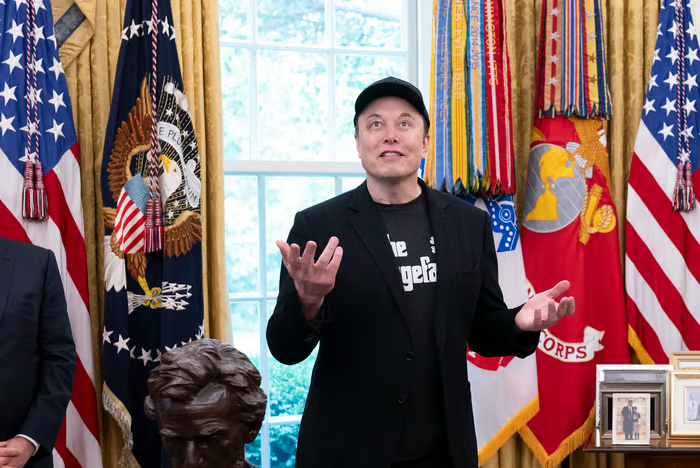
Image source: The White House.
How many shares of SpaceX does Musk own?
SpaceX’s SEC filings show Elon Musk effectively controls 6.4 billion shares of SpaceX as of the end of June. That’s 48.4% of the entire company at the time of this writing.
Importantly, just 849 million of those shares are Class A. The rest are Class B shares (or restricted stock units or options). Class B shares have ten times the voting power of Class A shares. As a result, Musk controls over 85% of the total votes, allowing him to make business decisions unilaterally.
With so much voting power, SpaceX can make acquisitions with its stock, while Musk retains total control over the corporation. For example, SpaceX just closed its $60 billion acquisition of Cursor, the developer of the artificial intelligence (AI) coding agent. Even after the hefty acquisition, Musk’s voting power will fall by less than a percentage point, even if all restricted stock units and options in the deal are fully exercised.
Considering how little impact the Cursor acquisition had on Musk’s voting power, he could make a much larger acquisition using SpaceX stock without losing control of the company. That’s exactly why he may look to merge Tesla with SpaceX.
Musk has every incentive to merge his companies
In early 2024, Musk said he wants about 25% of Tesla’s voting power to push the company toward the future of AI and robotics. He held just under 20% of shares as of June.
Tesla signed a new incentive package with Musk last fall that rewards him with Tesla shares if the company reaches certain market values and other milestones. Some of those milestones would be considered accomplished if Tesla is acquired, and the market-value milestones will pay out based on the acquisition price. That means Musk can pay a significant premium for Tesla with SpaceX stock, resulting in him receiving more Tesla shares and, therefore, ceding less control than the acquisition price might imply.
He can, in fact, offer an incredible premium on Tesla shares without losing his majority voting power in the combined company. Tesla shareholders will be incentivized to vote for the merger if the premium is high enough, and Musk controls the vote for SpaceX. So, the decision to merge the companies is practically within Musk’s control, assuming Tesla shareholder believe SpaceX shares will retain their value.
That’s not a great position for SpaceX shareholders. Paying a substantial premium for Tesla, which already trades at a high valuation, is unlikely to be in their best interest. We saw the same thing happen with the acquisition of xAI earlier this year, which seemed like a great deal for the AI company while significantly diluting value for existing SpaceX shareholders.
Of course, these are considerations that SpaceX investors already knew. The SEC filing detailing Musk’s exact stake in SpaceX didn’t reveal anything materially new to investors. Investing in SpaceX is investing in Musk’s vision of the future, as the stock is currently valued based on expectations for substantial revenue growth and eventual profits and cash flow over the long run.
Should you buy stock in Space Exploration Technologies right now?
Before you buy stock in Space Exploration Technologies, consider this:
The Motley Fool Stock Advisor analyst team just identified what they believe are the 10 best stocks for investors to buy now… and Space Exploration Technologies wasn’t one of them. The 10 stocks that made the cut could produce monster returns in the coming years.
Consider when Netflix made this list on December 17, 2004… if you invested $1,000 at the time of our recommendation, you’d have $429,223!* Or when Nvidia made this list on April 15, 2005… if you invested $1,000 at the time of our recommendation, you’d have $1,317,883!*
Now, it’s worth noting Stock Advisor’s total average return is 965% — a market-crushing outperformance compared to 212% for the S&P 500. Don’t miss the latest top 10 list, available with Stock Advisor, and join an investing community built by individual investors for individual investors.
*Stock Advisor returns as of August 23, 2026.
Adam Levy has no position in any of the stocks mentioned. The Motley Fool has positions in and recommends Tesla. The Motley Fool has a disclosure policy.