1
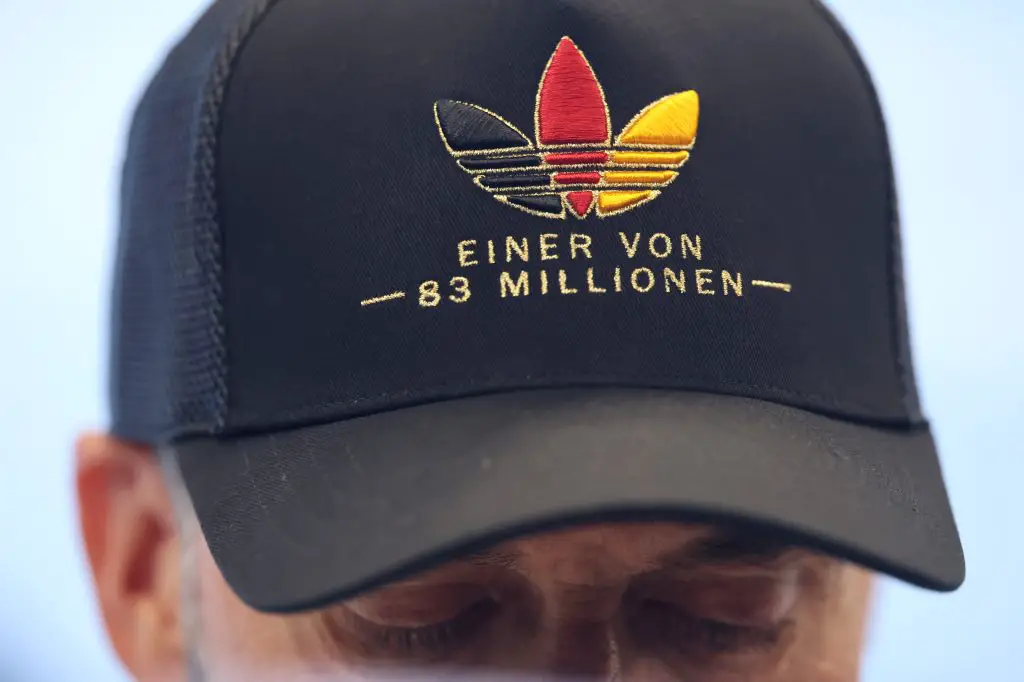
What began as one of Jürgen Klopp’s running jokes eventually became the most serious subject of his first Germany squad press conference. The new Bundestrainer arrived on Thursday wearing a cap bearing the black, red and gold of the German flag together with the phrase “Einer von 83 Millionen,” literally, “One of 83 million.”
The phrase appears to riff on German pop star Max Giesinger’s famous “80 Millionen,” whose refrain includes “Einer von 80 Millionen.” The song was released in 2016 and became one of the hits associated with that summer’s European Championship, with a special tournament version even incorporating commentary from Germany’s 2014 World Cup final. The reference certainly wasn’t lost on this Get German Football News journalist.
At first, the hat functioned exactly as one might expect from Klopp. With virtually his entire 44-player squad having leaked before the official announcement, the 59-year-old joked that any journalist who could still guess the final unrevealed name would receive one of the caps. Later, however, Klopp was asked whether the cap carried a deeper message.
It did.
“There are plenty of messages to be conveyed,” Klopp said. “First, the cap is supposed to be a bit facetious. Life is serious enough. Football would be a most unpleasant sport without a bit of fun. We need to rediscover some fun in the whole thing.”
From there, the conversation moved somewhere considerably more consequential.
Klopp addresses recent political developments in Germany
Klopp explicitly referenced the recent state election in Saxony-Anhalt. The vote took place on September 6. Preliminary official results gave the Alternative für Deutschland (AfD) 43.8 percent of second votes and 39 of the 83 seats in the state parliament. The CDU finished a distant second on 17.2 percent. The AfD therefore emerged as the largest party but fell short of an outright parliamentary majority.
The final state result will not formally be certified until September 22.
“Secondly, there’s also a lot of things that have taken place recently,” Klopp said. “An election [in Saxony-Anhalt] recently took place. [The result] may not be a problem for some, but others are now thinking, ‘good heavens, what’s happening here?’”
Klopp immediately placed limits around his intervention.
“I don’t want to make this into too big of an issue,” he continued. “I hope that I won’t be speaking about political matters too often here in press conferences in the future because I’m not an expert in that field. I’m just an interested layman like everybody else. I can merely offer up my perspective as an athlete and sportsman.”
That perspective nevertheless led Klopp directly back to the colors on his head.
Klopp wants to take patriotism back
“I want us to take the flag back,” Klopp said. “I don’t want people to think that due to this [political] swing that there’s something wrong with us [Germany]. I want people to be happy and consider themselves lucky to be born, raised, or have moved to this wonderful country. I would really like that. I also had the thought that I didn’t want ‘national pride’ left in the hands of the wrong people.”
The formulation touches upon a particularly complicated feature of modern German national identity.
Expressions of national pride and overt displays of the flag carried particular sensitivity in postwar Germany because of the country’s past. The 2006 World Cup subsequently became an important moment in which black-red-gold symbolism was displayed more openly in a lighter, football-centered form of patriotism. Klopp famously rose to prominence as a TV expert during the famed German “Sommermärchen”.
“I’m not even sure one can use that phrase [‘national pride’] anymore without being misunderstood,” Klopp said. “I was told that we can describe it as ‘positive patriotism’. Great. In my daily life, I’m finding out that I’m incredibly proud to be able to work this [Bundestrainer] job. And I think that we’re a wonderful country and the squad is a reflection of what we have in Germany.”
“Can one be proud to be a German while also being open, diverse, friendly, compassionate, and nice?” Klopp asked rhetorically. “I’m 100 percent convinced that one can.”
Klopp connects national optimism with his footballing message
The political remarks also intersected with another theme Klopp repeatedly emphasized throughout the press conference. When discussing why his enormous first squad had given him renewed optimism about German football, Klopp said his staff had consciously stopped concentrating on what the country supposedly lacked.
The same thought returned while discussing Germany itself.
“As I remarked at the beginning of the presser, it wasn’t about looking at what we didn’t have, but what we have,” Klopp said. “I don’t want to insinuate that the problems we have in Germany can be solved in a similar way, but we should still have a look at what we have rather than focusing on what we don’t. I think that approach would benefit a lot of people.”
Klopp was careful not to suggest that football could provide answers to political questions.
“I said in my first press conference that sport has…” Klopp began before stopping himself. “Okay. It’s more important that we have doctors, nurses, and all sorts of other professions. But, in the moments that we [as a nation] all focused on football, those are the moments in which we [as a country] all feel better. That we develop a sense of community, that we truly feel the power of sport.”
Klopp points to sport’s power to create national unity
“We’ve had a great summer with [German] tennis, hockey, basketball, and track & field,” he said. “All of these were big topics. Everyone who was interested in sport felt it. When we had two Germans competing to win the decathlon, I was simply happy that we had athletes doing this. And that’s now our mission [with the German national team football program].”
Klopp’s conception of patriotism, as he articulated it Thursday, rests on precisely that sense of belonging: pride without exclusion, identification without demanding sameness and a national flag that does not belong exclusively to any one political movement. One of Klopp’s quotes merits repetition and completion.
“Can one be proud to be a German while also being open, diverse, friendly, compassionate, and nice?” Klopp said. “I’m 100 percent convinced that one can. And with that in mind, if you’d like to put a cap on to demonstrate that, I’ve got one. If you don’t want to do it without the cap, simply think it.”
Klopp closes the press conference with another cap reference
At the end of the press conference, the topic cropped up once again. A few hours of discussion about leaked squad names, German footballing talent, political change, national identity and the meaning of black, red and gold concluded with another grin.
“Who will take a cap?” Klopp asked the journalists assembled in the room. “Cool. You can all be official Bundestrainers. Instead of just sitting there stupidly looking on, you all have to participate. Whoever puts on a cap has to take on some responsibility.”
In his first squad press conference, Klopp made it clear that he was prepared to take responsibility for quite a bit.