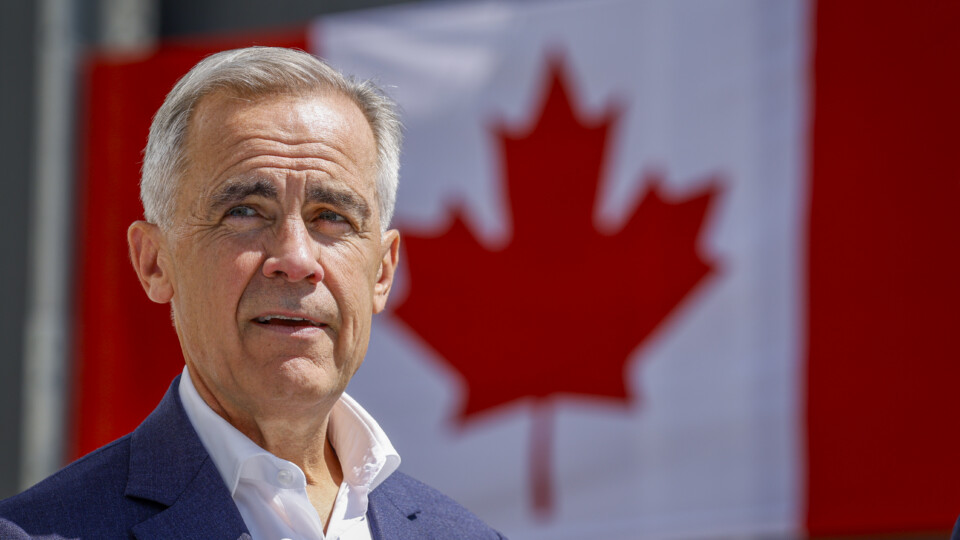
The CPP Investments Insights Institute, the research arm of the Canada Pension Plan Investment Board, released two reports Tuesday finding that many of the 65 global institutional investors it surveyed— managing roughly US$47 trillion across 20 countries — rank Canada low on investibility. The findings land days before the Canada Investment Summit, where Prime Minister Mark Carney hopes to court billions from those funds. With high aspirations, The Hub‘s Alberta bureau chief Falice Chin broke down how the government’s trillion-dollar target cannot be met by summitry alone without bigger assets, faster approvals and rules that survive an election.
The summit, scheduled for Sept. 14-15 in Toronto and co-hosted by the CPP Investment Board and the Public Sector Pension Investment Board, is central to Ottawa’s goal of catalyzing more than $1 trillion in total investment over five years. The institute found Canada competes for allocations against Japan, the United Kingdom and Germany, and frequently loses when fund managers weigh scale, fragmented regulation and a record of policy reversals.
Naomi Powell, director of the institute, wrote that while trust and predictable rules help build confidence, what ultimately draws capital is a deal large enough to matter, a structure that can turn a profit and a believable route to getting the project done. “Global capital is looking for opportunity, but opportunity alone does not make a market investible,” she wrote.
Survey respondents credited Canada with political stability, regulatory predictability and openness to long-term capital, and identified the same priority sectors Ottawa has championed: energy, infrastructure, critical minerals, digital systems and artificial intelligence. Yet funds managing between $200 billion USD and more than $500 billion—comparable to Canada’s Maple 8 pension plans—scored the country lower than smaller investors did. Among those drawn to Canadian energy, 59 percent pointed to risk-return concerns, along with policy-reversal risk, regulatory fragmentation and limits on scale or liquidity. Transportation and critical minerals faced similar constraints, while digital and AI infrastructure had the fewest opportunities large enough for major allocations. The institute framed the gap as a problem of execution rather than investor appetite.

The report pointed to a multibillion-dollar U.K. nuclear development, in which the Caisse de dépôt et placement du Québec joined the British government as lead institutional investor, as a template. The project offered regulated revenue during construction, long-term guarantees on key economic terms, targeted government protection against exceptional risks and a single government negotiating position, and it was ready to proceed before investors entered.
Chin observed that announcements alone will not close that gap. “The challenge involves more than simply willing a trillion dollars of investment into existence through eloquent speeches, memorandums of understanding, and all the pageantry of summitry for which our prime minister has become known,” she wrote. She noted that TD Economics has tallied more than $1 trillion in publicly announced major projects, including roughly $363 billion in energy, $281 billion in defence, $158 billion in artificial intelligence, $140 billion in resources and $114 billion in transportation. The summit, expected to draw executives from nearly 100 organizations, comes as trade talks with Washington have collapsed and reports of investor enthusiasm have been mixed, Chin observed.
Sébastien Betermier, a McGill University finance professor and executive director of the International Centre for Pension Management, explained that Canadian pension funds have become major owners of airports, ports and rail abroad while finding fewer such assets at home. In a 2024 paper he identified Toronto Pearson International Airport, the Port of Vancouver and Hydro-Québec as strategically attractive assets closed to pension capital. He warned that signs of a future government reversing current policy would give him pause. “If I’m getting a hint that this will happen, I will think twice before coming to Canada,” he said.
The permitting concerns flagged in the research echo criticism of Bill C-5, which allows cabinet to fast-track projects deemed in the national interest outside the existing regulatory system. Julio Mejia and Tegan Hill, writing in The Hub, argued the approach forces investors to win favour from a small group of politicians. “This is not only an invitation to corruption but a major source of uncertainty for investors,” they wrote. Chin noted that energy companies have called for repealing or rewriting the underlying laws instead, while Betermier said there was not yet enough evidence to judge whether the Calgary-based Major Projects Office is clearing the old roadblocks.
Ottawa has billed the two-day gathering as a first-of-its-kind platform bringing global investors, Canadian CEOs and public-sector representatives together to accelerate new investment into Canada.
The Hub’s mission is to create and curate news, analysis, and insights about a dynamic and better future for Canada in a…