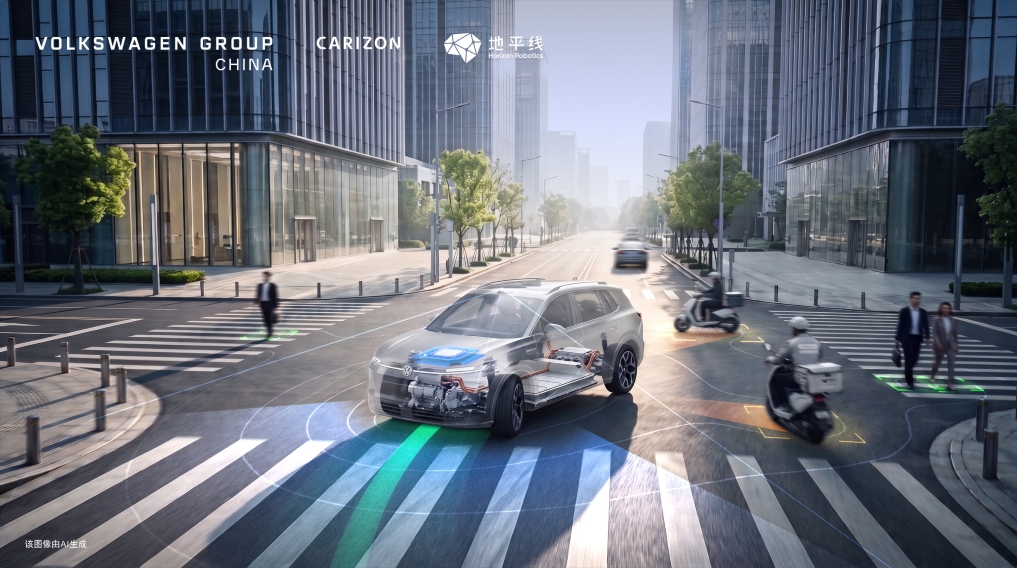
Gasgoo Munich- In the third quarter of 2026, a new driver assistance system will join Volkswagen’s lineup in China.
Named HS8 (HyperSense8), it is the first-generation all-scenario driver assistance system (L2++ ADAS) developed by CARIZON—a joint venture between Volkswagen Group’s software unit CARIAD and Horizon Robotics. It also serves as a single-stack, end-to-end solution for vehicles.
Under the current roadmap, HS8 will roll out across seven new models from Volkswagen’s three joint ventures in China, starting this quarter.

Image Credit: CARIZON
Rewind the clock more than forty years, and this scene takes on a certain significance.
In 1984, Volkswagen signed a joint venture agreement with SAIC Motor. For a long time thereafter, Volkswagen and a host of global automakers brought more than just individual models to China; they imported the R&D, manufacturing, quality control, and supply chain management systems of the modern automotive industry.
Back then, the flow of automotive knowledge moved in a clear, single direction: from Germany, Japan, and the United States to China. More than forty years later, that current has grown far more complex.
At the 2026 Chengdu Auto Show, the next-generation BMW iX3 opened for pre-orders, becoming the first to standardize a intelligent driving system deeply co-developed with Momenta. Tailored to China’s road conditions, the system is backed by more than 15 billion kilometers of local driving data.
Volkswagen’s partnerships with Chinese tech firms are also moving beyond traditional procurement relationships. In July this year, the German automaker deepened its ties with Horizon Robotics. Through a “white-box licensing” model, CARIZON will leverage Horizon’s AI foundation models to independently develop a unified AI driving solution for Volkswagen Group China.
This, of course, cannot be simply reduced to the student becoming the teacher.
Europe, Japan, and the United States still retain vast amounts of core automotive capability. What truly matters is that the flow of technology, knowledge, and industrial capacity in the global auto sector is becoming unmistakably two-way.
China is no longer merely a recipient of global automotive technology, a manufacturing base, or an application market; it is emerging as a key source of new technologies, products, and solutions.
A new question now confronts the global automotive industry: What kind of “China Solution” is the world waiting for?
More Than Just an L2++ System
Intelligent driving is merely the most visible piece of the puzzle.
Shifts in power batteries actually began earlier.
According to SNE Research data for the first half of 2026, global power battery installations reached 269 GWh. Six of the world’s top ten vendors are Chinese, commanding a combined market share of 63.9%.
Even more noteworthy, the mode of cooperation is no longer limited to “selling batteries.”
Ford’s battery plant in Michigan utilizes a licensing model for CATL’s lithium iron phosphate (LFP) battery technology. The facility belongs to Ford, while the Chinese company provides the relevant technology and services.
Zoom out, and this shift is happening simultaneously across multiple technology domains.
Data from Gasgoo Automotive Research Institute shows that in the first half of 2026, three local suppliers—Konghui Technology, Tuopu Group, and Baolong Technology—held a combined 91.4% share of China’s passenger vehicle air suspension market. In the LiDAR sector, Hesai Technology and Huawei claimed the top two spots with 34.2% and 31.1% respectively.
In electrification, FinDreams Power holds 35.4% of the market for highly integrated main drive systems, while BYD Semiconductor leads the power module market with a 19.3% share.

The influence of some Chinese technologies has already crossed beyond the domestic market.
Yole Group’s “2026 Global Automotive Market Report” indicates that Chinese LiDAR makers captured roughly 95% of the global automotive market in 2025. Hesai led global shipments of ADAS main LiDAR with a 43% market share. That year, the global automotive LiDAR market surpassed 1 billion USD for the first time, with annual passenger vehicle shipments reaching 3.7 million units.
Yet, this is not a monolithic sweep of “comprehensive leadership.”
In the first half of 2026, Infineon remained the leader in China’s silicon carbide (SiC) power module market. In areas like driving ADAS, international Tier 1 suppliers continue to hold significant ground.
This may be the more accurate picture of China’s automotive supply chain today: in some fields, progress has shifted from catching up to running neck-and-neck or even leading; in others, breakthroughs are still ongoing. Meanwhile, different technologies increasingly require systemic synergy.
Therefore, discussing the “China Solution” today requires looking beyond any single company or technology.
Intelligent driving, batteries, LiDAR, smart cockpits, brake-by-wire systems, electric drives, power semiconductors—more and more technologies are simultaneously coming into view for the global automotive industry.
More importantly, this shift is already influencing the choices of multinational automakers.
For the GAC Toyota BoZhi 3X, launched in May 2026, Chinese suppliers account for 65% of the entire supply chain, with over 100 domestic firms providing core components. Companies like Momenta, Hesai Technology, iFLYTEK, CALB, EVE Energy, and Desay SV have penetrated sectors ranging from intelligent driving and LiDAR to AI, batteries, and domain controllers.
At the same time, Toyota is advancing its “ONE R&D” initiative in China, shifting more R&D and product decision-making power to the region.
In the past, the world perceived China’s automotive industry largely through “Made in China”; today, it is seeing a far more complete technology and supply chain ecosystem.
But the question truly worth asking is: Why now?
The World Didn’t Suddenly Discover China—The Industry’s Problems Just Changed
The global automotive industry has never lacked mature solutions.
Over the past century, automotive powerhouses like Germany, Japan, and the United States have built highly mature systems.
How to build a reliable car, conduct crash and durability validation, manage thousands of suppliers, or ensure a component functions reliably for a decade—the global industry has mature answers for all of these.
What is truly difficult to replicate about Tier 1 giants like Bosch, Continental, ZF, and Denso is not just a single technology, but the R&D systems, quality standards, global delivery capabilities, and engineering experience accumulated over decades.
But today, the challenges facing the industry are shifting.
Electrification has reignited questions of cost and efficiency, software has altered the cadence of vehicle development, and AI has permeated intelligent driving, cockpits, R&D, and manufacturing. Meanwhile, chipmakers, software firms, and AI companies are continuously entering the traditional automotive value chain.
Consequently, the question facing global automakers is no longer simply “how to build a good car.”
It also includes: How to make EVs more affordable? How to shorten development cycles? How to enable continuous software iteration? How to truly integrate AI into vehicles? How to control costs while upgrading intelligence?
Of course, China is not the only place that can answer these questions.
Yet, over the past few years, they have converged most intensely within the Chinese market.
At a media briefing in August 2026, Han Sanchu, Executive Vice President of Volkswagen Group China and CEO of CARIAD China, remarked on intelligent driving: “It is easier to go from the simple to the sophisticated than from the sophisticated back to the simple. Just because a high-end solution works well doesn’t mean a mid-range one will be effective; but if you nail the mid-range, the high-end shouldn’t be too difficult.”
Behind this remark lies a very realistic challenge as intelligent vehicles enter a stage of mass adoption: technology must not only be developed but also reach a broader market.
CARIZON CEO Han Hongming further explained the strategy of starting with entry-level models: “If we only push this intelligent driving system on a handful of luxury or high-end vehicles, the data volume is actually quite small. Conversely, by pushing from the bottom up, we can collect far more data.”
Scale generates another layer of value here.
When a technology moves from a few high-end models into the broader mainstream market, it encounters not just more users, but also more road environments, more complex scenarios, and a vast amount of real-world data.
A massive new energy vehicle market, high-frequency product iteration, and the continuous trickle-down of new technologies into mainstream price segments have turned China into a high-intensity proving ground for both technology and business models.
The world didn’t suddenly discover China; rather, as the global automotive industry’s problems shift, China happens to stand where many of these new issues are emerging most intensely.
The World Starts Looking to China for Answers
This has also led some multinational automakers to redefine the role of their Chinese R&D systems.
In the past, a key task for China R&D centers was “local adaptation.” Once a global model’s primary development was complete, the Chinese team would tweak the wheelbase, cockpit, and specifications for Chinese consumers.
Now, that boundary is starting to blur.
The partnership between BMW and Momenta serves as a prime example.

Image Credit: BMW
Dr. Mike Reichelt, Head of the BMW New Generation product line, explained that BMW’s strategy is to “integrate Momenta’s technology stack into our full-stack system.”
The electrical/electronic (E/E) architecture of BMW’s New Generation vehicles features multiple “super brains” handling different functions. Momenta’s technology is integrated into one of these computing units while remaining relatively independent of other systems.
Mike explained: “This allows you to develop and test without affecting Momenta’s operations at all.”
This differs from simply purchasing a off-the-shelf, packaged intelligent driving system. BMW wants to leverage Chinese technological capabilities while simultaneously embedding them into its own E/E architecture and R&D system.
Volkswagen has chosen a different path.
In July this year, CARIZON announced it would adopt a “white-box licensing” model to independently develop a unified AI driving solution for Volkswagen Group China, leveraging Horizon Robotics’ AI foundation models.
The models differ, yet they point to the same shift: the relationship between global automakers and Chinese tech companies is moving beyond the traditional “specify requirements—procure components” dynamic.
They aim to leverage the technology and iteration speed of Chinese firms while embedding those capabilities into their own R&D architectures, engineering standards, and product systems.
Consequently, the reasons global automakers come to China are also evolving.
Initially, it was to find a market.
Later, it was to find manufacturing and supply chains.
Now, there is a new addition: seeking new technological capabilities and methods for solving problems.
Needing Chinese Innovation Doesn’t Mean Accepting the “China Solution”
But if the story ended here, it would easily become an ode to the Chinese supply chain.
Reality is clearly far more complex.
Today, as the global automotive industry confronts Chinese innovation, two simultaneous forces are at play.
On one side is industrial demand. Automakers need lower-cost batteries, faster software development, more mature intelligent driving, and more new technologies ready for rapid mass production.
On the other are geopolitics, data security, local manufacturing, industrial policy, and technical standards.
The stronger the technological competitiveness, the more likely it is to attract the attention of policymakers and regulators.
This means that success in the Chinese market does not automatically grant a technology a global passport.
“The world needs Chinese innovation” is not the same as “the world accepts the China Solution.”
Can the technology adapt to different markets? Can partnerships endure? Do local regulations, data rules, and industrial policies allow for genuine implementation? These questions determine whether a Chinese technology merely “goes global” or ultimately integrates into the global automotive industry system.
And this is the truly difficult part of the “China Solution going global.”
The Answers Are Just Beginning to Emerge
Let’s return to Volkswagen.
The impending arrival of HS8 in Volkswagen’s Chinese models only signals that a new mode of cooperation is taking shape.
Nor does CATL’s technology licensing entering U.S. factories prove that all Chinese new energy technologies can be replicated globally.
But taken together, these changes at least indicate a direction. For decades, China’s automotive industry has asked: When will China possess truly world-class automotive technology and supply chains?
Today, that question has not disappeared.
But alongside it, another question is emerging: Among the technologies and capabilities taking shape in China’s automotive industry, which will ultimately become part of the global automotive landscape?
This is precisely the question the 8th Gasgoo Awards 2026 hopes to explore further by adopting “China Solution to Global” as its annual theme.
“Coming from China” is clearly not a sufficient condition for a “China Solution”; leaving China does not mean it has become a “Global Solution.” From a technology completing validation in the Chinese market to truly entering different countries, automakers, and industrial systems, there are still too many questions to answer.

How can “China Speed” consolidate into global value? What kind of Chinese innovation truly has the potential to become a global solution? Once integrated into a global automaker’s system, is “adoption” the finish line, or the start of a new round of tests? How is the next-generation automotive supply chain evolving? Ultimately, how can the “China Solution” cross the “last mile” of regulations, standards, data, local manufacturing, and industrial ecosystems?
Addressing these questions, Gasgoo will launch a series of five observations centered on the 2026 Gasgoo Awards theme: “From China Speed to Global Value,” “What Kind of Chinese Innovation Can Become a Global Solution?”, “Global Adoption: A New Starting Point for the China Solution,” “What Is Happening to the Next-Gen Auto Supply Chain in China?”, and “How Can the China Solution Cross the ‘Last Mile’ of Globalization?”
The impending mass production of Volkswagen’s HS8 is just one facet of this story.
As the problems facing the global automotive industry shift, China is becoming an increasingly unavoidable destination for the world in search of answers.
As for what kind of “China Solution” will ultimately become a true “Global Solution”—the answers are just beginning to emerge.