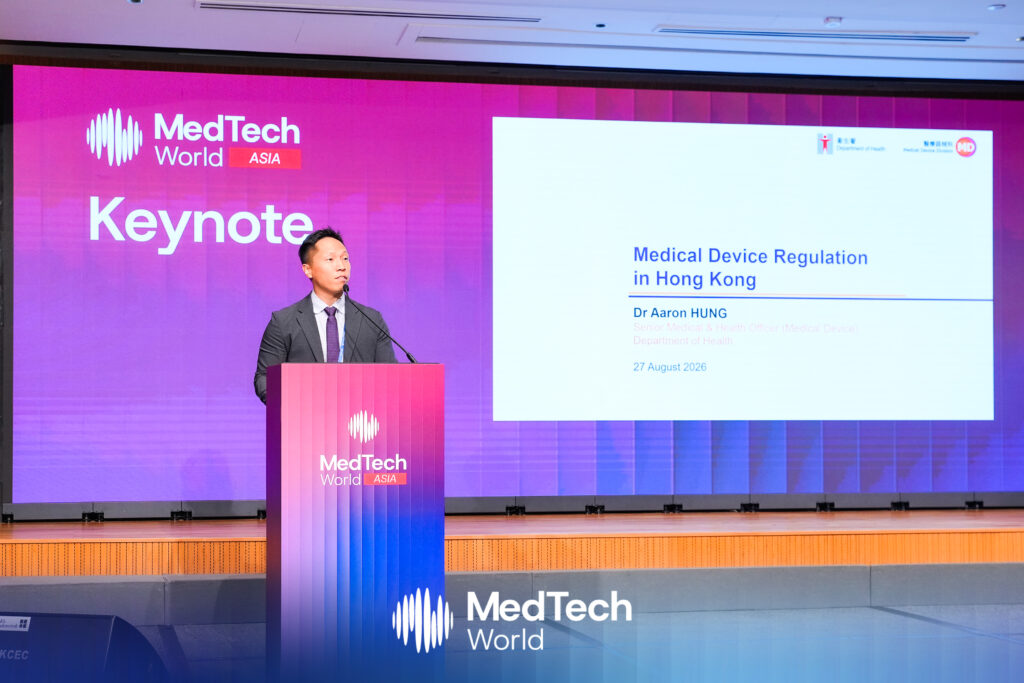
Hong Kong – MedTech World Asia opened on August 27, bringing together healthcare, medical technology, investment, and industry leaders at the Hong Kong Convention and Exhibition Centre (HKCEC). Dr Dylan Attard, CEO and co-founder of MedTech World, delivered the opening address, followed by keynotes from Hong Kong’s Department of Health and Malta’s Ministry for Health.
Connecting healthcare ecosystems across borders
In his opening address, Dr Attard reflected on his journey from medicine and surgery into entrepreneurship and investment. His experience working in surgical environments led him to question where medical technologies come from, who builds and funds them, and why some innovations reach patients while others do not. That curiosity eventually led him to build MedTech World.
Dr Attard said MedTech World had spent the past two years hosting events in Singapore and travelling across the region to meet founders, investors, hospitals, governments, and industry leaders. He said Hong Kong had now become a home for the organisation’s activities in Asia.
He highlighted Hong Kong’s interconnected ecosystem of universities, research institutions, science and technology parks, industry associations, government bodies, investors, and hospitals. For Dr Attard, the opportunity is not only to build companies in Hong Kong, but also to help them connect with Asia, Europe, North America, and the wider world.
“We are not simply organising conferences in different parts of the world. We are trying to connect those worlds together,” Dr Attard said. MedTech World aims to create connections across regions, where a founder from Hong Kong could meet an investor from Florida, a hospital in the Middle East could discover technology from Europe, and companies from Europe or North America could find people to help them understand Hong Kong, China, and the rest of Asia.
“Innovation happens faster when you bring the right people together in the same room,” he added.
Hong Kong prepares for the next stage of medical device regulation
Hung See Long Aaron, Senior Medical & Health Officer (Medical Device) at the Medical Device Division of the Department of Health, HKSAR, then delivered a keynote on Hong Kong’s approach to medical device regulation.
Hung outlined the Medical Device Administrative Control System (MDACS), established in 2004 as a voluntary and transitional system based on international practices. The system includes both pre-market and post-market controls and is intended to help the industry prepare for future statutory regulation.
He also addressed the growing use of AI-enabled medical devices, noting that regulators need to consider issues such as model updates, transparency, and market monitoring. He stressed the importance of early engagement between regulators and developers, with technical guidance helping companies understand regulatory expectations.
Looking ahead, Hung said Hong Kong will establish the Centre for Medical Product Regulation (CMPR), covering medicines and medical devices while strengthening approval mechanisms, clinical trial development, and regulatory capacity. The Department of Health is also working on a legislative proposal for medical device regulation.

Malta advances digital health through innovation
Dr Renzo De Gabriele, Permanent Secretary at the Office of the Deputy Prime Minister and Ministry for Health, Government of Malta, delivered a keynote outlining Malta’s digital health strategy through 2030.
The strategy focuses on collaboration across public and private healthcare, with the aim of improving services for citizens and patients. De Gabriele highlighted e-prescriptions, remote patient monitoring, telemedicine, and the development of a National Electronic Health Record connecting healthcare systems.
Malta’s digital health platform now has 281,000 registered users, representing around 75% of the country’s population. De Gabriele highlighted the platform’s growing use while also pointing to the need to address the digital divide and help patients make better use of digital health services.
Innovation also forms part of Malta’s strategy, with AI being used for imaging and histopathology reporting, alongside robotics for surgery and medication distribution. The country is also exploring predictive analytics to anticipate disease peaks and healthcare demand.

MedTech World Asia continues in Hong Kong
The first day of MedTech World Asia brought together speakers from Hong Kong and Malta to discuss practical changes across healthcare, including medical device regulation, digital health, and the adoption of new technologies.
With the summit continuing in Hong Kong, the programme will turn to further discussions on healthcare innovation, investment, AI, and emerging technologies, giving industry leaders and stakeholders more opportunities to share ideas and explore what comes next for the sector.
Can’t make it to Hong Kong this year? Pre-register now for MedTech World Asia 2027 and be the first to know when tickets and details go live.