Not long after Orange Police Chief James Sullivan called over his radio to get a cruiser to respond to Orange Town Hall to verify someone was at the location, he got a surprising call from the Athol Police Department.
The neighboring agency was looking to verify a report of an active shooting at Town Hall. However, there was nothing of the sort happening on that day in late April, both Sullivan and Athol Police Chief Jarret Mousseau confirmed.
Sullivan explained that a text summary generated by an artificial intelligence (AI) scanner app had misinterpreted the name of the person at Town Hall that was relayed over the radio to be “shooter at Town Hall.” This information was posted to social media, and Mousseau was notified by a dispatcher, which led him to call Sullivan.
The AI police scanner app CrimeRadar, created by Scoopz. Inc., created a report of the incident, though a spokesperson noted the report didn’t trigger the app’s “escalation criteria for high-stakes incidents,” and it didn’t receive user feedback on its accuracy or reports from law enforcement. The April 27 report is no longer available on CrimeRadar, as the app only displays incidents that have occurred in the last two weeks.
Notably, this isn’t an isolated incident of emergency dispatch traffic being misinterpreted or falsely reported due to apps like CrimeRadar, which listen to real-time radio traffic that is then interpreted by AI to highlight ongoing emergency responses.
And Orange isn’t the only community in western Massachusetts, or in the United States, learning how to navigate this technology.
“These things are definitely a problem,” Sullivan said about the apps.
What are these apps?
Police scanners are radio receivers that tune into frequencies for emergency communications between police, fire and emergency medical services. Some scanners can also pick up radio communications for weather alerts or electric utility communications, a post by Uniden, a scanner manufacturer, explains.
While typical police scanner radios can cost hundreds of dollars, many of these apps are free and more accessible for the public via their smartphones. A 2020 CBS News report detailed surging downloads of police scanner apps.
CrimeRadar is among the top police scanner apps available for free on the Apple App Store, with 33,000 reviews, many of them five-star. The app uses generative AI and speech-to-text technology to “summarize and map potential incidents” based on the radio traffic it monitors to increase the user’s awareness of public safety activity close to them, but it also allows users to tune into scanner traffic from all 50 states and the District of Columbia.
The app features a disclaimer that it provides users “situational awareness based on public-safety dispatch audio,” and its content is not an official incident report with verified information. Users are advised to rely on official sources for confirmation.
“We automatically verify addresses to help improve location accuracy, and posts undergo additional screening by enhanced AI systems,” a CrimeRadar spokesperson’s statement reads. “Incidents involving particularly sensitive circumstances, such as those involving children, are also escalated for human review.”
There are features available for users to submit feedback on both the accuracy of the AI-generated summary and whether the activity being reported is real. If the in-app feedback feature receives enough negative feedback, the incident is automatically removed. Once a post is removed, there is a review done to improve the audio-processing protocols.
If a public safety agency’s report on an incident is available, that information may be attached to the associated post, and if an agency points out a discrepancy, the spokesperson advises someone will update or remove the report “as a safety measure.”
“Our users frequently tell us that CrimeRadar provides peace of mind and helps them avoid areas where incidents are taking place,” the statement notes.
Tool or trouble?
In December 2025, the BCC reported that the app had sent out several false or inaccurate crime alerts, and highlighted several that had occurred in the U.S. since October 2025.
One such false report took place in Bend, Oregon, the BBC reports, when a “man down alarm” was signaled while an officer was, in reality, out for a “Shop with a Cop” charity event — a statement that was misinterpreted as “shot with the cop.”
CrimeRadar offers live audio of the incident it is flagging, and in the audio of the Bend, Oregon case, the feed is murky but clear enough to deduce the sentence as “Shop with a Cop.” However, the way humans interpret and understand language is different than that of a machine learning model, according to Laura Haas, a professor at the University of Massachusetts Amherst’s Manning College of Information and Computer Sciences.
Haas explained that as generative AI technology has developed, there is more data available to teach machine learning models how to recognize and interpret language, in part due to the vastness of information on the internet. However, data with human speech is less available, and the less data available for these learning models to learn from, the less accurate and reliable the generated product is.
Compounding the issue is the amount of data from dispatch radio communications to train the learning model, Haas said. Without large amounts of this specific data, the capabilities of the learning model to discern the nuances of what words are being said is diminished, especially if first responders and dispatchers are using coded language or if the transmission audio is muddled.
“It makes the recognition more difficult unless somebody has taught the system, very carefully, the vocabulary,” Haas said.
CrimeRadar advises that as errors in its transcriptions and summaries are found, they are reviewed and used to help improve its audio processing capabilities. In Haas’ view, it’s likely a matter of time until this machine learning technology analyzing emergency dispatch audio improves as more data is made available to it, but in its current form, generative AI capabilities from human speech should not be relied upon.
“Today they make mistakes, and so nobody should believe anything an AI tells them until A) it’s passed their common-sense check, and B) they have found a source that is not an AI,” Haas cautioned.
The game of telephone
While CrimeRadar isn’t the only police scanner app using AI, its incident reports are widely shared by users on social media, regardless of whether the information is verified. This is part of the issue that Sullivan has with how the app is used.
“They believe everything they see and go to Facebook,” Sullivan said.
In the case of the false shooting report in Orange, Mousseau of the Athol Police Department said it marked the first time he learned about what CrimeRadar was and its use. He finds the technology troubling.
“Look what it did in Orange — it’s one of the most severe things you could deal with and that’s certainly troublesome,” Mousseau said.
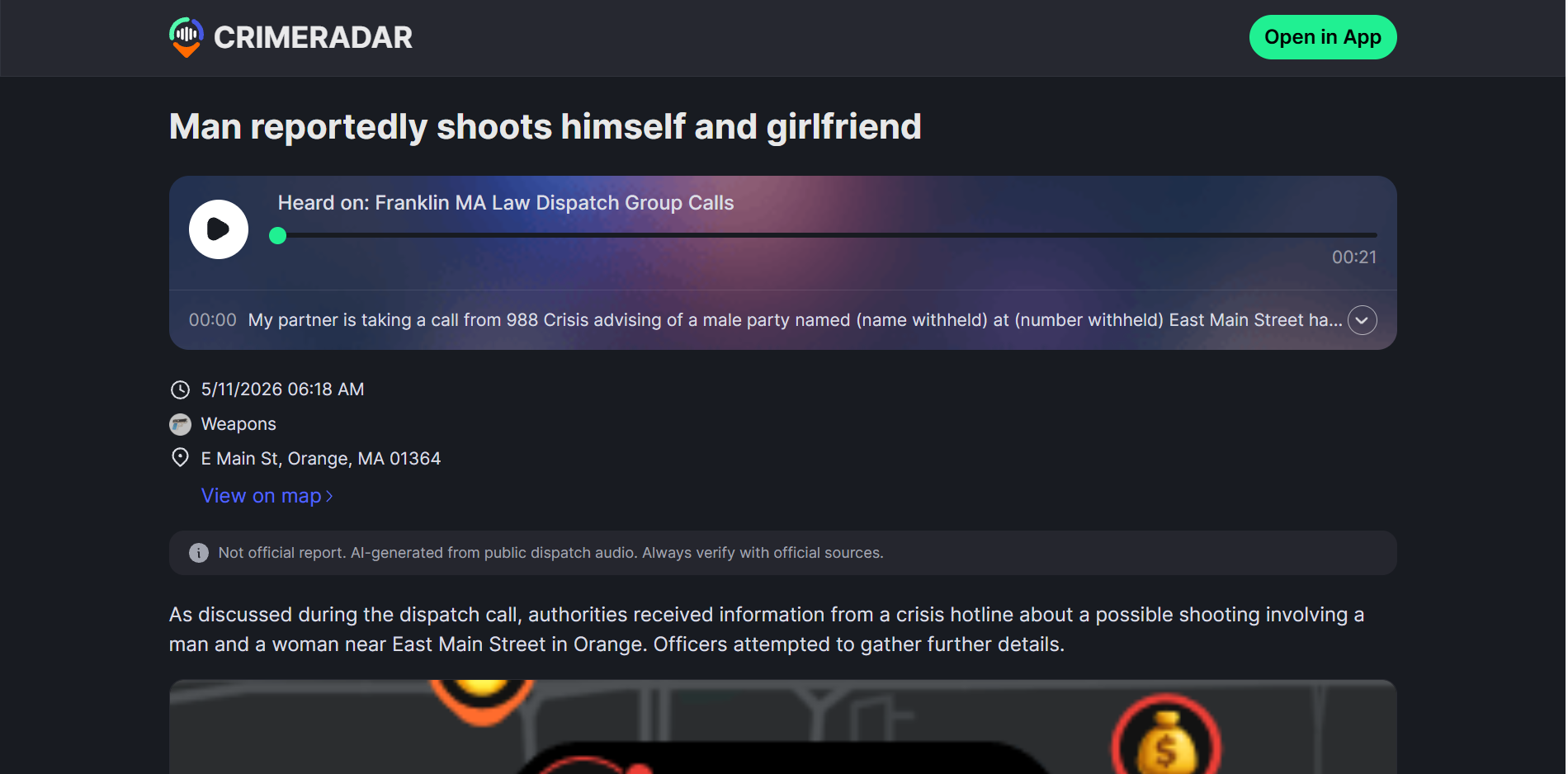
Outside of the April 27 Town Hall incident, another situation in Orange was reported on Monday, May 11, at 6:18 a.m. CrimeRadar’s AI-generated summary from the dispatch traffic states that authorities received information from a crisis hotline about a possible shooting involving a man and a woman near East Main Street. It states officers attempted to gather further details. The CrimeRadar report was subsequently shared on Facebook.

However, when Sullivan reviewed the Orange Police Department’s calls looking for anything that would have matched this report, he found nothing in the records to indicate that the incident took place as reported during that time period.
In Greenfield, Police Chief Todd Dodge said that while his department hasn’t had any issues with calls from the public regarding concerns from reports via CrimeRadar, it’s still problematic when there isn’t accurate information going out to residents.
“The accuracy of information is a big concern for us,” Dodge said.
Still, while information on CrimeRadar isn’t always accurate, some is. A CrimeRadar report of shoplifting at the Cumberland Farms on Federal Street in Greenfield on July 30 is one such case of the application picking up fairly accurate information.
According to Dodge, a 911 call came in at 9:32 p.m. regarding a male party inside the convenience store who allegedly put on a ski mask and showed a bread knife with a black handle. The individual destroyed property inside the store before leaving. As it was deemed a mental health incident, he was taken to the hospital.
CrimeRadar, however, incorrectly lists the time of the incident as 6:32 p.m

Although the AI-generated summary on CrimeRadar matched the details of this particular incident, Dodge cautions residents about believing information without verification, noting that people “quickly assume” they know the details and go online to share it, which is a primary concern for him. Dodge noted it is difficult for his department to monitor social media in an attempt to verify information being shared online, but he emphasized that if a public safety risk were to occur, Greenfield Police would communicate it.
Transparency or immediacy?
When it comes to the public’s perceptions of safety, Gallup reported in October 2025 that Americans have maintained a perception gap of the severity of crime nationally versus locally, with 49% of people viewing crime as “extremely or very serious” at the national level and 12% viewing crime at that same threshold locally. An analysis of this data by Frank Newport highlights a key element: lived experience informs perception, and when national news highlights specific crime, belief in its severity can be higher than that of the day-to-day experiences of those in their local communities.
In looking at the reviews of the CrimeRadar app on the Apple App Store, many reviews indicate positive sentiment toward the app for its ability to notify people about what is happening in their communities — a stated goal by developers.
Haas pointed out that the popularity of these apps may stem from the issue of the public lacking trust in emergency services officials and not feeling like there’s transparency coming from those departments.
“It’s one of those things, to me, if you trusted your public officials — your police, your fire department, your community public safety officers — you wouldn’t really need anything like this,” Haas said. “They would tell you what you need to know as soon as you need to know it, and it would be verified and truthful.”
Responding to Haas’ statement and whether he thinks people use the app for increased transparency, Dodge said, “We, in no way, care to hide anything in Greenfield, but we also have a vested interest in protecting your privacy.”
Dodge highlighted the balance of what information about law enforcement activities is made public versus what is withheld. His considerations as police chief are to calm the general public if needed, to give updates on an investigation as appropriate and whether there is an active threat to public safety.
“We need to make sure that everybody’s safe first,” Dodge said.
In Sullivan’s view about trust and transparency, he believes that the public using these police scanner apps is another element of the digital world people live in today and the desire for instant knowledge of what is going on.
“People want to know instantly why the blue lights and red lights are going past their house,” Sullivan said, noting that it isn’t a new phenomenon, but the community response has changed as different technology has become available.
In a similar vein to Dodge, Sullivan noted that certain details won’t be available to protect people’s privacy, along with maintaining the sanctity of an investigation. In fact, Sullivan said there are times when he wants to provide information, but he is limited based on policy, even if he thinks that sharing more would help civilians better understand the issues his officers face on a daily basis.
The question of how to verify is another quandary.
Though CrimeRadar notes that people should consult news media reports, listen to the live dispatch audio or check with authorities to verify information, if residents are calling to fact-check the app, it can “tie-up” dispatchers from assisting with emergency calls, said Cindy Hunter, the Greenfield Police Department’s dispatch supervisor. For that matter, dispatchers aren’t allowed to disclose certain details, with Hunter echoing Dodge’s explanation that important public safety information will come from an official source.
“Hopefully the tech develops in a manner that is useful, and not scary or alarming,” Dodge said, looking to the future of scanner apps, “but that’s to be seen.”