Foreign Exchange Market
Market Overview:
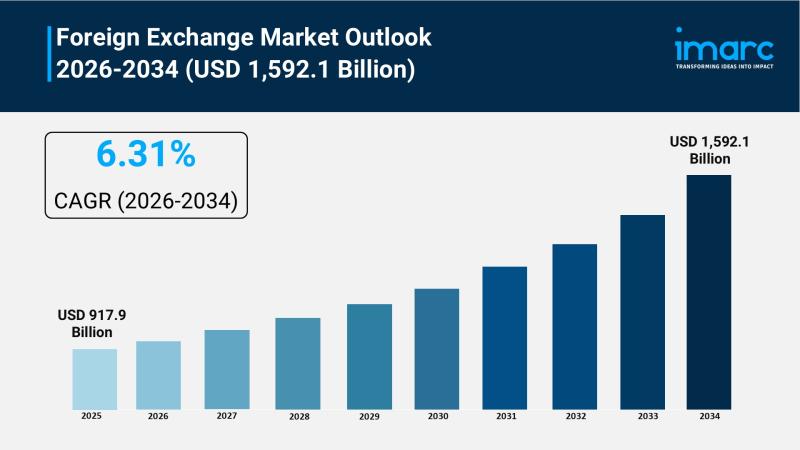
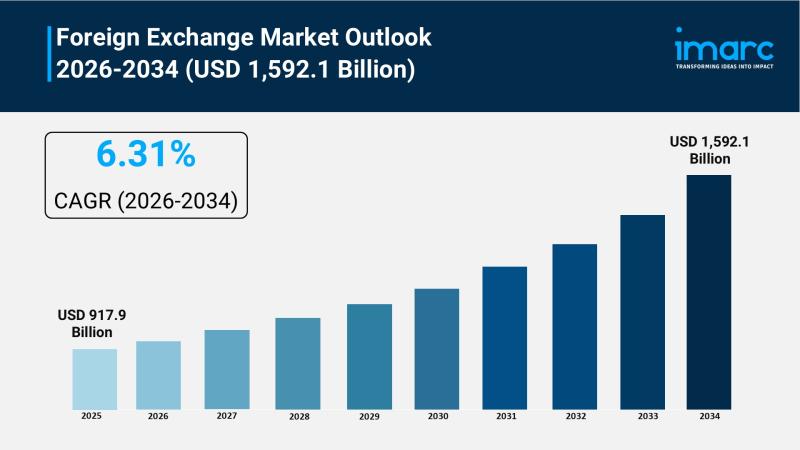
According to IMARC Group’s latest research publication, “Foreign Exchange Market: Global Industry Trends, Share, Size, Growth, Opportunity and Forecast 2026-2034”, The global foreign exchange market size was valued at USD 917.9 Billion in 2025. Looking forward, IMARC Group estimates the market to reach USD 1,592.1 Billion by 2034, exhibiting a CAGR of 6.31% from 2026-2034.
How Technology is Reshaping the Future of the Foreign Exchange Market
● The USD is involved in approximately 88% of all global forex transactions, making it the world’s primary reserve currency and anchoring liquidity for international trade, investment, and cross-border financial settlements.
● Algorithmic trading systems now manage more than 70% of forex transactions in the United States, enabling faster execution, reduced human error, and higher efficiency across institutional and retail trading platforms.
● Digital payment infrastructure from companies like PayPal has enabled seamless cross-border currency conversion, with projections indicating that 80% of business-to-business sales exchanges between customers and suppliers will take place online.
● North America holds the largest regional market share of 25.8%, driven by advanced technology adoption, robust financial infrastructure, and the dominant presence of major global banks such as JPMorgan Chase and Citibank.
● The currency swap segment leads all types with a 40.2% share, as multinational corporations and governments increasingly use these instruments to hedge exchange rate risk and secure foreign currency funding at competitive rates.
Download a sample PDF of this report: https://www.imarcgroup.com/foreign-exchange-market/requestsample
Key Trends in the Foreign Exchange Market
● Surging Daily Trading Volumes Reflecting Immense Market Liquidity: The global forex market recorded a daily turnover of USD 7.5 Trillion in April 2022, underscoring the extraordinary liquidity that makes currency trading one of the most accessible and cost-efficient financial markets in the world. This liquidity lowers transaction costs by eliminating the need for traditional exchange fees and commissions, enabling participants to execute large trades with minimal market impact, whether they engage in day trading, swing trading, scalping, or news-driven strategies.
● Increasing Consolidation Through Mergers, Acquisitions, and Strategic Partnerships: Key players in the foreign exchange space are actively broadening their capabilities and geographic reach through strategic alliances and acquisitions. Major financial institutions are partnering with environmental intelligence firms, technology providers, and fintech platforms to enhance their product offerings and competitiveness. This consolidation trend reflects the broader shift in the industry toward integrated financial services that combine forex execution with advanced analytics, risk management, and regulatory compliance capabilities.
● Growing Interconnection of Global Economies Driving Currency Demand: Financial market deregulation and digital infrastructure expansion have dramatically increased cross-border monetary flows. Businesses are now establishing connections with 30% more partners in twice as many locations, while leaders who integrate industrial value chains are innovating 25% faster than their peers. This accelerating economic interdependence is generating consistent demand for foreign exchange services across trade settlement, tuition payments, remittances, and international investment flows.
● Dominance of the Euro in European Forex Trading: The euro accounts for approximately 32% of daily global forex transactions, ranking as the second most traded currency in the world. Intra-EU goods trade reached Euro 4,102 Billion, which is 61% higher than exports to non-EU countries, underpinning enormous demand for currency exchange and hedging within the region. Financial hubs such as London, Paris, and Frankfurt are central to European forex activity, with London alone accounting for more than 38% of all forex transactions globally.
● Asia Pacific Emerging as a Major Forex Growth Engine: China’s annual trade volumes exceeding USD 3.5 Trillion have helped establish the yuan among the top five most traded currencies worldwide. Japan’s yen accounts for approximately 17% of all international forex exchanges, while Singapore ranks as one of the top three global forex hubs. India, receiving more than USD 80 Billion in foreign direct investment annually, is a rapidly growing contributor to the region’s expanding forex footprint, supported by sophisticated trading platforms and rising retail participation.
Growth Factors in the Foreign Exchange Market
● Interest Rate Differentials as a Primary Market Driver: Central bank decisions on interest rates are among the most powerful forces in the forex market. When a country’s benchmark rate rises relative to peers, its currency tends to attract higher capital inflows as investors seek superior returns. For example, when the U.S. Federal Reserve raises rates while the European Central Bank holds steady, the U.S. dollar typically strengthens against the euro, directly driving trading activity and influencing global exchange rate dynamics.
● Remittance Flows Powering Forex Activity in Emerging Markets: Remittances represent a significant and consistent source of foreign exchange demand in developing regions. Africa receives more than USD 85 Billion in remittances annually, with Nigeria and Egypt together accounting for approximately 60% of these flows. Gulf Cooperation Council countries generated more than 181.922 Billion riyals in oil revenues in a single quarter, requiring substantial forex transactions to manage revenue conversion, international payments, and sovereign reserves.
● Expanding Latin American Trade and FDI Creating Currency Transaction Demand: Brazil and Mexico together account for more than half of Latin America’s annual foreign trade of USD 500 Billion, while the region attracted USD 193 Billion in foreign direct investment flows in a recent reporting period. The Mexican peso, ranked as the thirteenth most widely traded currency in the world, exemplifies how emerging market economies are generating growing forex volumes as they integrate further into global trade networks.
● Regulatory Reform Enhancing Accessibility and Investor Confidence: Governments and central banks are actively modernizing forex regulatory frameworks to attract global investors and reduce procedural barriers. Recent policy changes have introduced digital payment options for compliance processes, streamlined application procedures, and created clearer guidelines for foreign participants. These investor-friendly reforms, developed in coordination with central banking authorities, are making forex markets more transparent, efficient, and accessible across multiple jurisdictions.
● Retail Trader Growth and Digital Platform Adoption Broadening Market Participation: Retail participation in the forex market is growing rapidly, with platforms offering low barriers to entry, real-time data, and automated trading tools. The United States alone had nearly 175,000 retail traders engaged in forex trading in a single quarter, while mobile-based forex applications are gaining traction across Africa, Southeast Asia, and Latin America. This democratization of access is expanding total market participation well beyond institutional players, adding depth and diversity to forex trading volumes globally.
Ask analyst of customized report: https://www.imarcgroup.com/request?type=report&id=1976&flag=E
Leading Companies Operating in the Global Foreign Exchange Industry:
● Barclays
● BNP Paribas
● Citibank
● Deutsche Bank
● Goldman Sachs
● HSBC Holdings plc
● JPMorgan Chase & Co.
● The Royal Bank of Scotland
● UBS AG
● Standard Chartered PLC
● State Street Corporation
Foreign Exchange Market Report Segmentation:
Breakup By Counterparty:
● Reporting Dealers
● Other Financial Institutions
● Non-financial Customers
Reporting dealers account for the dominant share, as major banks and financial institutions act as intermediaries providing liquidity, facilitating large-scale transactions, supporting price discovery, and ensuring transparency and stability across the global financial system.
Breakup By Type:
● Currency Swap
● Outright Forward and FX Swaps
● FX Options
Currency swap leads the type segment with a 40.2% share, driven by their widespread use among multinational corporations, governments, and financial institutions for hedging exchange rate risk and securing cost-effective foreign currency funding amid volatile market conditions.
Breakup By Region:
● North America (United States, Canada)
● Asia Pacific (China, Japan, India, South Korea, Australia, Indonesia, Others)
● Europe (Germany, France, United Kingdom, Italy, Spain, Russia, Others)
● Latin America (Brazil, Mexico, Others)
● Middle East and Africa
North America holds the leading position with a 25.8% share, supported by its advanced economic infrastructure, dominant role of the U.S. dollar in global reserves, and the presence of the world’s most sophisticated forex trading platforms and financial institutions.
Recent News and Developments in the Foreign Exchange Market
● April 2025: A major industry conference confirmed that India’s foreign exchange market nearly doubled in size, growing from USD 32 Billion to USD 60 Billion. Daily volumes in the overnight money markets rose from INR 3 Lakh Crore to over INR 5.4 Lakh Crore, while government securities trading volumes jumped 40% to INR 66,000 Crore, reflecting significant improvements in market transparency, product diversity, and the strengthening of links between onshore and offshore markets.
● November 2024: NYK adopted CLSSettlement and Bloomberg FXGO-CMS to enhance capital efficiency and simplify foreign exchange operations. The integration of payment-versus-payment net settlement reduced FX settlement risk by consolidating transactions into a single streamlined process, marking a significant shift toward reduced risk and smoother fund settlement in corporate foreign exchange management.
● September 2024: The Finance Ministry notified updated Foreign Exchange Compounding Proceedings Rules, replacing earlier guidelines. The reform simplifies processes for foreign investors by enabling faster application handling, digital payment options, and clearer regulatory procedures, aligning with the broader objective of reducing compliance hurdles and making foreign investment frameworks more investor-friendly.
● February 2024: Barclays announced the acquisition of Tesco’s retail banking division, incorporating Tesco’s credit cards, savings accounts, and banking businesses. The transaction is set to expand Barclays’ customer base and strengthen its position in the UK retail financial services sector, reflecting ongoing consolidation among major forex market participants.
Note: If you require specific details, data, or insights that are not currently included in the scope of this report, we are happy to accommodate your request. As part of our customization service, we will gather and provide the additional information you need, tailored to your specific requirements. Please let us know your exact needs, and we will ensure the report is updated accordingly to meet your expectations.
About Us:
IMARC Group is a global management consulting firm that helps the world’s most ambitious changemakers to create a lasting impact. The company provides a comprehensive suite of market entry and expansion services. IMARC offerings include thorough market assessment, feasibility studies, company incorporation assistance, factory setup support, regulatory approvals and licensing navigation, branding, marketing and sales strategies, competitive landscape and benchmarking analyses, pricing and cost research, and procurement research.
Contact Us:
IMARC Group
134 N 4th St. Brooklyn, NY 11249, USA
Email: sales@imarcgroup.com
Tel No: (D) +91 120 433 0800
United States: +1-201-971-6302
This release was published on openPR.