To have a coffee delivered to an office in Shanghai, simply ask one of China’s artificial-intelligence super-apps to choose a brew on your behalf, press “confirm” and the beverage will be on its way. Delegating such important decisions brings risks, of course. When your correspondent asked one popular AI app to deliver a “special coffee”, he received a rose-petal-vinegar-flavoured one. Nevertheless, the pace with which such services are being adopted in China is remarkable. Already more than 600m of its people are thought to have used some form of agentic app. The country is speeding towards a future in which AI chooses, purchases and delivers many of the goods and services people consume, upending its digital economy in the process.
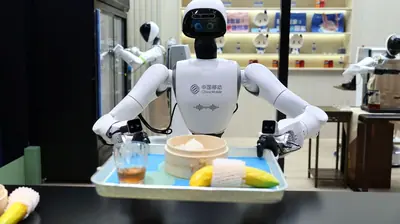
A picture taken on March 3, 2026 shows a robot serving food and drinks on China Mobile stand during the Mobile World Congress (MWC), the world’s biggest mobile technology showcase and fair in Barcelona. (AFP FILE)
Chinese netizens have so far lived through two distinct internet eras. From the early 2000s most turned to Baidu, a search engine, as their window to the web. When Google was forced to exit China at the end of the decade, Baidu, in effect, became a monopoly. But as it sought to monetise its service more aggressively, ad-driven recommendations took over, leaving users disgruntled. That brought a backlash against web-based search and, thanks to the spread of the smartphone, pushed China into a second internet era dominated by mobile super-apps that bring together functions such as shopping, entertainment, communication and payments.
One consequence is that China’s biggest technology firms—including Alibaba, an e-commerce titan, ByteDance, an entertainment giant, and Tencent, a gaming-and-messaging colossus—possess sprawling portfolios of digital services and logistics networks that can be used to develop agentic offerings capable of performing a wide variety of tasks for users. Another consequence is that any of these companies could conceivably emerge as the leader of this new, third era in China’s internet. Already the competition is ferocious. On May 13th Pony Ma, founder of Tencent, warned that a messy “land grab” for AI services was in the offing.
On May 11th Alibaba announced that it had fully integrated Qwen, its chatbot, with Taobao, its shopping app. With a few simple commands the AI can now procure all manner of products and services for users (including rose-petal-vinegar-flavoured coffee). ByteDance is preparing to release a similar integration between Doubao, its chatbot, and Douyin, its short-video app (which also incorporates shopping).
Tencent has been a dark horse in the race. Its investment in AI models started more slowly, but the company says that over the past six months it has completely revamped how its AI team works. A new model, Hy3, is in a testing phase and has performed well. Tencent is now slowly integrating this model with WeChat, its ubiquitous messaging-and-payments app. Millions of businesses have created “mini-programs” within WeChat that could be woven together with AI.
For the tech giants, AI super-apps may offer an attractive new source of growth at a time when consumer spending in China is anaemic. Adjusted operating profit in Alibaba’s Chinese e-commerce division was down by 40% year on year in the first quarter of 2026. And although the company’s cloud business is booming, as enterprises spend more on its AI infrastructure, that growth requires enormous capital investment, weighing on cashflows.
In private China’s tech giants say that their AI super-apps are not recommending products based on ad spending. But to make these profitable, they may eventually have to. Although ByteDance recently launched a paid tier for Doubao users wishing to access certain features, most chatbots in China are free to use. In February, to coincide with the Lunar New Year, many tech giants offered generous promotions to encourage people to start using their agentic services. With competition so intense, it seems unlikely they will start charging for the services soon.
The rationale for the tech giants may also be defensive. Some in the industry worry that the emergence of an AI-powered device with agentic capabilities embedded in its operating system could displace existing super-apps. OpenAI, an American lab, is reportedly working on such a device. ByteDance tried this in December when it launched a smartphone with ZTE, a device-maker, which came pre-loaded with an AI assistant. But despite an initial burst of enthusiasm, with around 30,000 of the devices produced, the project was a failure, in part because Alibaba and Tencent blocked it from using their payment platforms.
That will not stop others from trying. In March Xiaomi, a gadget-maker that has recently expanded into electric vehicles (EVs), announced the release of new AI models that would be embedded in its smartphones and cars. Huawei, another tech giant that makes both smartphones and software systems for EVs, could also muscle in. Auto executives reckon that many young Chinese will access agentic services through voice discussions with their car.
Xiaomi and Huawei already have hundreds of millions of users apiece. If Alibaba and Tencent were to try to hobble a push into agentic offerings by either company, China’s regulators might well intervene. As China’s internet enters its next era, a bitter fight for dominance looms.