Key Points
Tesla (NASDAQ:TSLA) initially unveiled its Cybercab concept in 2024. The design was simple: no steering wheel, no pedal, and limited features. The goal was to manufacture a simple, streamlined vehicle that can drive completely autonomously, operating as part of a larger robotaxi fleet.
Many analysts were quick to project rapid growth.
Missed Nvidia in 2009? This Rare Signal Is Flashing Again. In 2009, a “Double Down” signal flashed for a little-known chipmaker called Nvidia. For the first time in years, that same “Total Conviction” signal is flashing for a company 1/100th the size of Nvidia. Continue »
Wedbush analyst Dan Ives, for example, believed the Cybercab would unleash “a new chapter of growth around autonomous, FSD, and AI future at Tesla.” Ives touted that Tesla’s then non-existent robotaxi service would create “$1 trillion of value alone for Tesla over the coming years,” adding that the service could soon add “$10 billion to $15 billion in annual revenue” for the company.
Nearly two years later, Tesla’s robotaxi service is likely generating an immaterial amount of revenue for the EV maker, though the exact revenue breakdown has yet to be provided. Tesla has had issues scaling its robotaxi service as quickly as it would have liked, repeatedly running into both regulatory challenges and technical disruptions. The service, meanwhile, relied on Tesla’s Model Y, with Cybercabs nowhere in sight.
On Sept. 3, however, Tesla’s Cybercab model officially hit the streets. Around 45 company-owned Cybercabs were added to Tesla’s Austin robotaxi service, though the company will likely look to outside partners to scale Cybercab deployments to other cities and states.
Has Tesla’s robotaxi division finally reached a growth inflection point? There are two things investors must keep in mind.
1. Robotaxis are critical to Tesla’s valuation
It is hard to fathom Tesla’s valuation when viewing the company strictly as an automaker. Shares trade at 13 times sales and 354 times earnings. Ford (NYSE:F), for comparison, trades at just 0.3 times sales and 11 times earnings. Even Rivian (NASDAQ:RIVN) — another EV stock with exposure to the robotaxi market — trades well below 4 times sales.
Clearly, Tesla investors are pricing in more than just vehicle sales. That’s especially true given the company faced negative vehicles sales growth in both 2024 and 2025.
How much of Tesla’s current valuation relies on the success of its robotaxi service is debatable. But there’s no doubt that scaling and monetizing robotaxis is a “must” for Tesla’s $1.2 trillion valuation to be justified long term.
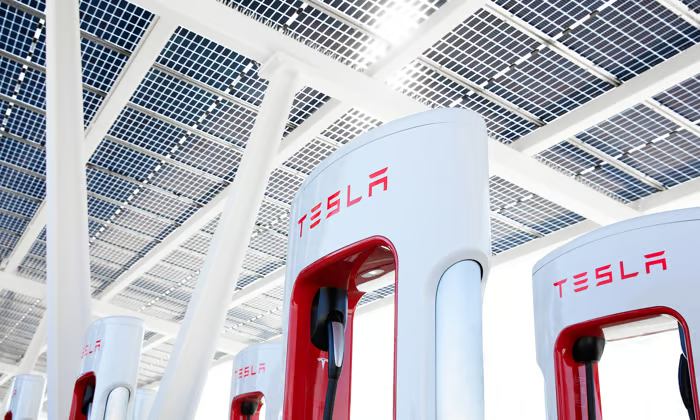
Image source: Tesla
2. We still know very little about how Cybercabs will scale
Despite how important robotaxis are to Tesla’s valuation, we still know very little about how the company will price or scale its new Cybercab model.
Tesla CEO Elon Musk has teased a starting price of around $30,000. But even after the major Cybercab event held on Sept. 3, exact pricing details have yet to be confirmed. Musk also failed to give any concrete details on Cybercab production volumes. Even worse, Tesla recently dropped the Cybercab from models the company expects to reach mass volumes this year.
To be clear, Tesla remains a strong robotaxi competitor. The company’s vertical integration and cost base will likely allow it to scale more aggressively than the competition. But as with most of Tesla’s growth initiatives, the timelines involved will likely be longer than investors (or even Musk himself) would like to believe. Tesla’s Cybercab launch in Tesla is exciting. But meaningful robotaxi revenue is not yet around the corner.
Don’t miss this second chance at a potentially lucrative opportunity
Ever feel like you missed the boat in buying the most successful stocks? Then you’ll want to hear this.
On rare occasions, our expert team of analysts issues a “Double Down” stock recommendation for companies that they think are about to pop. If you’re worried you’ve already missed your chance to invest, now is the best time to buy before it’s too late. And the numbers speak for themselves:
- Nvidia: if you invested $1,000 when we doubled down in 2009, you’d have $586,196!*
- Apple: if you invested $1,000 when we doubled down in 2008, you’d have $60,321!*
- Netflix: if you invested $1,000 when we doubled down in 2004, you’d have $414,015!*
Right now, we’re issuing “Double Down” alerts for three incredible companies, available when you join Stock Advisor, and there may not be another chance like this anytime soon.
*Stock Advisor returns as of September 9, 2026.
Ryan Vanzo has no position in any of the stocks mentioned. The Motley Fool has positions in and recommends Tesla. The Motley Fool has a disclosure policy.