XPeng (NYSE: XPEV; HKG: 9868) plans to expand its technology-licensing business to additional foreign automakers beyond Volkswagen (ETR: VOW3), Reuters reported on September 17, 2026, citing two people familiar with the matter. Some potential partners, including overseas automakers, software developers and auto-parts suppliers, have already expressed interest in the company’s technology, according to the report.
The push builds on XPeng’s existing partnership with Volkswagen, which first took a 4.99% stake in the Chinese automaker for about $700 million in July 2023. The two companies’ first jointly developed model, the Volkswagen ID. UNYX 08, rolled off the production line in March 2026 at a joint-venture plant in Anhui, running XPeng’s Vision-Language-Action driving software on 1,500 TOPS of onboard computing power.
Advertisement – Continue scrolling for more
That architecture deal has already grown once. In July 2024, Volkswagen and XPeng expanded their joint electronic-electrical architecture work from Volkswagen’s China-specific CMP platform to its global MEB platform, with Volkswagen committing that every pure-electric model it launches in China from 2026 onward will use the jointly developed system. Volkswagen pays XPeng on a monthly licensing-fee basis rather than through a joint venture, and has stationed engineers from its CARIAD software unit and China technology arm at XPeng’s Guangzhou headquarters to work alongside XPeng’s team, an arrangement XPeng has credited with shortening the architecture’s development timeline.
XPeng set up a dedicated strategic commercialization team roughly six months ago to pursue additional licensing deals beyond that arrangement, the Reuters sources said. The technologies on offer include electrical and electronic architecture, intelligent cockpit systems, the Turing AI chip and advanced driver-assistance software, along with robotaxi deployment and operation services, humanoid robots and broader physical AI applications.
XPeng founder and chief executive He Xiaopeng said the company is discussing expanded cooperation with Volkswagen while separately holding talks with other automakers and non-automotive companies on technology and chip partnerships. He added that announcements would come once timing was right, and pointed to next month’s Paris Motor Show as a possible venue for unveiling new overseas cooperation.
Advertisement – Continue scrolling for more
The licensing push follows a broader corporate pivot. XPeng changed its Chinese name from XPeng Motors to XPeng Group, effective April 1, 2026, dropping the word for “automobiles” to reflect an expansion into what He calls physical AI, spanning autonomous driving, robotics and chip development. The company has earmarked 7 billion CNY (about $1.04 billion) for physical AI research and development in 2026 and is targeting shipments of 1 million Turing chip units this year.
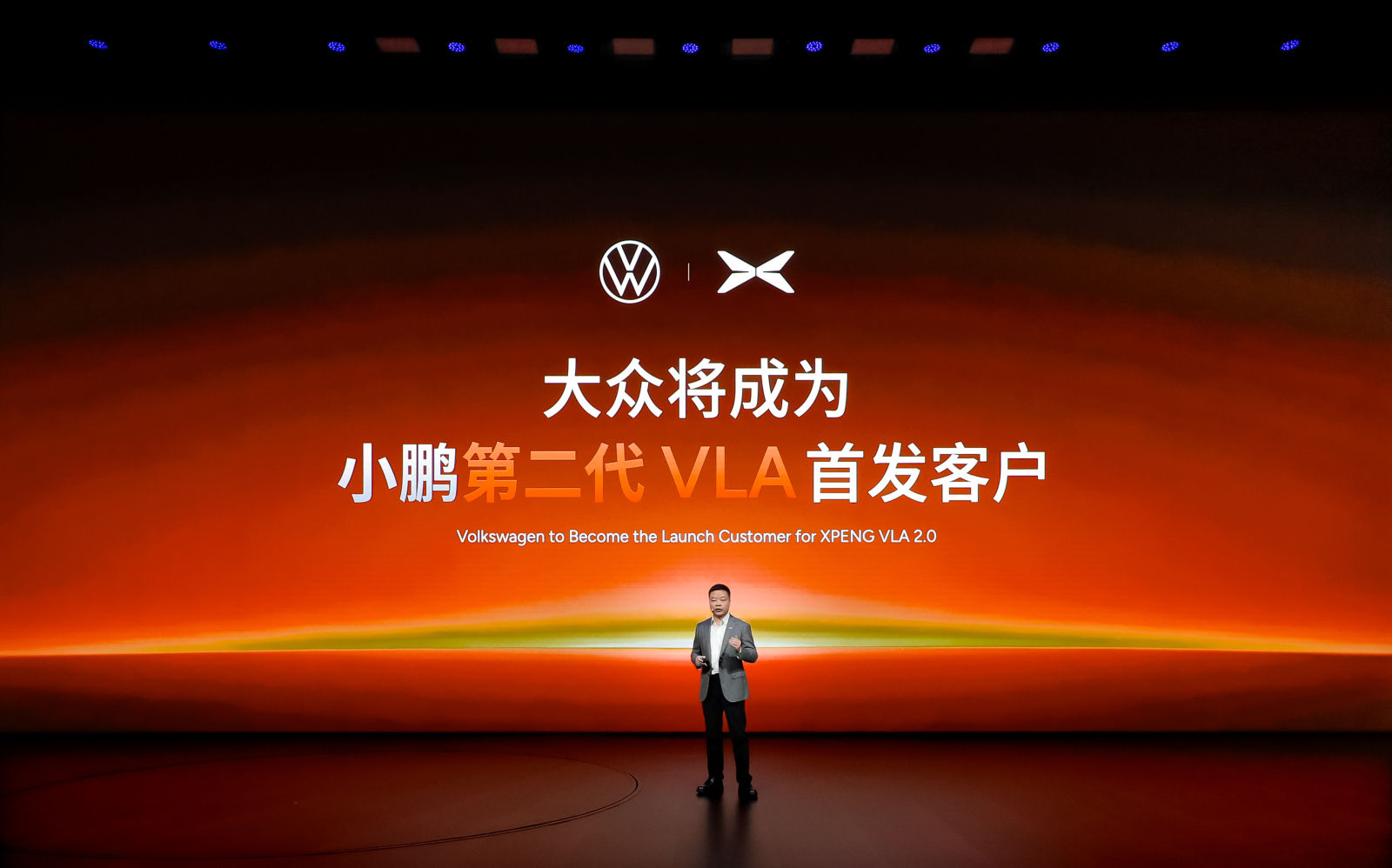
He Xiaopeng announces Volkswagen as the first customer for XPeng’s VLA 2.0 driving system, March 2026. (XPeng)
XPeng’s driver-assistance push centers on VLA 2.0, an end-to-end intelligent driving system that Volkswagen adopted as its first customer in China when the two companies announced the system in March 2026. XPeng has said it will begin international road testing of the system, with global deliveries, including a planned European rollout, targeted for 2027.
That shift is already visible in XPeng’s revenue mix. In the second quarter of 2026, vehicle sales revenue grew just 1.0% year over year to 17.05 billion CNY (about $2.51 billion), while automotive gross margin narrowed to 12.1% from 14.3% a year earlier. Total revenue for the quarter came to 19.74 billion CNY (about $2.91 billion), up 8.0% year over year.
Advertisement – Continue scrolling for more
Services and other revenue, which includes technology-development fees tied to the Volkswagen partnership and parts sales, nearly doubled to 2.70 billion CNY (about $400 million), with margin expanding to 75.1% from 53.6%. XPeng posted a net loss of 1.34 billion CNY (about $200 million) for the quarter, underscoring the appeal of a licensing model that carries far higher margins than building and selling cars.
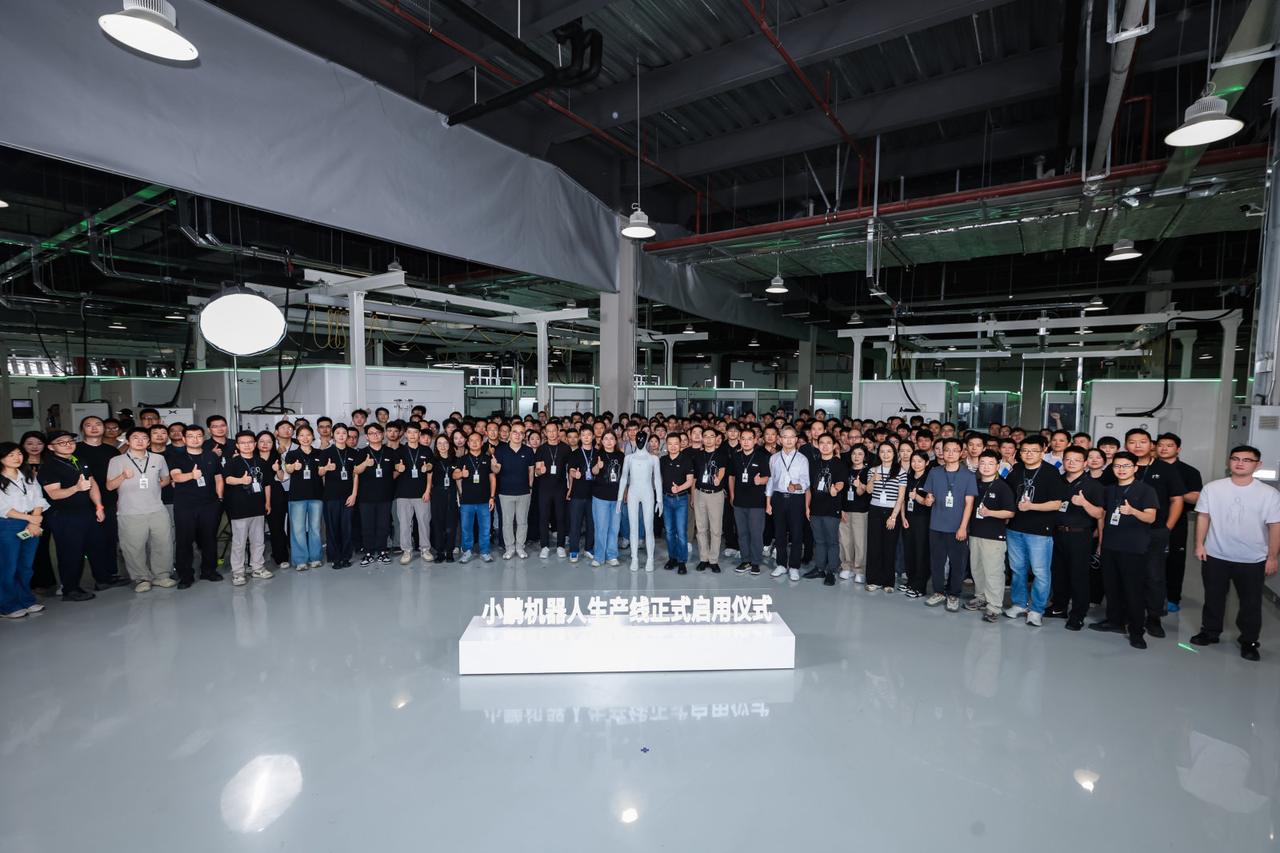
XPeng staff mark the official launch of the IRON humanoid robot production line, September 2026. (XPeng)
XPeng is pursuing a similar playbook in robotics. Its IRON humanoid robot entered production this month, and the company’s robotics unit raised more than $900 million at a post-money valuation above $6.3 billion in August 2026 to fund the effort. Commercial deployments of IRON in China and overseas markets are planned for 2027, alongside passenger-carrying robotaxi demonstrations XPeng has planned for the second half of 2026.
Advertisement – Continue scrolling for more
Not every read on that robotaxi push is upbeat. Bernstein analyst Eunice Lee has estimated XPeng’s robotaxi production cost could fall below 200,000 CNY (about $29,800) per vehicle, well under Waymo’s roughly $100,000, but cautioned that regulatory approval for full autonomous operation is unlikely before 2027 or later and that she does not expect a material financial boost from robotaxis over the next one to two years.
XPeng’s next SUV, the G9L, is scheduled to make its global debut on October 12 at the Paris Motor Show, reaching 64 markets as the fourth XPeng model built at Magna’s plant in Graz, Austria. It uses the same Turing AI chip that underpins the company’s robotics push, giving XPeng an additional showcase for the technology stack it hopes to license elsewhere.
Advertisement – Continue scrolling for more
XPeng’s overseas push has accelerated alongside the licensing talks. Overseas shipments accounted for 19% of total deliveries in the first half of 2026, up from 9.5% a year earlier, and cumulative international deliveries have topped 100,000 units since the company entered Norway in 2020. Germany was XPeng’s top overseas market in the first eight months of 2026, with registrations up 258% year over year to 5,773 units, and the company has set a 2026 export target of more than 90,000 vehicles, more than double the roughly 45,008 shipped in 2025.
XPeng shares rose roughly 3% in New York trading after the Reuters report, though the stock remains down more than 47% for the year, a steeper decline than rivals Nio (NYSE: NIO) and Li Auto (NASDAQ: LI), which have fallen 29% and 31%, respectively.
Reuters reported that the sources did not name any of the potential partners under discussion. With He pointing to next month’s Paris Motor Show as a likely venue for news, that event may offer the first real test of how many of those conversations have turned into signed deals rather than exploratory talks.
Conversion rate: 1 USD = 6.71 CNY as of September 17, 2026.
Advertisement – Continue scrolling for more