Key Points
-
Nvidia is expected to report strong growth in its upcoming Q2 update.
-
However, its stock has often fallen after beating Wall Street earnings estimates.
-
History favors long-term holders of the stock over market timers.
- 10 stocks we like better than Nvidia ›
Every quarter, the most highly anticipated earnings report is announced. And every quarter leading up to that report, investors ask the same question: Should I buy Nvidia (NASDAQ:NVDA) stock before the quarterly update?
Earnings announcements can be huge catalysts for stocks. That’s especially the case for a stock of the biggest company on the planet by market cap that’s at the center of one of the biggest technologies ever.
Missed Nvidia in 2009? This Rare Signal Is Flashing Again. In 2009, a “Double Down” signal flashed for a little-known chipmaker called Nvidia. For the first time in years, that same “Total Conviction” signal is flashing for a company 1/100th the size of Nvidia. Continue »
Nvidia is scheduled to report its 2027 second-quarter earnings following the market close on Aug. 26. Will the stock soar after that key date? Here’s what history shows.
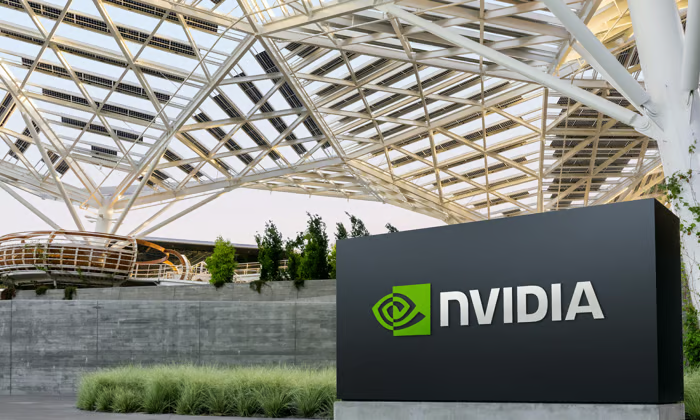
Image source: Nvidia.
Great expectations
Nvidia’s guidance issued in May 2026 projected revenue of $91 billion, plus or minus 2%. If the company hits that mark, it will reflect year-over-year revenue growth of roughly 95%.
Wall Street is slightly more optimistic. The consensus Q2 revenue estimate is $92.07 billion. Analysts also expect Nvidia to post adjusted earnings per share of $2.09, up from $1.05 in the prior-year period.
Unsurprisingly, most of Nvidia’s growth is likely to come from its data center business. The company’s graphics processing units (GPUs) continue to enjoy tremendous demand to power artificial intelligence (AI) applications hosted in data centers.
Nvidia CEO Jensen Huang predicts that his company will generate a whopping $1 trillion in total sales between 2025 and the end of calendar year 2027 from its Blackwell and Rubin GPUs. And that number doesn’t include any contributions from the Vera Rubin CPUs.
An impressive — and perhaps surprising — record
Beating Wall Street expectations has been a piece of cake for Nvidia in the past. In fact, the company has topped analysts’ estimates for an impressive 13 consecutive quarters.
Does this mean that Nvidia’s stock rose after each of those earnings beats? Nope. Perhaps surprisingly, the GPU giant’s share price has even fallen in some cases after handily exceeding earnings estimates.
One reason is that Wall Street often has “whisper numbers,” which are unofficial real earnings expectations for a company. Nvidia can report quarterly earnings that are higher than the announced analysts’ estimate but lower than the whisper number.
Another, perhaps even more important, factor is the guidance and commentary about near-term prospects that Nvidia gives in its quarterly updates. Investors are forward-looking. Nvidia can hit a home run with its quarterly results but still strike out if management talks about potential speed bumps ahead.
On the other hand, any hints of improving market opportunities can cause the GPU stock to rise following a quarterly update regardless of the numbers that it reports. A key factor to watch with Nvidia’s Q2 results this week is its China sales. The company’s guidance explicitly excludes any data center revenue from China. If Nvidia’s executives provide reason for optimism about AI chip sales in the country, look for Nvidia’s stock to pop after Wednesday.
The historical verdict
Will Nvidia stock soar immediately after Aug. 26? My best guess, based on its historical track record, is that it won’t.
For one thing, Nvidia’s margin of beating Wall Street earnings estimates and its own guidance has declined over time. For example, the company posted earnings that were 22.8% above the midpoint of its guidance range in the second quarter of fiscal 2024. In fiscal 2027 Q1, Nvidia beat the consensus earnings estimate by around 5.5%.
Another concern for Nvidia relates to the growing apprehension about hyperscalers’ AI infrastructure spending. Investors have become increasingly uneasy about the significant investments that cloud providers and other tech companies are making to expand their compute capacity. When the dynamics surrounding these AI companies are so murky, it makes things more difficult for Nvidia to overcome the negativity, regardless of how strong its Q2 results are.
I could be wrong, though. Nvidia could wow Wall Street with its upcoming quarterly update as it has at times in the past.
More importantly, whether or not Nvidia’s shares soar after Aug. 26 doesn’t matter in the big scheme of things. Investors who have held the stock over the long term have made a lot of money. I suspect that will continue to be the case no matter what Nvidia’s Q2 results are.
Should you buy stock in Nvidia right now?
Before you buy stock in Nvidia, consider this:
The Motley Fool Stock Advisor analyst team just identified what they believe are the 10 best stocks for investors to buy now… and Nvidia wasn’t one of them. The 10 stocks that made the cut could produce monster returns in the coming years.
Consider when Netflix made this list on December 17, 2004… if you invested $1,000 at the time of our recommendation, you’d have $429,223!* Or when Nvidia made this list on April 15, 2005… if you invested $1,000 at the time of our recommendation, you’d have $1,317,883!*
Now, it’s worth noting Stock Advisor’s total average return is 965% — a market-crushing outperformance compared to 212% for the S&P 500. Don’t miss the latest top 10 list, available with Stock Advisor, and join an investing community built by individual investors for individual investors.
*Stock Advisor returns as of August 24, 2026.
Keith Speights has no position in any of the stocks mentioned. The Motley Fool has positions in and recommends Nvidia. The Motley Fool has a disclosure policy.