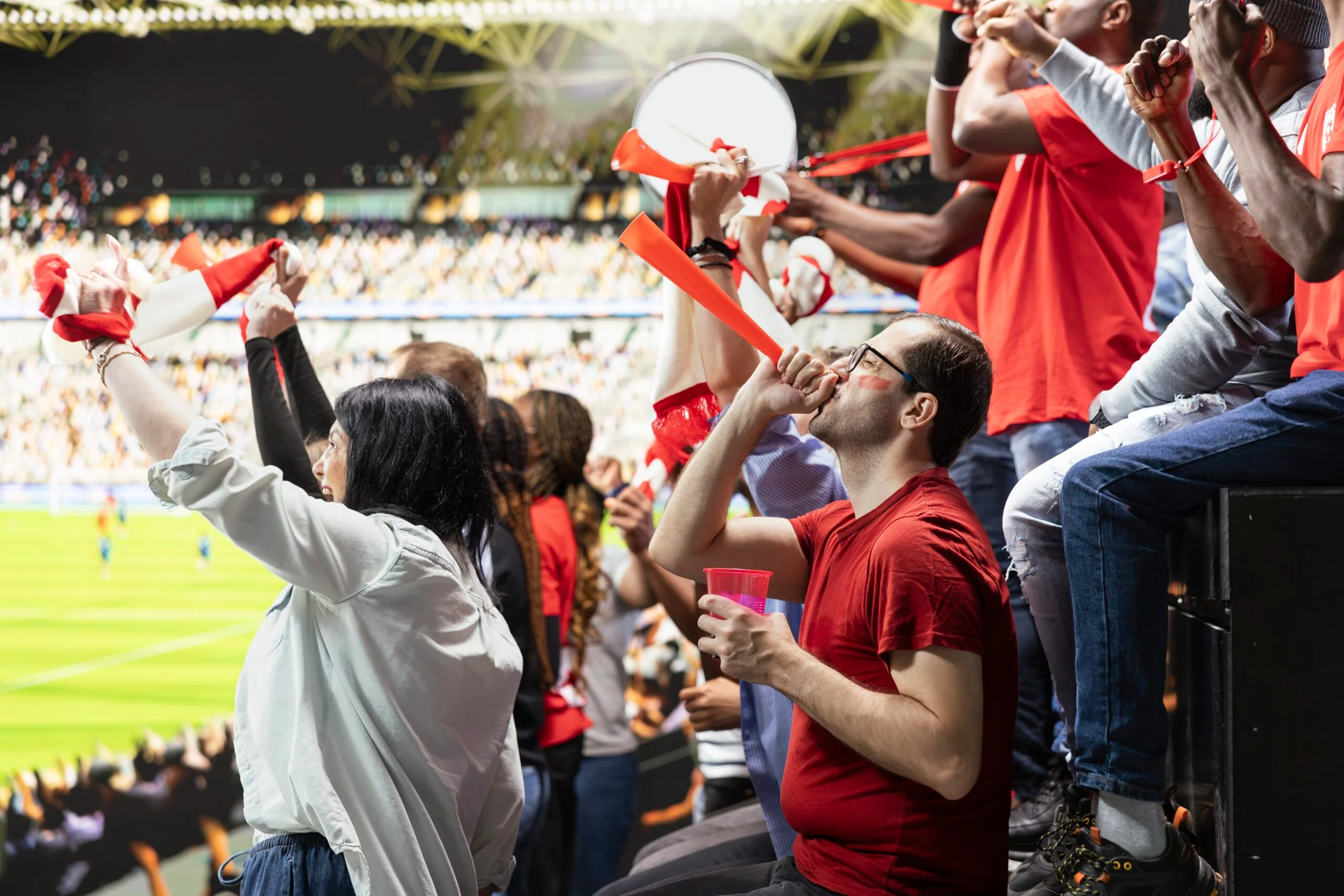
Football stadiums may look similar from the stands, but they do not sound the same. Across Europe, the music, chants and singing that fill a match are shaped by local habits, club culture and national identity, giving each country its own distinct match-day voice.
That is the argument behind new research by Nicolai Jørgensgaard Graakjær, a professor at Aalborg University in Denmark, who examined how popular music and football come together during elite-level league matches. Published in Popular Music and Football by Cambridge University Press, the study traces how songs are chosen, how they are sung, and how they become woven into the flow of the game itself.
What emerges is not a picture of random entertainment between whistles, but of a carefully recognizable sound world. In one country, songs erupt in reaction to a moment on the pitch. In another, they are sustained, rhythmic and led from within organized supporter sections. The result is that football stadiums across Europe do not simply host different teams, they produce different kinds of collective sound.
Where the crowd finds its voice
Graakjær’s analysis spans several European case matches over the past decade and focuses on what happens inside the stadium environment. He identifies three main forms of interaction: music interacting with other music, music interacting across types, and music interacting with the match itself.
That framework may sound technical, but the basic idea is easy to hear. A club anthem, a goal celebration song, a chant pulled from pop music, and a spontaneous burst of singing from the terraces do not serve the same purpose. They can overlap, compete, build emotion, or redirect it.
The study pays particular attention to what it calls “emotionally charged, identity-infused mega-performances” by musical amateurs. Many of the people creating that noise may not sing anywhere else. In the stadium, though, they become part of a temporary public choir, using music as a form of release, participation and belonging.
“The differences in stadium sound tell us something about how community, participation and emotion are expressed in different football cultures,” Graakjær said.
England’s short bursts, Germany’s steady pulse
In England, the study found, stadium sound is often driven by spontaneous collective singing. Songs rise quickly from the crowd, often in direct response to events on the field, then disappear just as fast. Supporters borrow familiar tunes from popular music, add new lyrics, and turn them into brief, forceful chants.
Among the examples noted in the research are club versions of “Oh, When the Saints Go Marching In,” “Guantanamera” with rewritten words, and Gala’s “Freed From Desire,” now widely used as a celebration song. The sound in English grounds, Graakjær writes, is organic and changeable, with the atmosphere capable of shifting several times in a single match.
Germany offers a different model. There, stadium sound is typically more organized, more rhythmic and more sustained. Drums matter. Chant leaders matter. Songs often continue for longer stretches, producing a more constant wall of sound that gives the match a steady pulse.
German supporters may sing club anthems such as Bayern Munich’s “Stern des Südens,” while fixed musical signals can mark goals. One example in the study is Offenbach’s “Can-can.” In that setting, music is not just reacting to the game, it helps structure the experience of the game.
“Music is not just background noise in the stadium. It is an active part of the match and helps turn each stadium into a unique sonic community,” Graakjær said.
Club rivalry and national belonging
The meaning of singing also changes depending on the kind of match being played.
At club level, music and chanting are often directed outward, toward rivalry, strength and confrontation. Supporters use sound to project unity and intimidate opponents. Songs can be aimed at rival clubs, especially in recurring local matchups where history gives every lyric extra force.
“The national identity is one large, overarching category of identity, whereas club identity is more local and typically tied to frequent, regularly recurring matches against specific opponents, including local rivals, who are ‘sung against’,” Graakjær said.
International football shifts that balance. At national team matches, the study says, music and singing are much more oriented toward inclusion and community. Instead of drawing lines against a familiar club enemy, the sound is more likely to gather supporters into a broader shared identity.
That helps explain why national anthems carry so much weight. They are not just ceremonial openings. In these settings, they become one of the clearest tools for producing collective feeling on a large scale.
More than noise around the game
The wider point of the study is that football and popular music are two of the most widespread and culturally significant practices in contemporary life, and their overlap deserves more attention than it usually gets.
Neither one fully defines the other. Still, when they meet in a stadium, the effect is powerful. Songs become social signals. Chants become memory devices. Repeated musical cues can tell supporters when to celebrate, when to taunt, when to hold together and when to answer the tension on the field with a louder response.
The stadium, in that sense, is not just a place where music happens to appear. It is one of everyday life’s most layered and contested spaces for giving popular music meaning.
That also means the people making the sound matter. The study draws attention to supporters who may be musically inactive or overlooked in daily life, yet become central performers in the match environment. Their voices help create a shared emotional landscape, one that can be local, national, improvised, rehearsed, welcoming or hostile, sometimes all within the same ninety minutes.
Football matches, singing and music
- Music builds atmosphere. General stadium music such as mainstream pop and rock functions as a kind of “sonic architecture”.
- Music tells the audience what is happening. Team music such as entrance music, goal music and victory music is linked to specific events: players entering the pitch, the home team scoring or the home team winning.
- Music and singing create identity. When the same music is used repeatedly at specific moments, it becomes associated with the club.
- Music gets bodies and communities moving. Music can make people clap, sing, jump and dance together.
- Music creates “us” and “them”. Supporter songs are more than entertainment. They mark affiliation: who we support, who we oppose and who belongs to the community.
- “Oh, When the Saints Go Marching In” — used in club-adapted versions
- “Guantanamera” — with new club- or player-related lyrics
- “Freed From Desire” — Gala, used as a victory and celebration song
- “Glory Glory” — melody from “Battle Hymn of the Republic”, used as a club anthem by several clubs
- “Stern des Südens” — club anthem, Bayern Munich
- “Infernal Galop” / “Can-can” — Jacques Offenbach, used as goal music by Bayern Munich
- Drum-based chants led by chant leaders and sustained throughout the match
- “Hala Madrid y Nada Más” — club anthem and goal/entrance music, Real Madrid
- Less continuous communal singing during matches
- International pop and rock songs such as Tina Turner’s “The Best”
- Classic, short fan chants adapted to clubs and players
Internationally / many countries
- “Seven Nation Army” — The White Stripes
- “We Will Rock You” — Queen
- “Who Let the Dogs Out” — Baha Men
- “UEFA Champions League Anthem” — official tournament music