Key Points
-
Investors historically reaped gains from Nvidia primarily through share price appreciation.
-
The company’s decision to raise its dividend could be a sign that it wants to welcome a new cohort of investors beyond those seeking artificial intelligence (AI)-driven growth.
-
Nvidia’s dividend is now at a level that should appeal to value funds, endowments, and pension funds.
- 10 stocks we like better than Nvidia ›
During its fiscal first-quarter 2027 earnings release, Nvidia (NASDAQ: NVDA) announced that it would be increasing its quarterly dividend from $0.01 to $0.25 per share. All shareholders on record as of June 4 will be eligible for the increase.
I see this move as a deliberate evolution in Nvidia’s capital-allocation playbook. For the last few years, the company has been the archetype of hypergrowth — dumping excess profit into research and development (R&D) amid historic levels of artificial intelligence (AI) infrastructure spending.
Will AI create the world’s first trillionaire? Our team just released a report on the one little-known company, called an “Indispensable Monopoly” providing the critical technology Nvidia and Intel both need. Continue »
By lifting its dividend payout, Nvidia is signaling that the business has matured enough to return cash while still funding an ambitious roadmap. In my eyes, Nvidia’s decision to raise its dividend by 2,400% is a strategic pivot designed to widen its shareholder base beyond the retail traders and momentum funds that have crowded its ownership throughout the AI revolution.
Image source: The Motley Fool.
Attracting more income-oriented and institutional capital
Nvidia’s prior dividend payment of $0.01 was nominal. Frankly, it was a token gesture that did quite little to interest pension funds, insurance companies, or endowments whose mandates require steady yields.
By raising the payout to a level that actually registers on income screens, Nvidia quietly opens the door to a new cohort of capital that cherishes predictability over pure price appreciation. These types of investors usually do not index on the latest quarterly beat or next quarter’s guidance. Instead, they opt for underwriting decades-long compounders — thus demanding a visible, sustainable yield as evidence of prudent financial discipline.
Institutional funds often face internal hurdles when buying zero-yield tech stocks. A credible dividend helps remove this hurdle, potentially unlocking billions of dollars in fresh inflows from investors that were previously sidelined.
The timing here is clever: With AI capital expenditures (capex) accelerating to record levels, scrutiny over Nvidia’s near-term returns will likely intensify. Offering a generous dividend acts as ballast, reassuring investment committees that the company is not burning cash on speculative new product lines.
Nvidia should be able to sustain this dividend hike
I think the dividend increase also serves as a quiet declaration that Nvidia’s management believes the company’s cash machine is robust enough to support both explosive product growth and rising shareholder distributions.
Nvidia CEO Jensen Huang has stressed that AI tailwinds are durable and that the company is well-positioned to fund next-generation chip architectures, build new AI factories, and enhance its software ecosystem. For investors who previously questioned whether AI demand is cyclical or whether Nvidia’s gross margins may compress under competition, I think the dividend raise sends a powerful message.
Generally speaking, a company that raises its payout is implicitly betting it can maintain or even expand that payout in the future. Otherwise, the move is a major credibility risk. I see Nvidia’s dividend hike as a concrete vote of confidence in the longevity of its competitive moat spanning data centers, developer lock-in from CUDA software, and a full-stack AI ecosystem that competitors still struggle to replicate at scale.
How has Nvidia stock performed relative to its peers lately?
Lastly, the decision to raise its dividend may be a response to Nvidia stock’s more muted price action compared to some of its AI chip peers over the last year.
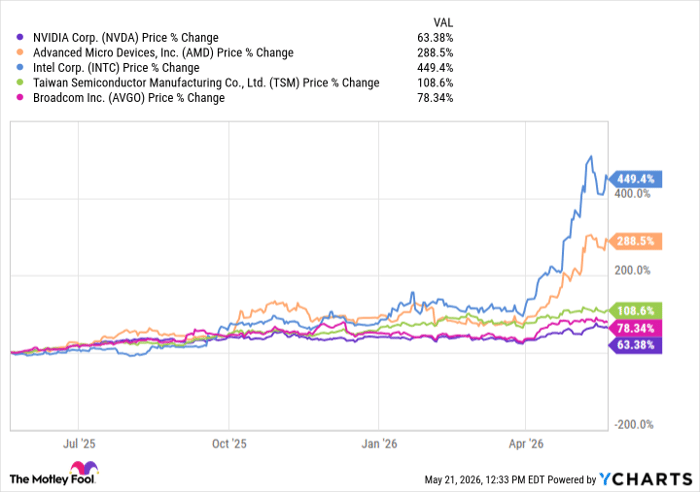
Given this relative performance, it’s fair to wonder whether some investors thought the market had already priced in peak AI exuberance for Nvidia and had rotated into emerging names within the AI chip value chain.
A dividend increase offers a different form of return that can stabilize the company’s valuation profile while rewarding patient holders. In doing so, Nvidia mitigates the risk of meaningful multiple compression by creating a floor through passive income rather than relying entirely on share price appreciation.
The dividend raise also shifts the narrative from a company growing at any cost to one more aligned with disciplined growth and measured capital allocation. This template appeals to value funds scanning for evidence that the AI trade is entering a more mature phase.
Nvidia’s dividend raise is less about its absolute size and more about the message the company is sending. The company has reached a scale and level of predictability that justifies welcoming a broader investor base. To me, this is a clear sign that Nvidia is ready to graduate from a pure growth story to an enduring compounder.
Should you buy stock in Nvidia right now?
Before you buy stock in Nvidia, consider this:
The Motley Fool Stock Advisor analyst team just identified what they believe are the 10 best stocks for investors to buy now… and Nvidia wasn’t one of them. The 10 stocks that made the cut could produce monster returns in the coming years.
Consider when Netflix made this list on December 17, 2004… if you invested $1,000 at the time of our recommendation, you’d have $477,813!* Or when Nvidia made this list on April 15, 2005… if you invested $1,000 at the time of our recommendation, you’d have $1,320,088!*
Now, it’s worth noting Stock Advisor’s total average return is 986% — a market-crushing outperformance compared to 208% for the S&P 500. Don’t miss the latest top 10 list, available with Stock Advisor, and join an investing community built by individual investors for individual investors.
*Stock Advisor returns as of May 25, 2026.
Adam Spatacco has positions in Nvidia. The Motley Fool has positions in and recommends Advanced Micro Devices, Broadcom, Intel, Nvidia, and Taiwan Semiconductor Manufacturing. The Motley Fool has a disclosure policy.
The views and opinions expressed herein are the views and opinions of the author and do not necessarily reflect those of Nasdaq, Inc.