Spain are men’s world champions for a second time. And, as you may have predicted following another unerring victory over Argentina in the final on Sunday, they made it through the 2026 World Cup having taken more touches, completed more passes and attempted more shots than any other side along the way.
But perhaps a less celebrated aspect of their approach is a commitment to the grittier side of the game.
That also shines through in the statistics: no team recovered possession more often in the attacking third or allowed their opponents less time on the ball than Luis de la Fuente’s defensively disciplined side, pressing high and nicking the ball whenever they could.
Patient possession and free-flowing football spring to mind when you think of Spain, but equally critical to their consistent domination of World Cup games over the past month-plus has been a desire to win the ball straight back whenever a pass goes astray.
In possession, Spain dictate the tempo, move the opposition from side to side and force them deeper and deeper as they try to protect their goal. Without it, they snap straight into tackles to keep that pressure on.
Spain defeats Argentina to win the World Cup
David Ornstein and Lia Griffin
That is exactly how they penned Argentina in from minute one yesterday, defending from the front and keeping Lionel Messi and company far away from their goal. The defending world champions played for 116 minutes before they managed a shot. They had only two over the two hours of football.
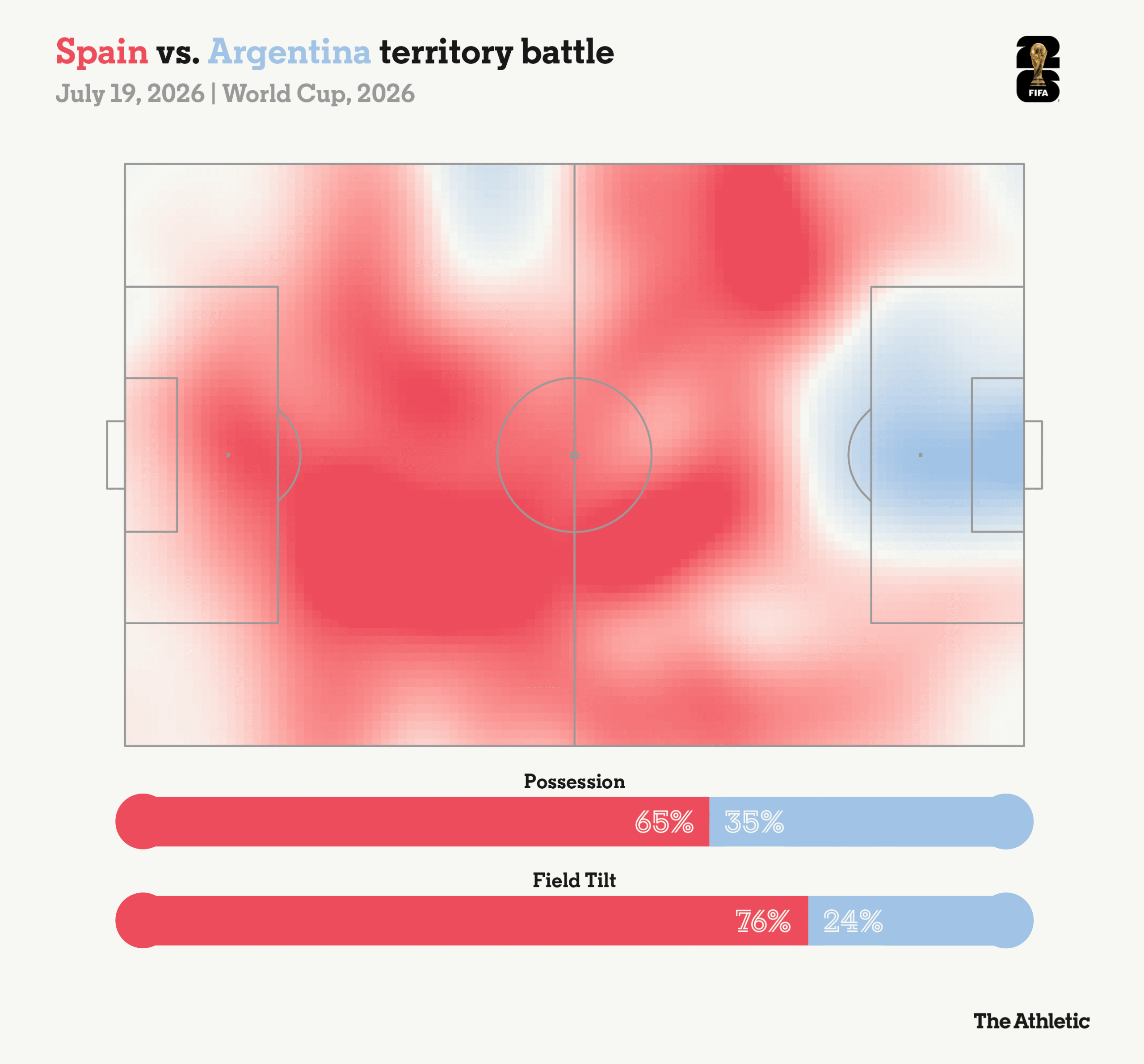
As we can see from the territory plot below, where the pitch is shaded in favour of the team who controlled more possession per area of the turf, Spain restricted Argentina to a pocket of space down the right, where Lionel Messi and overlapping full-backs would occasionally combine after long passes out to the flank.
Otherwise, the only area of the pitch Argentina truly commanded with the ball was their own penalty area, where goalkeeper Emiliano Martinez took 21 touches in the safety of his six-yard box after goal kicks.
Spain sought to manage the flow of the game from the start, encouraging their defenders to push high whenever they had the ball. That helped to compress the space in the opposition half, meaning Spanish players were close to one another to combine with quick passes, but also able to seize on the ball whenever it ran loose.
Even when their high line was briefly compromised with surging Argentine runs forward on the break, sweeper-’keeper Unai Simon was alert to cover the space they left in behind.
Here on five minutes, for example, Spain lose possession, and their deepest defenders are momentarily caught up the pitch. But even as Messi looks to be set through on goal, Simon appears from nowhere to intercept the through ball, helping to keep his team on the front foot after an early scare.

De la Fuente’s faith in Simon was questioned before the tournament, particularly given David Raya’s stellar form last season for Arsenal.
The 29-year-old has made high-profile errors in previous competitions, notably letting a back-pass slip under his foot against Croatia at Euro 2020. But Simon has been a calm presence with the ball at his feet this summer, and justified his selection through his sense of anticipation alone, completing more defensive actions outside his penalty area than any other goalkeeper this tournament.
That combination of a high line and defenders who consistently win their duels — even when pulled out of position — along with an alert ’keeper who patrols the space behind makes it difficult for the opposition to escape.

Spain are always alert to ensure they defend as a team and lock onto the opposition when they can, and not only across the back four.
Numbers from FIFA Football Performance Insights’ enhanced data set help to quantify their appetite to win the ball straight back.
After a team lose the ball in open play, FIFA analyses the following two seconds and defines the sequence as a “counter-press” if the team without possession puts pressure on the ball within that time. No side at this World Cup regained possession more often (51) from such counter-pressing sequences than Spain, nicking the ball back six times on Sunday alone.
Here is an example, as an attack breaks down following a loose pass from Mikel Oyarzabal. Argentina finally get a chance to take the sting out of the game, but as Alexis Mac Allister receives the ball, he is surrounded by seven red shirts.
Right-back Pedro Porro is tight to Nico Gonzalez — the only realistic out-ball, given the Spanish pressure — while even centre-back Pau Cubarsi is involved to pick up the loose ball.
He plays it back to fellow central defender Aymeric Laporte, and as the camera pans, it becomes clear just how many players Spain commit to the pressure, happy to take risks and leave only two players back if that helps to squash the time and space the other team have on the ball.

That energy did not wane as the game went on. In our next example, they race up the pitch to apply pressure on their opponents later in the second half.
Argentina themselves do well at first to force Porro into a long pass forward, but Spain are quick to pounce on Cristian Romero’s miscontrol, as first Lamine Yamal and then Oyarzabal close down the ball immediately. Nicolas Tagliafico shows composure to cut inside and play the pass to Enzo Fernandez in midfield, but look at the Spanish numbers surrounding the ball once again.
The back four push high, Fabian Ruiz and Alex Baena steam into the challenge, and Dani Olmo eventually comes away in possession.
With little time to recover on the ball, such sequences only serve to exhaust Argentina, running low on energy to exert such pressure themselves. That allowed Spain to control more of the ball, something they gratefully accepted with their quality in possession, allowing them to further wrestle momentum their way.

After a demoralising first half in which they failed to take a single touch in Spain’s penalty area, Lionel Scaloni’s world champions began to resort to long passes to avoid losing possession close to their own goal.
That didn’t work too well either.
Julian Alvarez huffed and puffed as he tried to run the channels, but he could not consistently offer the out-ball his team-mates needed. Messi also stayed forward, but at age 39 he lacks the pace and athleticism to latch onto bouncing balls up the pitch.
As we can see from Argentina’s passing network below, both players cut lonely figures at the top of the team, as their colleagues struggled to build from the back under Spanish pressure or find them with more direct passes forward.

Exemplary off-ball discipline and application go a long way to explaining the pattern of this game, but the extent to which Argentina were smothered in their seventh World Cup final was a huge surprise. Even with Messi having been in inspired form throughout this tournament, they played for nearly two hours on Sunday without even taking a shot on goal.
Before extra time, Argentina had managed 39 touches in the attacking third. Only on two occasions this summer have teams mustered fewer — Cape Verde against Spain in their opening game, a goalless draw where the Spanish had 74 per cent possession and took 27 shots themselves, and Qatar, who were down to nine men for the last 40 minutes of a 6-0 defeat by Canada. Even Paraguay, much-maligned for their negative approach against France in the round of 16, were capable of one more than that.
Scaloni’s team had space taken away from them throughout — the finest example yet of Spain’s dominance, both with and without the ball.