AI memory boom is reshaping investor perceptions of Korea’s two chip giants
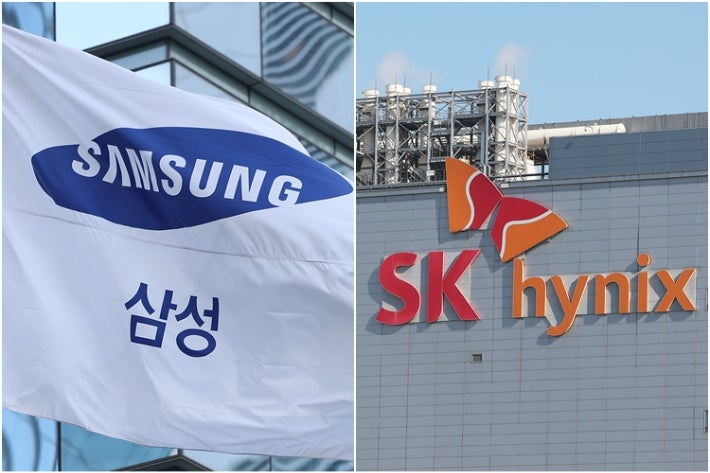
Samsung Electronics’ 26-year reign as the benchmark Kospi’s most valuable company came to an end on June 22, when its crosstown rival SK hynix briefly overtook the tech giant in market capitalization.
While Samsung Electronics’ lead remains solid when preferred shares, worth roughly 165 trillion won ($106 billion), are included in its valuation, SK hynix’s surge on a common-share basis has nevertheless challenged its long-standing dominance at the top of Korea’s equity market.
The shift was driven by SK hynix’s strong gain as the company emerged as one of the biggest winners of the artificial intelligence boom, fueled by its heavier concentration in memory chips.
Though Samsung Electronics soon reclaimed the top spot, even excluding preferred shares, the lead has since changed hands repeatedly, underscoring an increasingly fierce battle between the two memory behemoths.
As of Wednesday, Samsung Electronics’ common-share market capitalization stood at 1,864.96 trillion won, closely followed by SK hynix at 1,826.65 trillion won, leaving a gap of less than 40 trillion won.
The battle for the Kospi crown is about more than market capitalization. It reflects which company investors see as the face of Korea’s stock market and which is better positioned to lead the country’s semiconductor industry in the AI era.
Korea’s retail darling under threat
Prior to SK hynix’s growth, Samsung Electronics had long remained the dominant retail favorite. It was even the stock many parents chose to give to their children, often as a way of introducing them to investing.
According to KB Securities, the tech giant was the most gifted domestic stock to minors through the brokerage’s stock-gifting service in April, accounting for 56.3 percent of all such transactions.
By contrast, SK hynix accounted for just 1.5 percent. While its higher share price may have been a factor, the gap also reflects Samsung Electronics’ long-standing status as Korea’s quintessential retail stock.
“For years, investors viewed Samsung Electronics as the default choice in the Korean stock market. The fact that SK hynix has managed to overtake it in terms of market cap, even briefly, carries symbolic weight,” a local economics professor said.
“Losing the top spot, even temporarily, is bound to be a wake-up call for Samsung Electronics.”
Even Samsung Electronics’ once-unrivaled retail investor base is showing signs of weakening.
While the company still boasts the broadest shareholder base in Korea, with 4.61 million shareholders as of the end of 2025, that figure fell by more than 1 million from 5.67 million a year earlier, according to data from the Korea Securities Depository.
By contrast, SK hynix’s shareholder base grew from fewer than 800,000 to 1.19 million over the same period, making it the stock with the country’s third-largest investor pool.
“The change in the market-cap rankings appears to reflect investor perceptions that SK hynix has presented a more focused strategy in the era of AI-driven transformation,” said analyst Lee Young-won at Heungkuk Securities.
Samsung Electronics’ share buyback plan is a key factor that could reshape the rivalry in the coming months.
The electronics giant is expected to accelerate its treasury share buyback to fund a special bonus for its chip employees. The planned buyback, estimated at a record 90 trillion won, would amount to about 5 percent of its common shares.
Considering two-thirds of the treasury shares awarded under the chip bonus will be subject to one- and two-year lockup periods, limiting the immediate supply of tradable shares, the share buyback plan could serve as a supportive tailwind for the stock.
Brokerages said the planned buyback could provide a strong catalyst for Samsung Electronics’ shares, pointing to the company’s track record of share-price gains following large-scale repurchase programs.
Shares rose 50.3 percent between January and November 2017 after Samsung Electronics announced a 9.3 trillion won buyback. More recently, the stock gained 7.2 percent on the day it unveiled a 10 trillion won repurchase plan in November 2024 and climbed a further 68.1 percent by the end of September the following year, when the program was completed ahead of schedule.
“A shareholder return policy supported by nearly 250 trillion won in free cash flow is seen as a key tailwind for the stock price, with the company’s supply advantage expected to drive a visible narrowing of the valuation gap with peers,” Kim Hyeong-tae, a Shinhan Securities analyst, said.
silverstar@heraldcorp.com