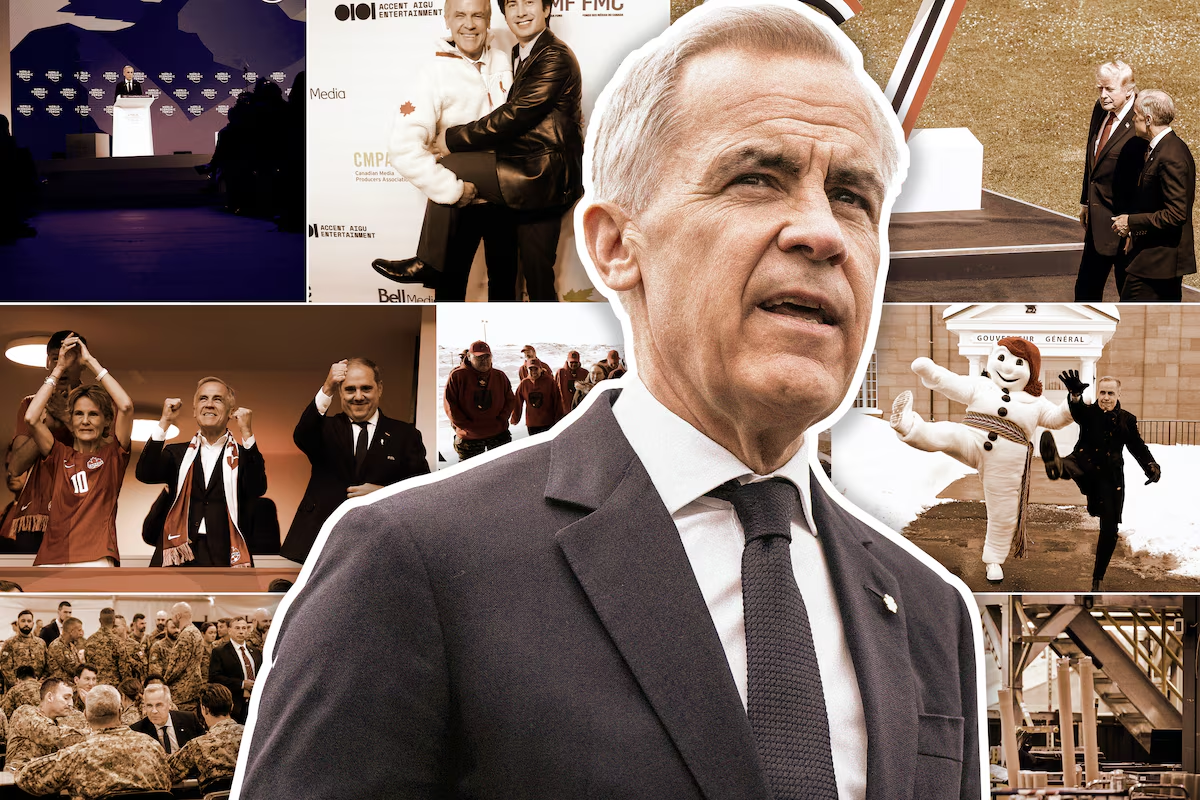
What is the story Mark Carney is telling us about Canada? And why is he doing it?
These seem like ridiculous questions on the surface, because the Prime Minister’s entire political career has unfolded in a maple-soaked tourism commercial, thanks to the ferocious nationalism unleashed by Donald Trump’s unhinged threats. It’s like asking what ice has to do with hockey: The question seems to miss the point.
We all know the refrains: The President wants to break us so America can own us; elbows up; maître chez nous; we rely not just on the strength of our values, but the value of our strength. Canadiana is the medium in which the Prime Minister been working all along.
But the wallpaper in your childhood home becomes invisible because it’s always there. And Mr. Carney has spent the past year and a half telling a specific story about this country – who we are, what we do in the world, what we are capable of – that serves a political purpose. It’s worth scrutinizing the pattern on those walls.
In his 2024 book Canada’s Prime Ministers and the Shaping of a National Identity, University of Regina history professor Raymond Blake argues that weaving a grand narrative about the country is pretty close to the central job of a prime minister.
U.S. President Donald Trump, left, with Mr. Carney, right, at a working lunch in Evian-les-Bains, France, earlier this month.Evelyn Hockstein/The Canadian Press
“They’ve got to deal with the fiscal situation, they’ve got to deal with the military, they’ve got to deal with immigration,” he said in an interview. “But foundational to every prime minister are things like national unity, creating a story of Canada, and how they can keep this large ethnically, geographically diverse country together.”
Or, as journalist and historian Arthur Milnes puts it in riffing on Sir John A. Macdonald: “When you get up in the morning, your main job is to ensure that Canada lasts one more day, because it’s so improbable.”
The stories prime ministers tell us about ourselves often achieve that end more than their policies do, Prof. Blake said, because plenty of those policies don’t last, never get enacted or weren’t seriously meant to see the light of day in the first place.
But if that national narrative functions for the country as a shared identity, the very same story serves a purpose for the politician telling it. It’s a permission slip, an infomercial, a fable that justifies the way they’re running things and why they’re the only one who knows what we need in what is inevitably described as a pivotal moment.
In the context of Prof. Blake’s thesis about knitting people together, the election and first year of governing for Mr. Carney were a breeze. Canadians everywhere were united in their fury toward the White House, anxiety about our vulnerability to the whims of its orange monarch and fierce pride in all things maple leaf.
Demonstrators gather beneath a billboard promoting Alberta independence during a rally in Taber, Alta., on Sunday.Matthew Bruce/The Canadian Press
Now, the menace of Mar-a-Lago is an even greater threat, with the USMCA deal that prevented the worst tariff damage hanging in the balance. But the air-raid siren quality of that danger, once so novel and acute that it summoned us all to rally ‘round the flag, has subsided to a case of chronic national tinnitus.
Alberta and Quebec separatist movements are on the march, and the cost of living is a steady hum of worry and discontent everywhere.
Mr. Carney continues to enjoy very high public approval ratings. But in the second year of his mandate with a majority in his back pocket, Canadians are going to start asking whether his grand economic plan is making a difference in their lives and communities.
“If you can walk on water, you can turn that water into wine pretty fast,” Prof. Blake said. “And of course, we haven’t seen the wine yet.”
Everything is about to get much harder, for Mr. Carney and for the rest of us. Which means that patriotic narrative, the wallpaper that the Prime Minister is conjuring about Canada’s national identity, suddenly becomes load-bearing.
Surprisingly for a technocrat with no prior political experience, Mr. Carney has proven to be both adept at and invested in political symbolism. No gesture, speech or location seems to be an accident.
Immediately after he was sworn in last March, he strode to a lectern in front of Rideau Hall to address Canadians for the first time as Prime Minister. He was less than 30 seconds in when he described Canada as a country “built on the bedrock of three peoples: Indigenous, French and British.”
Mr. Carney speaks during a news conference at Rideau Hall in Ottawa after his swearing in ceremony on March 14, 2025.DAVE CHAN/AFP/Getty Images
That press conference was immediately followed by his first international trip to Paris and London and then back to home soil in Iqaluit – global connect-the-dots built around that tripartite origin story.
On that trip, Mr. Carney also described Canada as “the most European of non-European countries,” and he’s spent great quantities of time, travel miles and political capital since trying to cement that in trade and security terms. Under this Prime Minister, Canada turns its face unmistakably to the east and across the Atlantic Ocean toward Europe – not south across the 49th parallel.
“It used to be trying to get away from Britain – trying to get away from Britain, but not too much, and we were trying to be friendly to the U.S., but not too much,” said Anthony Wilson-Smith, president and chief executive of Historica Canada. “And of course, now it’s the exact reverse. We’re trying to get away from the U.S. – but not too much – and get closer to Europe, but not too much.”
Canadian prime ministers have been seeking out dance partners other than the U.S. for so long that it’s “almost laughable,” said Patrice Dutil, a professor of politics and public administration at Toronto Metropolitan University and author of multiple books on Canadian political history.
Macdonald established an international trade ministry before he died in 1891 to try to diversify away from the untrustworthy Americans, Prof. Dutil said. And here his descendants are, still sending three-quarters of our products to the U.S.
Mr. Carney speaks alongside Minister of Housing and Infrastructure Gregor Robertson, left, and CEO of the Major Projects Office Dawn Farrell, right, at Skeena Substation in Terrace, B.C., in November.ETHAN CAIRNS/The Canadian Press
“To say ‘rupture’ – I mean, come on, man, we are addicted to the Americans,” Prof. Dutil said. “The Americans are next door.”
On the domestic front, this government’s core economic plans have a retro quality. Mr. Carney tells us that Canada is a nation of builders, and what we build are sturdy, tangible things like mines, ports, roads, railways and pipelines, along with newfangled elements such as AI. Modular housing and nuclear power are where it’s at again, and there is the overarching pledge that we will do this – all of it, somehow – at speeds not seen in generations.
The postwar vibe suggests that we will build something new and better, not on the ashes of a global conflict as generations before us did, but on the tufts of dyed blond comb-over left behind from – well, whatever this is.
In collective emotional terms, this Prime Minister’s version of Canada is confident, ambitious, self-possessed and, above all, sovereign. Philippe Garneau, a branding expert and president of GWP Brand Engineering – as well as brother of the late Liberal cabinet minister Marc Garneau – sees the Prime Minister as “the living mascot” of Canada in a very literal way.
When Mr. Garneau created the ING Direct guy, everything from his suit to his posture and the way he told you to “Save your money” was painstakingly thought out, and sometimes people would say they wished that guy ran the country. Mr. Carney embodies a buttoned-down, unflappable quality that mirrors what he wants Canada to project in a world gone mad, Mr. Garneau said.
When Mr. Carney went into the locker room after the Canadian men’s team thumped Qatar 6-0 at the World Cup, what Mr. Garneau heard in his remarks was the Prime Minister’s preferred definition of Canada: Character in the face of adversity, class and solidarity – but displaying all of that in a decisive win, not some earnest 13th-place finish.
Mr. Carney congratulates Team Canada after its historic 6-0 victory over Qatar at the World Cup, telling players he ‘couldn’t be prouder’ of their performance.
The Canadian Press
Contrary to the docile America’s-hat caricature that the classic “I am Canadian” commercial debunked, historians will be quick to tell you that foundational Canadian leaders projected a distinctly chest-out version of Canada.
In a Dominion Day speech in London, England, in 1897, Sir Wilfrid Laurier extolled this country’s fertile land capable of supporting 100 million citizens, lakes “equal to the seas,” summertime skies “as blue as the skies of Italy,” and a history as “romantic and touching as fiction” that could not be outdone by England or France.
The likes of Laurier and Macdonald “didn’t think they were subservient to Britain,” said Mr. Milnes, who was a speechwriter for Stephen Harper and a research assistant on Brian Mulroney’s memoirs. “They thought that we were better than Britain, and Britain was a decaying country, though its ideals, its parliamentary institution, its literature were, they thought, the greatest empire since Rome.”
If you read that and it occurs to you that we are currently watching another historical friend and empire crumble into the sea directly south of us, then you and I and Mr. Milnes are all having the very same thought.
Several of the historians I spoke to see Mr. Carney’s image of Canada as falling directly into line with the past occupants of his office – with the exception of the most recent.
“[Justin] Trudeau could not speak about Canada’s image without making apologies, without making excuses. It’s almost as if Trudeau saw modern Canada – the Canada of today – as a triumph over its past,” Prof. Dutil said. “Whereas Carney, like all his predecessors, sees Canada as the product of its past, and so he’s not as inclined to make excuses, to emphasize the wrong, to make apologies.”
There are not a lot of places where the policy priorities and rhetoric of the current Prime Minister match those of Mr. Trudeau. But there is one, and it does heavy lifting for Mr. Carney.
Mr. Carney during a news conference at the National Press Theatre in Ottawa last week.DAVE CHAN/AFP/Getty Images
“I think I’m not revealing any big state secrets when I say that it does appear that this government is trying in many different instances to say that they’re different than the previous administration,” said Steven Guilbeault, a former cabinet minister in both of those governments. “It’s not the case on nature, not at all.”
Mr. Carney doesn’t emphasize Canada’s diversity as a series of fault lines the way Mr. Trudeau did, but he gives considerable attention to nature and the wide-open outdoors as a universal and unifying Canadian experience.
“As a cabinet minister, whenever I would do something related to nature and parks, I was always the envy of many of my colleagues,” said Mr. Guilbeault, who was at one point minister of Canadian culture and identity and Parks Canada, all in one.
“It is usually very popular,” he added.
That public affection is useful for Mr. Carney, but it ultimately felt a bit hollow to his former cabinet minister.
Mr. Guilbeault said it became clear to him that the Prime Minister sees a role for government in conservation, but does not believe regulation is key to climate change and largely expects the market to take care of it. Mr. Guilbeault resigned from cabinet last fall over the federal government’s pipeline deal with Alberta, and in May announced he was stepping down as a Liberal MP because he wanted to take the fight for environmental protection elsewhere.
In the face of critiques like that, nature also serves as a political fig leaf for Mr. Carney. Whenever he’s pushed on where his climate ambition went, he deflects the accusation by pointing to his government’s $3.8-billion nature strategy, which focuses on land, water and species conservation.
In May, Steven Guilbeault announced he was stepping down as a Liberal MP.Spencer Colby/The Canadian Press
The broad national narrative he’s weaving affords Mr. Carney other political advantages, too – starting with the words “Prime Minister” in front of his name, and the wildly improbable majority he now leads.
“Listen, the Liberal brand was virtually dead before he came to the scene, and it’s still virtually dead at the provincial level,” said Allan Gregg, principal of opinion research at Earnscliffe and a former Conservative strategist. “His favourability ratings are running a good solid 10, 15 points ahead of current votes, which means, just in aggregate math, he’s got a whole bunch of non-Liberals saying, ‘This guy’s pretty good, I like him a lot.’ That strengthens his hand in everything he does.”
Building big infrastructure, selling our resources and accelerating major projects might be the best way to buttress Canada against both its pre-existing weaknesses and the accumulating carnage of U.S. trade policies. Or maybe it’s not.
But sweeping narratives do not, by their very nature, invite questions about their conclusions. Every element that’s in Mr. Carney’s image of Canada represents a choice about something else that’s missing, but the story he’s telling overshadows any debate on the path not taken.
Then there’s the question of whether Canada is walking the talk on that most celebrated chapter of Mr. Carney’s story about Canada and the world as it is: his speech to the World Economic Forum in January.
Prof. Dutil argues that we are “nowhere near” living up to that.
“For the Davos speech to work, we would have to see what he was calling for, which is a cultural transformation away from the Americans towards something completely new. And we will not see that,” he said. “We will not see that in our lifetime. It’s a pious wish.”
Underneath that idea lies what is maybe the greatest risk for Mr. Carney, and for Canada: the fact that this is all likely to get much worse before it gets better, or at the very least, that it will be a long, painful climb out. That grim reality is nowhere in the gleaming story he’s telling us.
Mr. Carney speaks during the annual meeting of the World Economic Forum in Davos, Switzerland, on Jan. 20.Markus Schreiber/The Associated Press
In April, Mr. Carney put out a “Forward Guidance” video intended as the first of a series explaining to Canadians what’s going on and what we’re going to do about it. In it, he pledged, “I promise you, I will never sugar-coat our challenges.”
But that simply has not been true so far.
Maître chez nous, being global leaders in middle-power clothing, giving ourselves more than any foreign country can take away – he’s rendered all of it for us in bright and optimistic candy hues. There’s no sign of the murkier tones implied by the tough trade-offs that are surely coming.
What makes that soft storytelling choice more vexing and puzzling is that Mr. Carney enjoys almost comical amounts of political capital in the form of his perfect-for-the-moment reputation, and the uncommon faith that vast numbers of Canadians have granted him.
A central banker and a politician work in fundamentally different paint palettes. Mr. Carney has the unique ability to use both, if only he could bring himself to tell us a story about a great country that doesn’t ignore the dark clouds gathering in the summer sky.
More from The Globe
Rob Carrick: Mr. Carney, can you share your plans for government spending, taxing and cutting?