China now generates close to a third of the world’s innovative-drug pipeline, and foreign multinationals are committing billions to specific addresses. We map where the capital is going, and why each of China’s three anchor life sciences clusters suits a different kind of investor.
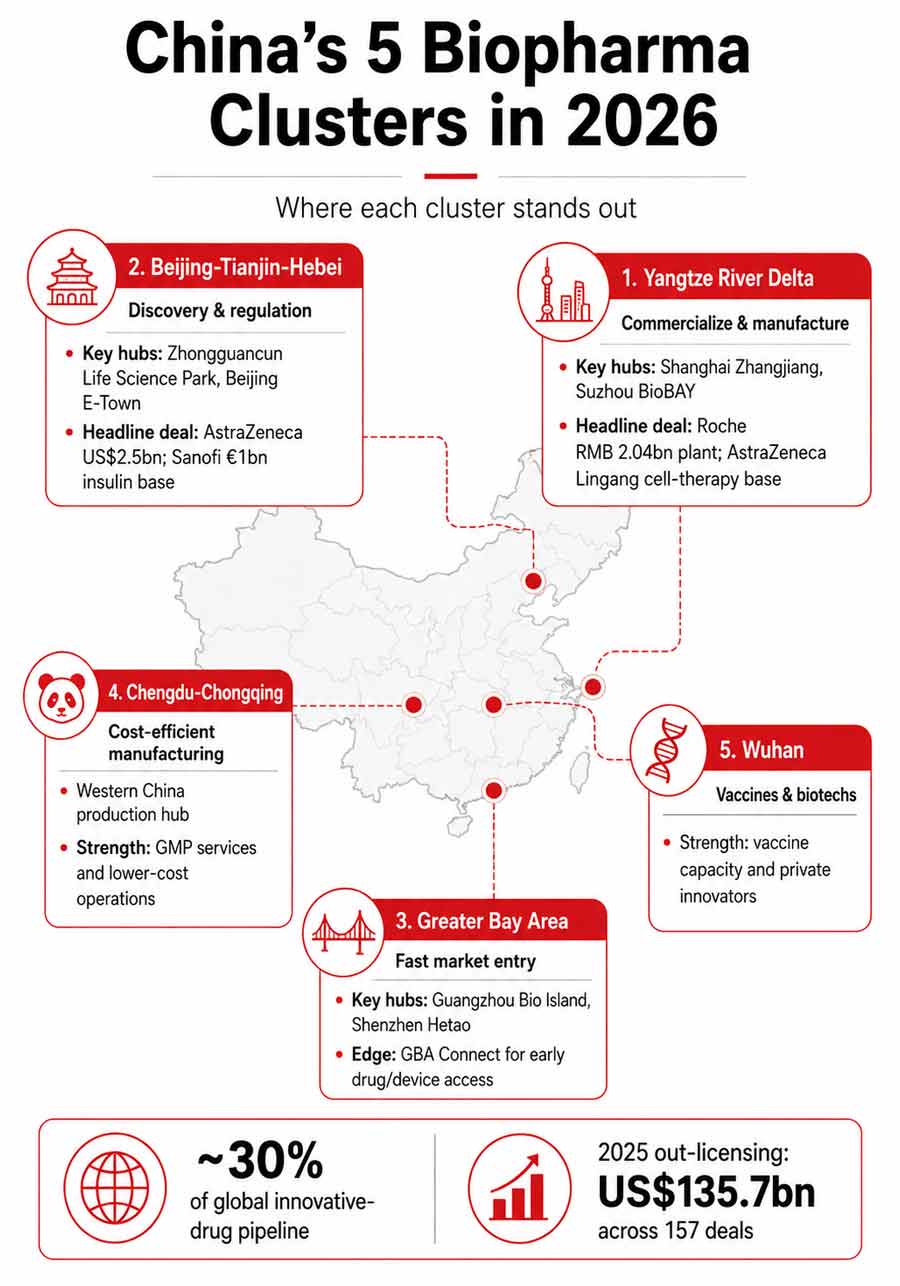
China’s life sciences sector has crossed a threshold. The country now accounts for roughly , and in 2025 its cross-border out-licensing deals hit a record , around a third of global deal value.
Find Business Support

The pull is speed, scale, and cost. Regulatory reform has compressed drug-approval times from around four years to roughly one, than the global average, and clinical development costs a fraction of US levels. That efficiency has drawn record foreign capital into bricks and mortar (not just licensing deals) and the destinations are specific.
That said, knowing where to invest is just as important as deciding what to invest in. Geography remains a critical determinant of success, influencing access to talent, research institutions, clinical resources, manufacturing capacity, and investor networks. The country’s three anchor clusters have divided the labour between them, and choosing well means matching a cluster to a function.
Start exploring
Yangtze River Delta: Commercialize and manufacture
The delta, spanning Shanghai, Jiangsu, Zhejiang and Anhui, is China’s most commercially complete life sciences base, holding , with Shanghai alone at 57 percent. Its anchor is Shanghai’s , “China’s Pharma Valley,” a 95-square-kilometre hub home to more than 1,700 biomedical companies and seven of the world’s top ten drugmakers; Pudong’s biopharma output alone reached . The deals are concrete.
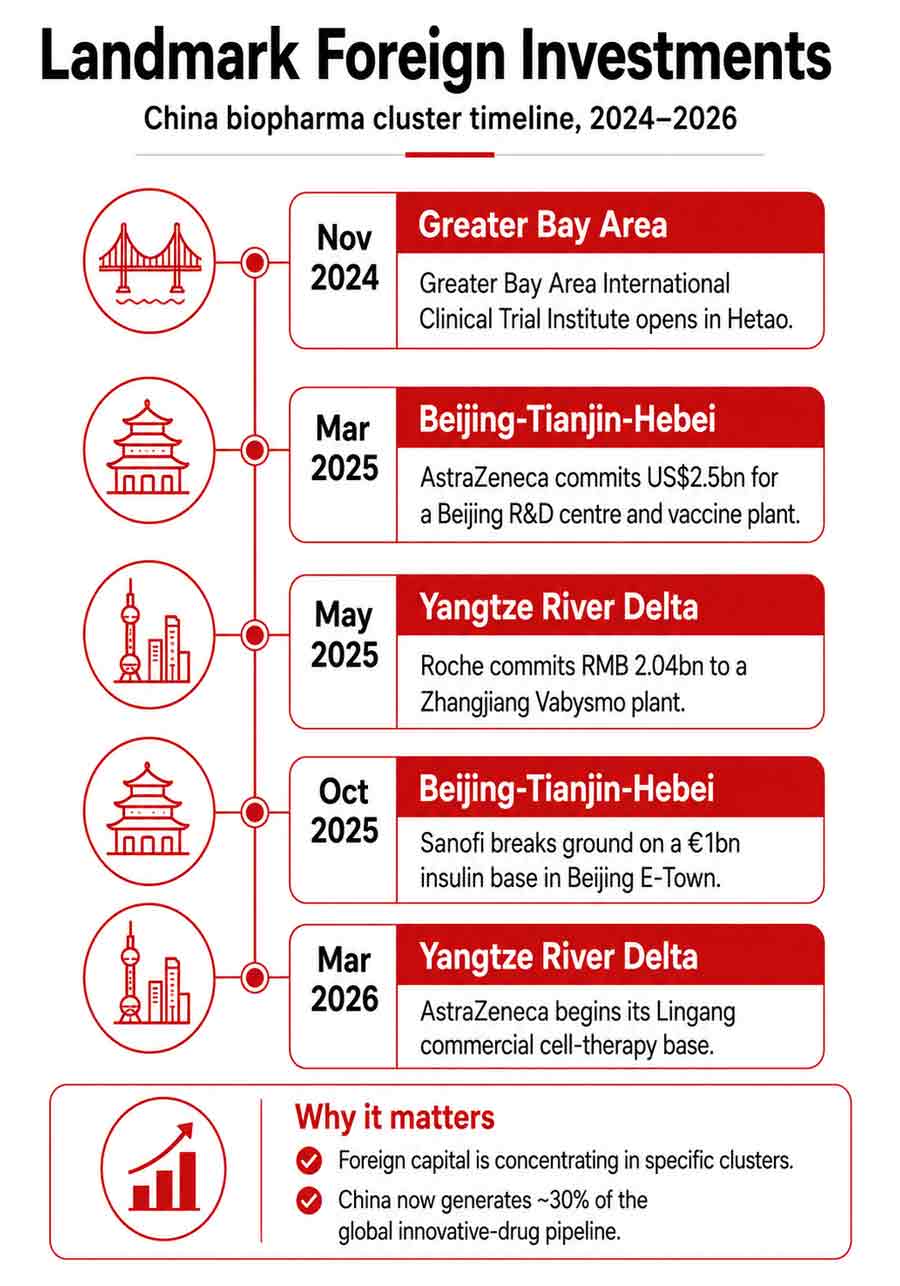
In May 2025, to a new Zhangjiang plant for its eye drug Vabysmo; and in March 2026, , the first end-to-end cell-therapy capability by a multinational in China. Suzhou’s BioBAY adds CDMO depth and headquarters subsidies, and in August 2025 the State Council approved a for the Jiangsu Free Trade Zone. This is where to commercialize and manufacture at scale.
Beijing-Tianjin-Hebei: Discover and engage regulators
If the delta makes and sells, Beijing discovers. The in Changping, “Life Valley”, clusters elite public institutes, the National Institute of Biological Sciences and Chinese Institute for Brain Research among them, alongside homegrown champions BeiGene and InnoCare. Its decisive edge is proximity to the National Medical Products Administration (NMPA).
That regulatory gravity is now pulling in large foreign builds: in March 2025 to its sixth global strategic R&D centre and a first China vaccine plant in Beijing, lifting its local workforce to 1,700; and in October 2025 in Beijing’s E-Town, its largest-ever single China investment and the first foreign-invested biotherapeutic-API plant in the country. For discovery, translational science and regulatory engagement, BTH is unmatched.
Greater Bay Area: Enter the market fast
The GBA, nine Guangdong cities plus Hong Kong and Macao, is less a factory floor than a . Guangzhou’s International Bio Island anchors R&D, but the region’s unique asset is regulatory: under the GBA “Connect” scheme, designated hospitals may use Hong Kong-registered drugs and devices ahead of full NMPA approval.
As of December 2025, , a fast, low-risk route to test products and build the real-world evidence that later supports nationwide approval. Shenzhen adds genomics and device strength, plus the Hetao zone, where the . For firms prioritizing speed to patients and cross-border trials, this is the gateway.
Beyond the big three
Western and central China compete on cost.
The has become western China’s leading hub, part of a “golden triangle” of GMP services with Guangzhou and Suzhou, while Wuhan pairs Sinopharm’s large-scale vaccine capacity with private innovators in bispecific antibodies. Both suit cost-sensitive manufacturing rather than frontier discovery.
Choosing the right cluster
Find Business Support
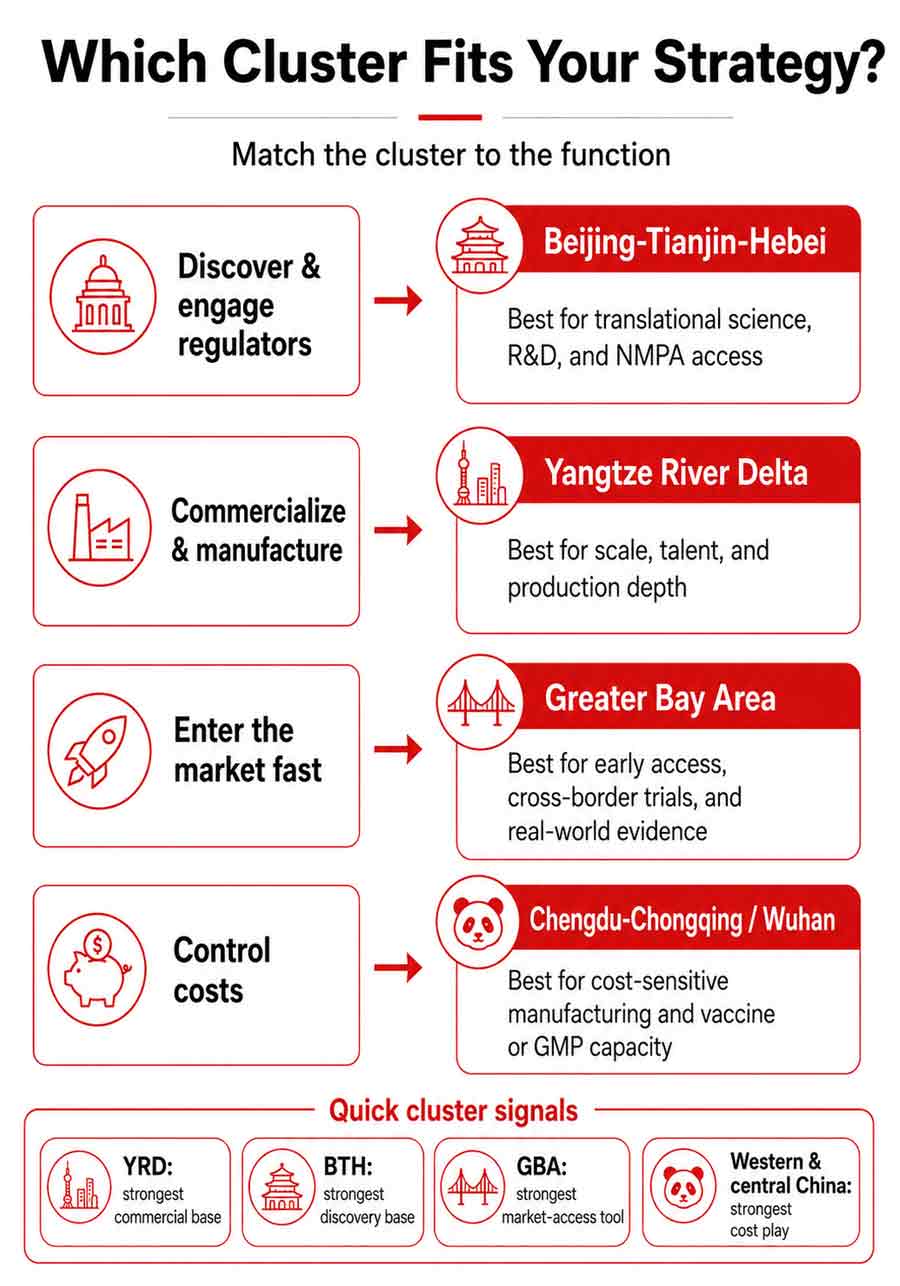
China’s biopharma opportunity is increasingly bet on the ecosystem that best matches a firm’s strategic objective. Companies seeking large-scale manufacturing, commercialization, and supply-chain depth are likely to find the strongest fit in the Yangtze River Delta. Firms prioritizing discovery, translational science, and engagement with regulators may benefit most from Beijing-Tianjin-Hebei. Those focused on accelerating market access, cross-border clinical development, and real-world evidence generation should look first to the Greater Bay Area.
Entry can be staged: license an asset or run a GBA sandbox trial first, then commit to a wholly owned build once the economics are proven. National openings help, foreign firms can now develop cell and gene therapies in the Beijing, Shanghai and Guangdong FTZs, and wholly foreign-owned hospitals are permitted in nine cities plus Hainan. Yet investors still face challenges ranging from pricing pressure under public reimbursement schemes to geopolitical uncertainty and evolving regulatory expectations. Success increasingly depends not on whether companies enter China, but on whether they match the right function to the right cluster.
Navigating licensing requirements, manufacturer due diligence, and ongoing compliance obligations can be complex, particularly for companies new to the Chinese market. Dezan Shira & Associates‘ teams on the ground in China can support foreign food companies at every stage, from market entry and entity setup to supplier vetting and compliance program design. Contact us at china@dezshira.com to discuss your plans.


As one of Asia’s leading business setup consultants, we help companies structure entities to meet strategic goals and maximize operational efficiency, including cross-border asset transfers, M&A transactions, and corporate relocations.
Partner
About Us
China Briefing is one of five regional Asia Briefing publications. It is supported by Dezan Shira & Associates, a pan-Asia, multi-disciplinary professional services firm that assists foreign investors throughout Asia, including through offices in Beijing, Tianjin, Dalian, Qingdao, Shanghai, Hangzhou, Ningbo, Suzhou, Guangzhou, Haikou, Zhongshan, Shenzhen, and Hong Kong in China. Dezan Shira & Associates also maintains offices or has alliance partners assisting foreign investors in Vietnam, Indonesia, Singapore, India, Malaysia, Mongolia, Dubai (UAE), Japan, South Korea, Nepal, The Philippines, Sri Lanka, Thailand, Italy, Germany, Bangladesh, Australia, United States, and United Kingdom and Ireland.
For a complimentary subscription to China Briefing’s content products, please click here. For support with establishing a business in China or for assistance in analyzing and entering markets, please contact the firm at china@dezshira.com or visit our website at www.dezshira.com.