HONG KONG – Kowloon, an area north of Hong Kong Island, is a melting pot of cultures.
The pre-war Edwardian architecture of the Old Yau Ma Tei Police Station, now a cultural landmark and exhibition space, sits across a retro branch of Wellcome supermarket. Commercial and residential complex Chungking Mansions, a mosque and a wall of neon signs on narrow shopfronts line Nathan Road. The urban peninsula wears its layered history without apology, and every turn reveals something different.
Several of Kowloon’s biggest draws in 2026 are culinary hot spots and cultural exhibits, including temporary exhibitions from leading South Korean contemporary artist Lee Bul at art museum M+ and a collection of 250 ancient Egyptian treasures at the Hong Kong Palace Museum, some of which have been newly unearthed.
Taste Hong Kong, a gourmet guide released in January by the Hong Kong Tourism Board and Chinese Culinary Institute, features 250 restaurants recommended by local master chefs, ranging from affordable street food to Michelin-starred kitchens. The city’s private dining scene is also emerging, as diners seek a more private and customised experience.
Here are four stops to add to your next Hong Kong itinerary.
Contemporary art exhibits
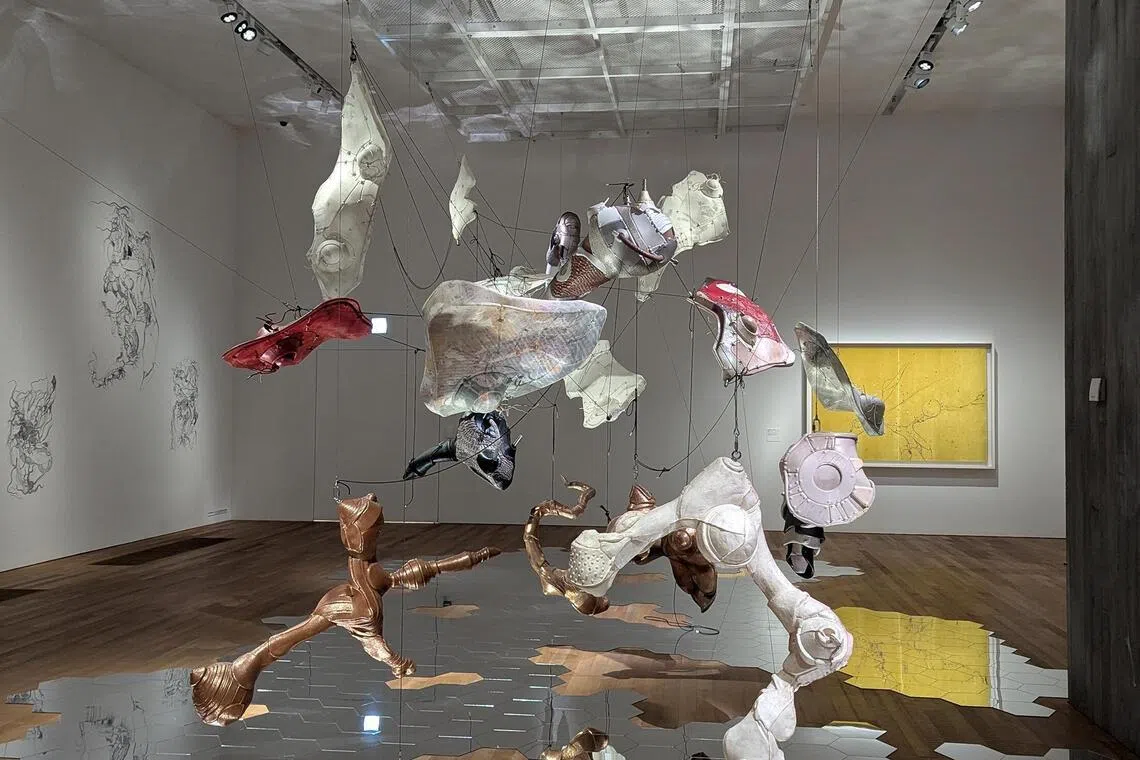
I walk through a tunnel-like contraption covered in mirror fragments and find myself transported to a hyper-futuristic world.

South Korean artist Lee Bul, a leading figure in contemporary art, is exhibiting over 200 sculptures, installations and contemporary works at M+ museum.
PHOTO: LARA EVIOTA
This is Lee Bul: From 1998 To Now, a temporary exhibition at M+, Asia’s global museum of contemporary visual culture. World-renowned South Korean artist Lee Bul, a leading figure in contemporary art, fills the space with over 200 sculptures, installations and contemporary works from her studio, as well as private and institutional collections.
The theme is utopia and dystopia as two sides of the same coin, says our guide Sunny Cheung, curator of design and architecture at M+.
Aubade, for instance, is an art series comprising 10 structures, with two exhibited here. The structures resemble guard towers installed with blinking LED lights; one spells out hard-to-decipher text in Esperanto, a language invented for universal communication in 1887 that failed to catch on widely around the world.
The two towers, facing each other from across the room, are meant to reference the conflict between North and South Korea.

Aubade is an art series comprising 10 structures, with two on display at M+.
PHOTO: LARA EVIOTA
Mixed-media sculpture Thaw (Takaki Masao) depicts former South Korean authoritarian president Park Chung-hee enclosed in an iceberg-like sculpture. Through the artwork, Lee grapples with how Park contributed to her country’s progress, yet ruled with an iron fist.
“To use the word ‘success’, it must always co-exist with failure. It is simply human destiny,” says Lee, 62, in a video recording playing in the exhibition space. The exhibition runs until Aug 9.
Another temporary exhibit is the interactive art project Dial-A-Poem Hong Kong, an installation of telephone sculptures inspired by American poet John Giorno through which 30 local poets read poetry in Cantonese, English and Mandarin. Even if I do not understand the poem I am listening to, there is something intimate about the way it is whispered in my ear.
Tickets to M+, which allows access to all galleries, cost HK$190 (S$31) for an adult and HK$100 for children, students and seniors.
A private kitchen with a twist
There is nothing at the entrance of commercial building Charmhill Centre, in Tsim Sha Tsui, to suggest a restaurant is here. But on the ninth floor, outside a dining room that fits about 20 people, a small label reads “George Private Kitchen”, run by chef George Ip.

Chef George Ip runs George Private Kitchen, which he founded in 2016.
PHOTO: HONG KONG TOURISM BOARD
Private kitchens have emerged in Hong Kong since the late 1990s and early 2000s, with plenty hidden in plain sight. Many have no flashy signage or Google Maps listing and rely on word of mouth.
Ip, 68, cooks to bring back ancient, time-consuming recipes predating many modern Chinese restaurants. “I try to pass on the dishes to the next generation,” he says.
The Stuffed Orange with Crab Meat dates to the Southern Song Dynasty and resurfaced in the last decade – it was notably served at the Group of 20 state banquet in Hangzhou, China, in 2016. In Ip’s rendition, the orange suffuses the crab in a citrusy sweetness.

Stuffed Orange with Crab Meat from George Private Kitchen.
PHOTO: HONG KONG TOURISM BOARD
The Braised Pork Knuckle with Baby Pigeon is simmered for three hours until the fat renders, the collagen-rich skin turns meltingly soft and the sauce slow-cooks the pigeon. The recipe is said to be the favourite dish of China’s Qianlong Emperor.
During dinner, Ip shares anecdotes from a career that had little to do with food. He spent his working years in the packaging industry, including a stint at a Finnish forestry company.

Braised Pork Knuckle with Baby Pigeon.
PHOTO: HONG KONG TOURISM BOARD
Cooking came only after retirement, when an encounter with friend and mentor Chan Mong Yan, one of Hong Kong’s first food writers, turned a hobby into a calling. He founded George Private Kitchen in 2016, and turns to a blue hardbound volume of the popular Food Classics (食经) by Chan as a key reference for many of his dishes.
Make reservations at least a week in advance. Prices start at HK$600 a person for a nine-course menu with a minimum group size of at least four people.
Egyptian relics
I gaze at an anthropoid coffin with a peculiar green face and curved beard. It is meant to resemble Osiris, the god of resurrection, and is covered in hieroglyphs and funerary iconography.
This is one of 250 artefacts in Ancient Egypt Unveiled: Treasures From Egyptian Museums at the Hong Kong Palace Museum, on loan from seven major Egyptian museums and the Saqqara archaeological site, an ancient Egyptian necropolis. Also on display are the latest archaeological discoveries from Saqqara.
The temporary exhibition follows the 5,000-year history of ancient Egyptian civilisation and includes rare statues, stelae, gold ornaments, cat mummies and sarcophagi, regarded among the top archaeological discoveries of the century.
Throngs of museumgoers stop to look at the red granite statue of a kneeling Hatshepsut, one of Egypt’s rare female pharaohs. She wears the male shendyt kilt and ceremonial beard out of respect for royal tradition. Hatshepsut is said to have brought prosperity to Egypt for about two decades, but many of her statues were deliberately defaced after her death.
It strikes me as odd to be exhibiting Egyptian relics in Hong Kong, but the exhibit draws parallels between the two destinations. Egypt and China are both ancient civilisations with writing systems rooted in signs and images, and funerary rites rooted in beliefs of an afterlife. In the past decade, China and Egypt have grown into close collaborators in the fields of archaeology and exhibitions. The distance between them is bridged in a way that feels fitting for the multicultural Kowloon district.
Access to the ancient Egypt exhibition starts at HK$190 for adults, and an all-access pass to the museum costs HK$250 for adults. An Egyptologist-led audio guide is available for rent (HK$50) at the counter. The exhibition runs until Aug 31.
Comfort food at a historical landmark

The Queen serves an elevated take on Chinese regional cuisine.
PHOTO: THE QUEEN
The words “Indian Constables”, in big, block letters on the lintel above a doorway, mark the entrance to heritage hotel FWD House 1881, which served as the Hong Kong Marine Police Headquarters from the 1880s until 1996.
In those days, the police force drew from British, European, Indian, Chinese and Russian ranks.
The hotel has preserved the pigeon houses and stable blocks from the old police headquarters, but the purpose of our visit is tucked in a courtyard, where restaurant The Queen serves an elevated take on Chinese regional cuisine.
It serves dim sum as well as dishes such as a Double-boiled Chicken Soup with Black Garlic and Polygonatum Root, which tastes as restorative as it sounds. Polygonatum root, a classic Cantonese tonic ingredient, rounds out the broth with a mild, earthy sweetness.
Other mains are refined versions of familiar dishes, such as the umami-laden scallops with asparagus and XO sauce, and Braised Pork with Black Vinegar, which achieves the requisite balance of rich and juicy meat countered by sweet, tangy and savoury sauce.
The dishes are upscale yet comforting – like a meal at a grandmother’s house.
Getting there
Airlines such as Cathay Pacific, Singapore Airlines and Scoot fly non-stop from Singapore to Hong Kong in four hours. Return fares in August start at around $380, based on checks by The Straits Times in July.
-
The writer is a travel and culture journalist who was hosted by the Hong Kong Tourism Board.
-
Weekend Trip is a series that looks at regional destinations through fresh eyes. For more travel stories, go to str.sg/travel